

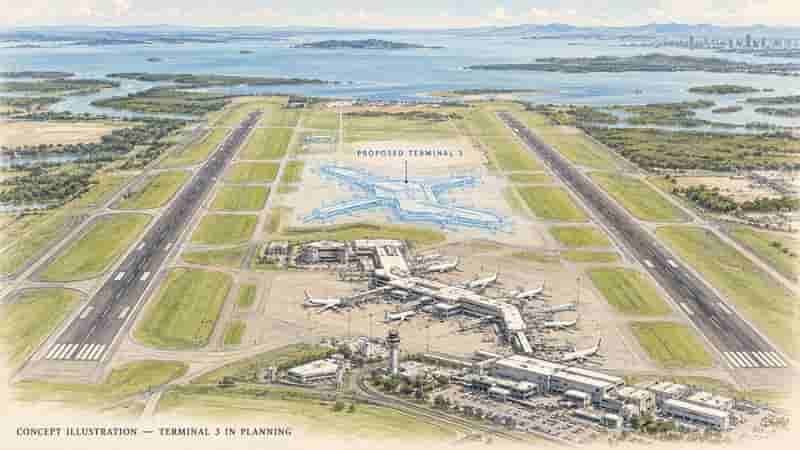
Brisbane Airport is upgrading its existing terminals and planning a third, but the opening of Terminal 3 before 2032 remains unconfirmed, and the published development programme reviewed identifies no third-runway project.
Brisbane Airport has an Olympic appointment, a substantial investment programme and a task familiar to anyone who has ever watched a departure board: getting the timing right.
Its $5 billion-plus Future BNE transformation is improving Queensland’s principal aviation gateway through terminal upgrades, passenger-processing changes and wider precinct development. A proposed third terminal offers more capacity as the region grows.
However, one detail is worth checking before anyone orders the opening-day bunting. Terminal 3 remains officially in planning, with its published timing listed as the 2030s. That allows for several possible delivery dates. It does not mean passengers will walk through the doors before the Brisbane 2032 Olympic and Paralympic Games.
The runway question is clearer. Brisbane’s western parallel runway opened on 12 July 2020. No third-runway project before 2032 was identified in the published development information reviewed for this article.
A $5 billion-plus programme, with several moving parts
Brisbane Airport Corporation describes Future BNE as a programme spanning multiple developments, rather than a single construction project.
In its June 2026 master-plan announcement, the corporation said it planned to invest more than $5 billion over the following five years. The figure represents planned investment across the airport programme; it is neither money already spent nor the standalone price of Terminal 3.
That distinction matters. Airport investment announcements can pick up extra baggage as they travel, especially when a large number and an attractive terminal rendering appear together.
The overarching framework is the Brisbane Airport 2026 Master Plan, approved by Federal Infrastructure Minister Catherine King on 15 June 2026 and publicly announced the following day.
It sets the direction for development over 20 years. The airport’s accompanying announcement outlines additional terminal capacity, hotels, retail, entertainment and commercial space, alongside better transport access.
The corporation says the long-term plan provides for capacity to handle more than 50 million passengers annually in approximately two decades. That is a planning outlook, not a promise about passenger numbers in 2032.
Terminal 3: a significant proposal, with timing unresolved
The proposed Terminal 3 would sit between Brisbane’s two parallel runways and integrate with the existing terminals. Its official project description also preserves options for links to the wider transport network.
The location has a practical attraction. The airport has identified reduced aircraft taxiing as one reason for placing new terminal capacity between the runways.
The eventual operating model remains less settled. In its published explanation of the proposal, Brisbane Airport Corporation says it is consulting airline partners about additional domestic capacity and the possibility of accommodating some international services.
That could improve connections, depending on the final design and airline arrangements. A passenger arriving from overseas and continuing to another Queensland destination will understandably prefer a straightforward transfer.
A terminal’s usefulness, however, cannot be measured by its roofline alone. Walking distances, baggage handling, accessibility and clear directions will determine whether the finished facility delivers the promised convenience.
The official project page reviewed does not specify a firm opening date, final airline allocations or a standalone construction price.
Will Terminal 3 make the Olympics?
Earlier reporting anticipated a pre-Games opening. The airport’s current public project page uses the broader timeframe of the 2030s and describes the development as in planning.
The responsible conclusion is that a pre-2032 opening remains unconfirmed. Neither an Olympic deadline nor an artist’s impression should be treated as an opening announcement.
For travel sellers and tourism businesses, that means future programmes should reflect confirmed facilities and schedules as they emerge.
The Games will bring an exceptional occasion to Brisbane, but an airport must also serve everyday travel before, during and after the event. Domestic holidays, business trips and regional connections will continue while the sporting world watches.
The enduring prize is therefore an airport that functions efficiently beyond the closing ceremony. A terminal earns its keep through years of useful service, rather than the size of the scissors at its opening.
International upgrades have clearer milestones
Work at the existing International Terminal has more specific published targets.
The airport’s current development overview identifies passport-control relocation, self-service check-in, automated bag-drop improvements and a retail overhaul among the changes.
The International Self-Check-in project lists construction as underway and timing as 2027. Its published update says the new facilities are being delivered in stages, with check-in rows 1 and 2 already completed.
The dining programme also has a stated milestone. In an April 2026 announcement, Brisbane Airport said all 13 new and upgraded food and beverage outlets would be fully open by the end of 2027.
These dates apply to particular International Terminal projects. They should not be interpreted as the completion date for Future BNE as a whole, which extends beyond those works.
For travellers, the test is practical: fewer unnecessary steps, clearer instructions and facilities that work when needed. Technology is welcome when it saves time. A kiosk that requires a small committee to operate it has somewhat missed the brief.
Domestic improvements and essential supporting works
The Domestic Terminal is also changing.
Brisbane Airport’s current Future BNE overview says it has already delivered a direct Skywalk entrance, upgraded screening equipment, and additional parking.
Such improvements may attract less attention than a new terminal, yet they shape the experience of regular airport users. A convenient entrance and a manageable security process can remove several irritations before a passenger reaches the departure gate.
The broader precinct programme also includes additional aircraft parking and apron space. Across both terminals, the airport says it is progressively replacing 20 aerobridges, with completion scheduled by 2029.
These facilities rarely appear on holiday postcards. They nevertheless help turn architectural ambition into an operating airport.
Runway renewal should not become a third-runway story
Brisbane’s western runway is complete, having officially opened in July 2020. References to the airport’s new runway can therefore describe infrastructure that has already been operating for years.
Published airport information also identifies maintenance and renewal of the existing eastern runway.
Care is needed with the dates and descriptions. A current precinct overview lists a scheduled eastern runway overlay, while an April 2024 update separately described concrete-slab replacement due to begin that June. These references should not be merged into a newly announced runway project.
The distinction is straightforward: maintaining existing pavement does not create an additional runway.
Nor would another runway, by itself, solve a queue at passport control. An airport’s performance depends on the connected operation of its airfield, gates, terminals, baggage systems and ground access.
The final connection is on the ground
Brisbane Airport has also called for governments to collaborate on reliable, affordable transport connections for passengers and workers, including links serving Brisbane, the Gold Coast and Sunshine Coast.
Those requests are advocacy. They do not establish that every desired service has funding or a confirmed opening date.
For Queensland tourism, ground access is essential to the visitor experience. Arriving passengers still need to collect their bags, find their transport and reach their accommodation.
Brisbane Airport’s plans deserve attention for the improvements already delivered and the capacity being prepared. They also deserve reporting that clearly identifies proposed facilities, scheduled milestones, and completed projects.
The ambition is substantial. The next test is delivery, and for passengers, the most convincing result will be reaching their destination with their luggage and good humour still accompanying them.
By: Jill Walsh – © 2026.
Read Time: 6 minutes.
Author Bio:
 Jill Walsh has always kept a pen close and a suitcase closer. She started in media releases, then learned the trade by escorting press trips around the world, discovering which stories travel well and which need a sharper edit.
Before long, she wasn’t just promoting destinations; she was representing them, translating civic ambition and local pride into words people actually wanted to read. These days, semi-retired and happily so, Jill has traded departure boards for deadlines, joining old friend and colleague Stephen at EGT Media on a casual basis.
Her patch is the business end of wanderlust: balance sheets, route maps, tender wins and the numbers that quietly decide where travellers go. She writes with dry humour, clean prose and an old-school respect for facts a steady voice when the market starts shouting.











