

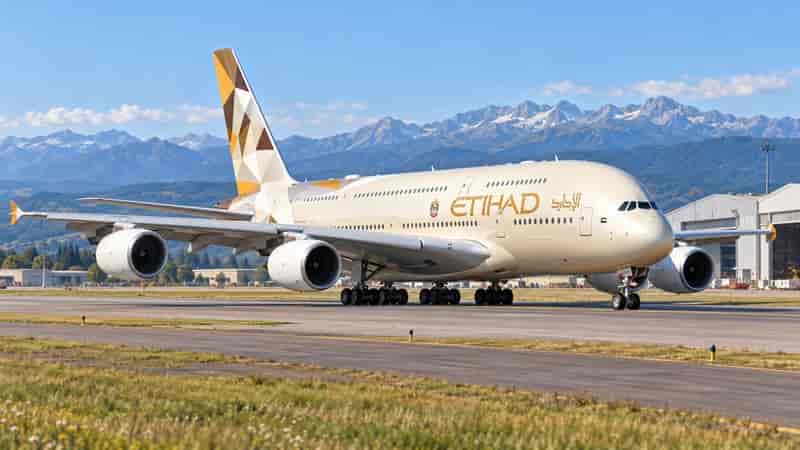
For nearly six years, an Etihad Airways Airbus A380 sat in southern France as the world rediscovered the pleasures, frustrations, and occasional indignities of international travel.
Now the giant has headed home.
The aircraft, registered A6-APB, departed Tarbes-Lourdes-Pyrénées Airport for Abu Dhabi on 17 September 2026. Etihad took delivery of it in 2015; it was withdrawn from operations in 2020 and moved to Tarbes that December.
Its departure marks an important step towards completing the recovery of Etihad’s surviving superjumbo fleet. However, it does not mean the aircraft has resumed carrying passengers.
That distinction matters. An aeroplane can be ready for a ferry flight while still requiring substantial work before returning to commercial operations. Boarding passes come later.
At the time of the September departure, reporting said further heavy maintenance would follow in Abu Dhabi. Earlier plans pointed to January 2027 for the aircraft’s return to passenger service, although this article has not independently confirmed a firm date.
After such a lengthy absence, there is little point in rushing the final chapter.
Nine survivors, one different ending
Etihad grounded its original ten A380s during the pandemic. Nine survive. The tenth, registered A6-APA, was scrapped in 2025, according to aviation reporting.
When A6-APB returns to commercial operations, it will complete the planned recovery of those nine surviving aircraft.
This is therefore a fleet revival with one conspicuous absence, rather than the restoration of all ten original superjumbos.
The difference is more than arithmetic. It reflects the hard decisions airlines face when demand disappears, and expensive aircraft become assets without an immediate assignment.
Keeping an aircraft available for another working life costs money. Bringing it back costs more. The case must extend beyond passenger affection and an impressive photograph.
Passengers may fall in love with an aeroplane. Finance departments tend to request a spreadsheet.
Etihad’s commercial A380 comeback began on 25 July 2023, when the airline restored passenger services between Abu Dhabi and London Heathrow. Earlier departures from storage prepared for that return, rather than marking passenger-service milestones.
A6-APB’s journey belongs to the same sequence: first recovery, then the work required for commercial deployment.
Storage involves work, too
A parked aircraft can look abandoned to an observer beyond the airport fence. Managed storage is a different proposition.
TARMAC Aerosave describes preservation measures and maintenance intended to protect aircraft and engines, following manufacturers’ guidelines. The company also says its facilities are away from saline environments to help limit corrosion.
The objective is to preserve condition and value while an aircraft awaits its next assignment.
A6-APB’s time at Tarbes should therefore be described as managed storage, rather than years of neglect.
AeroTime, citing Flightradar24, reported eight months of preparation before the aircraft’s departure for Abu Dhabi. That figure reflects preparation for flight; it should not be mistaken for the entire commercial return programme.
Nor should a ferry flight be treated as evidence that the cabin, aircraft and operational arrangements are ready for paying passengers.
For an aircraft of this scale, the journey from preservation to passenger service demands more than a wash, a fuel delivery and a hopeful turn of the key.
Anyone who has coaxed a reluctant car into life after a long holiday may sympathise. The resemblance becomes rather limited once four jet engines enter the conversation.
What an earlier restoration involved
Etihad Engineering’s documented work on the first aircraft in the 2023 return programme offers a useful illustration of the engineering effort.
The company reported a major maintenance check that included removing, inspecting and reinstalling the cabin. The scope also covered structural modifications, work on all four engines, and inspection and servicing of components in specialist workshops. www.etihadengineering.com.
Those details describe that earlier aircraft. They are not an itemised account of A6-APB’s current maintenance.
The distinction keeps an instructive example from becoming an unsupported claim.
It also gives the comeback its proper perspective. The aircraft’s departure from France is the visible moment, but the technical preparation makes that moment possible.
A fleet restoration may produce glamorous photographs. Much of the achievement belongs to people who work far from the departure lounge.
The commercial argument
Etihad explained its initial revival decision in December 2022 by pointing to increased travel demand and customer appetite for the A380.
It also said deploying the aircraft to London would free up capacity for more frequencies on existing routes and new destinations, www.etihad.com.
That is the business case in practical terms. A larger aircraft can serve a busy market while another aircraft works elsewhere in the network.
The potential benefit therefore extends beyond one flight.
Naturally, one condition applies: the seats must earn their keep.
Capacity alone does not establish profitability. Fares, cabin demand, operating expenses and reliable utilisation all influence whether an aircraft makes commercial sense.
A full cabin is encouraging. A profitable flight is the point.
Recovering the final surviving A380 can reasonably be interpreted as confidence in the aircraft’s future usefulness. It does not prove the profitability of individual routes or guarantee a particular deployment.
The superjumbo remains a tool for selected markets, rather than a universal answer to fleet planning.
A distinctive proposition for passengers
Etihad’s published A380 configuration includes nine First Apartments, 70 Business Studios and 405 economy seats, alongside The Residence.
The airline’s July 2023 announcement divided that economy total into 68 Economy Space seats and 337 Economy Smart Seats, www.etihad.com.
At the premium end, The Residence comprises a private living room, bedroom and ensuite shower. First Apartments offer privacy doors, while Business Studios provide fully flat beds, www.etihad.com.
A separate bedroom stands out in an industry where many passengers consider an empty neighbouring seat a considerable stroke of luck.
For travel advisers, these differences matter commercially. A client buying a particular experience needs advice that considers the scheduled aircraft and cabin, not just the airline’s name.
Equally, the hundreds of economy passengers remain central to the aircraft’s commercial purpose. The whole configuration has to work.
The Australian connection
Etihad’s published A380 destination list currently includes London, Tokyo, Toronto, Paris and Singapore, on selected flights from Abu Dhabi.
Australia does not appear on that list. Therefore, the return of A6-APB provides no basis for announcing an Australian A380 comeback, www.etihad.com.
Australian travellers can nevertheless consider the aircraft when comparing onward flights through Abu Dhabi, where their itinerary offers a suitable connection.
The important qualification is “selected flights”. A destination appearing on the list does not mean every service uses an A380.
Travellers and advisers should check the scheduled equipment and reconfirm cabin details before departure, particularly where the booking centres on a specific premium product.
A future Australian assignment would require an airline announcement. Enthusiasm, however understandable, is a poor substitute for a timetable.
The next chapter
A6-APB’s departure from Tarbes is a compelling comeback because it combines years of preservation with a renewed commercial purpose.
The next milestone to watch is confirmation of its return to passenger service and its intended assignment.
For now, the accurate story is that Etihad’s final stored A380 has left France for Abu Dhabi, advancing the recovery of the airline’s surviving superjumbo fleet.
The giant is awake. Its next job is to earn its keep.
By: Michelle Warner – © 2026.
Read Time: 7 minutes.
Author Bio:
 Michelle Warner has always carried stories the way others carry passports lightly, faithfully, and with purpose. She learned her craft in newsrooms, shaping sentences with care, before swapping deadlines for departures as a flight attendant with some of the world’s great airlines. Years aloft sharpened her eye for character and deepened her fondness for the small, dignified rituals of travel, the quiet kindness of strangers, the poetry of arrival, the patience learned between time zones.
Now grounded by choice, Michelle has come home to writing with the same calm authority she once brought to turbulent cabins. Her prose blends an editor’s discipline with a traveller’s wonder, tinged with humour and reverence for the golden age of travel. Each piece feels like a handwritten boarding pass, gracious, observant, and unmistakably alive.











