


If Day 1 of Web in Travel (WiT) Singapore asked what agentic AI means for travel, Day 2 heard from the people already living with the answers. An airline boss who kept a country connected through a war. A Google study showing travellers still want to make their own decisions. And Agoda’s leadership arguing that travel is too complex to hand over to a general-purpose AI.
There was news from WiT itself too. Closing a panel on platforms, Yeoh Siew Hoon announced that WiT is heading to a new continent, with WiT LATAM launching in Buenos Aires next year. Guido Becher, global head of travel and loyalty at Rappi, will be its co-founder.
Running an airline through a war
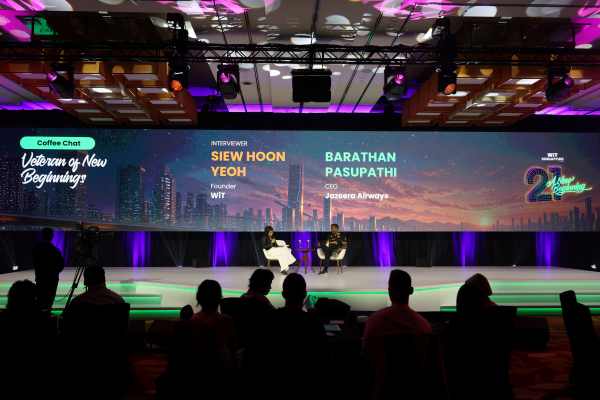
One of the most extraordinary stories of the day came from Barathan Pasupathi, CEO of Jazeera Airways. When Kuwait International Airport was hit and shut for 57 days, Jazeera became the only airline serving Kuwait, operating out of Qaisumah in Saudi Arabia, a three-hour drive away.
The airline moved 1,000 seats out of its terminal and set up a temporary one at an exhibition ground overnight. At the peak it ran 450 buses, “eight times more buses than planes,” to move around 300,000 people across 1,500 flights, with 20 of its 22 aircraft based in Saudi Arabia and two in Cairo.
Pasupathi, who spent 12 years building Jetstar Asia, admitted he was “heartbroken” by its closure and took its last flight. He expects more consolidation among low-cost airlines in South-east Asia as fuel costs, a strong dollar and rising airport charges squeeze margins. Jazeera is still betting on growth, with a licence to set up Jazeera Saudia in a market seven times the size of Kuwait.
Agoda: travel deserves its own agent
In the day’s final interview, Agoda CEO Omri Morgenshtern and CTO Idan Zalzberg were clear that general AI assistants will not replace specialist travel brands. “I think travel deserves its own agent,” said Zalzberg. “When you do millions of transactions, even if you make a mistake one in a million times, that’s still actual people that get impacted. So we build them very carefully. Trust first and usability after.”
Morgenshtern, who is now also taking on Booking Holdings’ combined B2B business, said he took the role because it was hard and because “you can win with velocity.” For him, B2B in travel comes down to trust, relationships “and most importantly, it’s about the best tech.”
Google: travellers want curation, not delegation
Laura-Marie Arens, head of travel vertical search APAC at Google, shared five early findings from Google’s annual traveller study, which launches next month. Asia Pacific is leading on AI, and seven in 10 Gemini prompts in the region are written in local languages. Yet AI is not shortening trip planning. Travellers who use AI have twice as many touchpoints as those who don’t, using it for the dull jobs such as visa rules and baggage fees so they can spend longer on the fun part.
What they want from AI is a shortlist. Some 74% want between one and 15 options, but only 8% are happy for AI to handle the whole booking. And 90% say they love planning their trips. “Good news for all of us: travel is still fun,” said Arens.
The plumbers: Etraveli, Mews and Spotnana
Three founders and CEOs made the case for doing the hard, unglamorous work behind the scenes.
- Etraveli: CEO Mathias Hedlund said the flight specialist runs at more than 20% profit margin and, for the first time, is growing without adding headcount. Asked about the latest ruling against Booking Holdings’ bid for the company, he said it was expected and Etraveli had moved on. He sees an IPO as the most likely route, while its fraud module alone lifted one OTA’s EBITDA by €15 million.
- Mews: Founder Richard Valtr said Mews should be “20 times” bigger within three years. Merging product managers, designers and engineers into a single “product builder” role has given the company an eightfold productivity boost. His pet hate: “The fact that we call it a check-in and not a welcome, and we call it a check-out and not a goodbye, I think is actually embarrassing.”
- Spotnana: Founder Sarosh Waghmar explained how his infrastructure now powers travel for companies including Workday and Brex. “The biggest problem in travel is never the search and the shop. It’s post the shopping, it’s the servicing piece,” he said.
Social, platforms and the outsiders
Marcus Yong, vice president, global marketing at Klook, said 94% of APAC travellers have used AI to plan a trip, but 85% don’t trust it at face value and turn to social media to check. “People still trust people,” he said. Klook now works with around 30,000 creators across 88 markets, most of them micro and nano influencers.
Non-travel platforms are moving in fast. Grab has 50 million monthly transacting users and launched its hotel booking product in months by working with partners. TikTok’s Eason Zhang said more than 60% of people now use social media to plan trips, up from 20% five years ago.
A renaissance, not just a revolution
JTB chairperson Eijiro “Eddie” Yamakita said the industry has spent too long talking about digital transformation and now needs a human one. Asked what he would give the travel industry for its 21st birthday, he answered: “Renaissance. We need to be reborn, but maintaining the original essence of tourism.”
New research from Vikram Malhi, CEO and founder of ZUZU Hospitality, echoed that. Some 60% of independent hotels in South-east Asia already use AI, but 79% want check-in and check-out to stay human. While 51% want to build their own AI systems, only 9% have started, which Malhi said is where the opportunity lies.
The humans win the great debate
The day ended with WiT’s signature debate on the motion that AI will do more harm than good to travel in the next decade. Despite strong arguments from Martin Symes, Jeff Pan of Belli and Blanca Menchaca of BeMyGuest, the audience sided overwhelmingly with Timothy Hughes of Agoda, Luke Clark of The Reset Practice and Astha Kalbag of Talk to Magpie AI. “AI won’t make travel worse in a decade because the humans in this room won’t let it,” said Clark.
It was, Siew Hoon noted, the first time a team with Hughes on it had ever won.
Other highlights from Day 2
- Winners: GlobePlanner, led by Victor Gaya, won the first Agentic AI Hackathon run by Alibaba Cloud and Atlas, ahead of Northstar AI and YuanFen. In the WiT Phocuswright Global Startup Pitch, Crewfare won the scale-up People’s Choice award and Lobby won the seed-up award. Both will present at the Phocuswright Conference in Fort Lauderdale in November. SPUN Global took the AirAsia MOVE award.
- WiT Africa: Wakanow group CEO Bayo Adedeji put the opportunity in perspective: “The entire air travel in Africa, the continent, is less than the travel out of Spain, one country.”
- Asia’s OTAs: More than 85% of Rakuten Travel’s new users come from the wider Rakuten ecosystem, while AirAsia MOVE said 80% of its sessions are organic.
- WiT for Good: The day opened with Ram Banzuela, who grew up scavenging on the dumps of Tondo in Manila and now runs programmes for the Young Focus Foundation. WiT for Good has raised close to $1 million since 2008, and Tony Fernandes donated a dinner with him and flights for two to the evening’s charity auction.
Closing the 21st edition, Siew Hoon reminded delegates what matters most as the industry finds its way through the AI era: “There are many paths to choose. There are many oceans to cross. Our North Star must remain the traveller.”











