

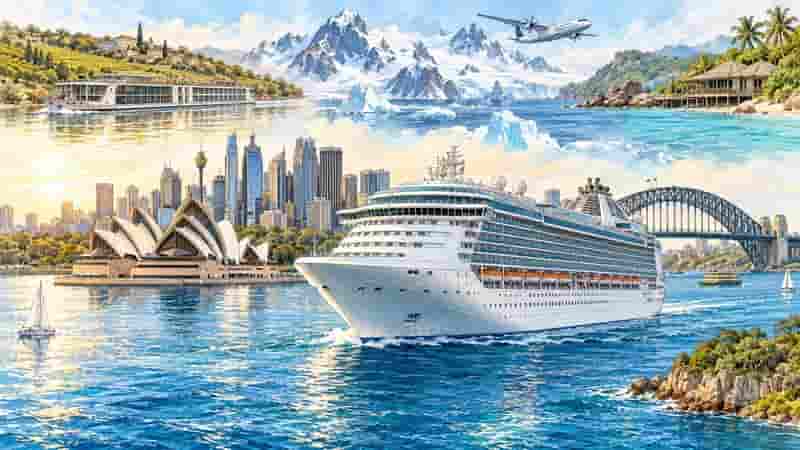
With global passenger numbers at record levels and cruise companies stretching into resorts, rivers and Antarctica, Australia faces a simple question: will the next wave of growth sail our way?
Sydney Harbour seldom needs help putting on a show. On 7 October, Crown Princess offered another splendid silhouette beside the Opera House before setting sail on an Australian itinerary. The ship helped open the 2026–27 summer cruise season on 2 September, but her latest visit reminded everyone that Australia’s cruising business is back in the spotlight.
The industry is no longer just selling a cabin, a buffet, and a deckchair with a commanding view of the horizon. Increasingly, cruise groups want a place in almost every corner of the holiday market, from European rivers to Caribbean resorts and Antarctic adventures.
Cruise Passenger editor-in-chief Peter Lynch has highlighted that transformation in his Cruise Month coverage. It deserves closer scrutiny, particularly from an Australian perspective.
That makes Cruise Month 2026 a timely celebration and a timely examination of whether Australia is keeping pace.
Cruise Month puts four holidays under one banner
Cruise Lines International Association (CLIA) has launched its October #LoveCruise campaign with four distinct themes: ocean cruising from 4–10 October, river cruising from 11–17 October, expedition cruising from 18–24 October and luxury cruising from 25–31 October.
For travel advisers, the campaign offers promotions, marketing material and an expanded education programme, including almost 40 webinars for CLIA members. For would-be passengers, it reminds them that choosing a cruise is like choosing a restaurant: a wonderful recommendation for one person may be entirely wrong for the next.
CLIA’s Australasian managing director, Joel Katz, says 89 new cruise ships are on order worldwide, representing an investment of almost US$100 billion. It is a striking pipeline, though ships on order aren’t necessarily under construction or destined for Australian waters.
Passenger numbers support the enthusiasm. CLIA’s 2026 State of the Cruise Industry report recorded 37.2 million ocean cruise passengers worldwide in 2025, up 7.5 per cent from 2024. Almost 90 per cent of surveyed cruisers indicated that they intended to cruise again.
A separate forecast from Maximise Market Research estimates the cruise market was worth US$19.41 billion in 2025 and could reach US$38.48 billion by 2034. That forecast applies only to the market as defined by the research firm, not the industry’s full economic contribution. The same analysis estimates that about 35 per cent of ocean cruise travellers in 2025 were younger than 40.
The familiar notion that cruising is reserved for retirees may need to retire.
The floating holiday is becoming a whole holiday empire
The clearest evidence of change is coming from cruise companies’ boardrooms.
On 23 September, Royal Caribbean Group announced an agreement to acquire a 50 per cent interest in the business comprising Sandals and Beaches Resorts for approximately US$3 billion. The transaction, subject to approvals and closing conditions, is expected to complete in early 2027.
Royal Caribbean, Celebrity Cruises and Silversea already give the group a range of experiences at sea. A stake in the all-inclusive Caribbean resort business would expand its reach ashore. Existing bookings and loyalty arrangements continue as usual; travellers should not assume any future cross-brand benefits have already arrived.
Celebrity is also preparing to take its name upriver. Celebrity River Cruises is scheduled to begin sailing in August 2027, offering itineraries on the Danube and Rhine. Its published fare inclusions cover meals, selected drinks, Wi-Fi and one shore excursion per day. Those details matter: the difference between a tempting brochure price and a comfortable holiday budget often hides in the inclusions.
MSC Group’s luxury brand Explora Journeys has signed a letter of intent with Dutch shipbuilder Den Breejen Shipyard for a proposed fleet of river ships. Sales are planned to open in 2027, but designs, delivery dates and routes are still to be announced. A letter of intent is a promising first chapter, not a completed shipbuilding contract.
Then there is Lindblad Expeditions, which in September acquired a 60 per cent controlling interest in White Desert Antarctica and associated aviation businesses. The price was approximately US$61 million, plus about US$6 million for cash on the balance sheet, subject to adjustments. It takes Lindblad further into aviation-led expeditions and luxury land-based Antarctic experiences.
Asia is changing the picture, too. Disney Adventure began sailing from Singapore in March 2026, becoming Disney Cruise Line’s first Asia-based ship. The move matters for regional capacity and competition, though commercial success cannot be judged without reliable operating results.
Why the cost-conscious traveller is still listening
For Australians watching household expenses, a locally departing cruise can offer an attractive alternative to a complicated overseas holiday. A single booking bundles accommodation, much of the food, entertainment, and travel between ports. Departing from a nearby homeport may also eliminate the need for international airfare.
But nobody should mistake the advertised fare for the final account. Drinks, speciality restaurants, shore tours, internet access, gratuities and transport to the terminal can add to the bill, depending on the line and package. Review travel insurance and cancellation conditions before you pay any deposit.
A good travel adviser will compare the holiday’s full cost, not just the fare in the largest type. Families may favour a large resort-style ship; others might prefer a quiet expedition vessel or a river itinerary with more time ashore. The right cruise isn’t necessarily the largest, newest, or cheapest.
Australia’s billion-dollar opportunity comes with a warning
While the global industry expands, Australia’s recent figures tell a more complicated story. The Australian Cruise Association reported that cruise tourism generated A$7.32 billion in national economic output in 2024–25 and supported 22,720 full-time-equivalent jobs. Those are substantial numbers, yet economic output fell 13.2 per cent from the previous year as local cruise activity declined.
In New South Wales alone, the cruise sector generated A$3.94 billion in economic output in 2024–25, according to Destination NSW. That spending reaches well beyond terminals: coach operators, tour guides, hotels, restaurants and regional businesses all have a stake in which ships arrive.
Global orders, however, do not guarantee local deployments. Cruise lines compare port charges, infrastructure, itinerary appeal and operating rules before assigning vessels. A magnificent harbour helps, but even the Opera House cannot negotiate a company’s operating costs.
An important regulatory development has occurred. On 2 October, the Federal Government extended the exemption for eligible cruise ships under the Coastal Trading (Revitalising Australian Shipping) Act 2012 until 31 December 2028. The decision offers operators greater short-term certainty, but it is not a blank cheque.
From 1 January 2027, qualifying arrangements must not restrict seafarers’ ability to engage in collective bargaining. Operators will also have to report information about onboard Maritime Labour Convention complaints to the Australian Maritime Safety Authority. The exemption excludes voyages between Victoria and Tasmania, and the Government says it intends this to be the final extension as it pursues broader coastal trading reforms.
This is Australia’s policy test: provide a competitive, reliable environment for cruise tourism while maintaining worker protections and responsible maritime standards. Ports, tourism agencies, transport authorities and governments will need to pull in the same direction, preferably before the next ship is allocated elsewhere.
What Cruise Month should really celebrate
Cruise Month deserves its enthusiasm. More ships, new destinations and a wider choice of holiday styles give travellers and travel advisers plenty to discuss. Yet this year’s bigger story is not simply how many vessels are coming off the production line. It is how quickly the meaning of a cruise holiday is changing.
For passengers, the best outcome is genuine choice and transparent prices. For Australia, it is more competitive homeports, better-supported regional destinations and rules that provide certainty without abandoning safeguards.
The next great cruise boom may be approaching. The question is whether Australia will welcome more of it alongside or find itself watching the opportunity disappear over the horizon.
By: John Alwyn-Jones – © 2026.
Read Time: 8 minutes.
Author Bio:
 John Alwyn-Jones is one of those rare figures who can make the business of travel sound positively adventurous.
A lifelong communicator with the polish of a broadcaster and the curiosity of a journalist, he’s spent decades shaping stories and strategies across tourism, aviation, and the cruise world. He’s led from the front as CEO, director, mentor, and advisor, and still brings warmth and wit to every boardroom and microphone.
Known for his sharp insight into global cruise lines and destinations, John has an old-school belief in professionalism, tempered with the sparkle of someone who’s genuinely seen the world. He’s not just in the travel business; he’s made it an art form.











