

Airports are remarkable places. They can send a passenger halfway around the planet before lunch, then spend the afternoon pretending not to know where his suitcase has gone. Yet beneath the boarding calls, security trays, and mysterious airport sandwich prices, a more serious business is taking place.
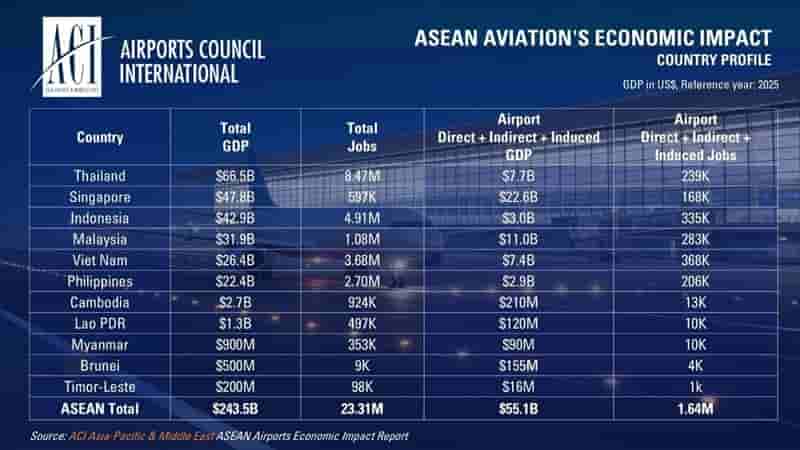
According to a new study, Southeast Asia’s airports and the air connections they make possible supported US$244 billion in GDP and 23.3 million jobs in 2025.
That is quite a performance for an industry whose public image sometimes depends on whether the luggage turns up.
But a nasty little sting in the tail remains. To cope with the crowds expected in the decades ahead, ASEAN airports could need US$341 billion in investment by 2056. Not pocket change. Not even the sort of bill you can quietly pass to the fellow at the end of the table while everyone admires the dessert menu.
This is the uncomfortable conclusion of research published on 7 October by Airports Council International Asia-Pacific & Middle East (ACI APAC & MID). Southeast Asia has built an aviation success story. Now it must find the money, political will and practical sense to keep that success from getting stuck in the departure lounge.
A US$244 billion business hiding in plain sight
The report, Strengthening the ASEAN Single Aviation Market (ASAM) for Greater Connectivity within and beyond ASEAN, is the first comprehensive assessment of airports’ economic contribution across the regional bloc, according to ACI. Prepared with assistance from InterVISTAS Consulting, it attempts to put a price on something most travellers take for granted: the sheer usefulness of being able to fly somewhere.
One distinction matters. The US$244 billion figure is not what airport companies earned, nor what travellers spent on coffee, car parking and the privilege of taking a bottle of water through security. It is ACI’s estimate of the GDP supported by airport operations and the wider effects of air connectivity, including tourism, trade and investment.
Airport-related activity on its own, direct operations, suppliers, and employee spending accounted for an estimated US$55 billion in GDP and 1.6 million jobs.
The study also puts associated tax revenue at US$36 billion, including US$8 billion linked to airport activity and US$28 billion from broader economic effects.
Think of a small hotelier in a secondary city, a local guide whose livelihood depends on visitors, or an exporter waiting for a time-sensitive shipment. None needs to own an aircraft to have a very personal interest in an airport timetable.
An airport, in short, is not simply somewhere to buy overpriced headphones while waiting for a flight. It is economic infrastructure with wings attached.
Open skies have given Southeast Asia quite a lift
For years, ASEAN has pursued the ASEAN Single Aviation Market, a framework intended to make regional air services less restricted and more competitive.
The language is diplomatic. The effect, when it works, is wonderfully undiplomatic: more airlines competing for passengers, more places within reach and a much greater chance that a holidaymaker can fly directly rather than take an unwanted tour of three transit terminals.
ACI estimates that direct air connectivity increased by 358% between 2004 and 2025. Almost all ASEAN member states at least doubled scheduled seat capacity over that period. Much of the rise in flights within ASEAN occurred between 2010 and 2015, around the signing of important market-opening agreements.
The study associates those connectivity gains with about US$50.6 billion in GDP and six million jobs. These are components of its broader economic assessment, not additional figures to pile on top of the headline totals like bags on an overloaded airport trolley.
And then came the low-cost carriers.
In 2008, budget airlines accounted for 29% of seats on intra-ASEAN flights. By 2025, their share had reached 51%.
Their revolution has not always been elegant. Fares may be cheap, legroom may seem designed by a committee of folding-chair manufacturers, and the charge for a checked bag can briefly revive interest in travelling with a toothbrush and nothing else.
But the commercial result is significant. Lower-cost flying has opened more of Southeast Asia to family visits, weekend escapes, independent travellers and tourism businesses that previously depended on far fewer international connections.
It has also made destinations compete harder for visitors. A beautiful beach is an asset; a beautiful beach that people can reach without sacrificing two days and a small inheritance is a business.
Tourism is sitting in the front row
The latest estimates tell their own story. Some 84.8 million international tourists arrived in ASEAN by air during 2025, generating around US$127 billion in tourism spending.
ACI calculates that air-arriving visitors accounted for about two-thirds of international tourism expenditure across the region.
That should capture the attention of tourism ministers who sometimes speak about new hotels, attractions and marketing campaigns while treating airline access as a detail to be settled later.
Without suitable flights, an exciting tourism promotion can become a magnificent invitation to a party nobody can attend.
Air connectivity matters particularly in an area made up of vast archipelagos, busy cities and regions separated by substantial distances. Across Indonesia and the Philippines, for example, geography alone makes aviation an essential part of the transport picture.
The report says ASEAN airports handled more than 700 million passengers and almost nine million tonnes of cargo in 2025.
The cargo deserves its moment in the spotlight. Tourists may bring spending money and alarming amounts of luggage; aircraft also carry products and components whose value depends on arriving promptly. Aviation is a commercial artery, not merely a holiday conveyance.
Singapore has the dollars, Vietnam has the jobs
The study’s country comparisons offer an intriguing glimpse of how varied the aviation economy has become.
On airport-related GDP, Singapore ranked first at approximately US$22 billion, followed by Malaysia at US$11 billion and Thailand at US$7.7 billion.
Employment tells a different story. Vietnam led with around 368,000 airport-related jobs, followed by Indonesia with 335,000 and Malaysia with 282,000.
Those differences reflect distinct aviation markets and economic structures; the figures should not be mistaken for a league table of which country has the best airport, the most charming immigration officer or the least bewildering terminal signage.
Singapore’s strength as an international hub is hardly a surprise. But the employment numbers are a useful reminder that regional airports, domestic networks and supply chains matter just as much to livelihoods as the gleaming gateways that attract the publicity.
And the next contest may be won beyond the biggest hubs.
The overlooked cities want a ticket too
ACI argues that ASEAN must further open access to secondary cities. That is an unglamorous phrase for a highly consequential idea: smaller destinations should have a better chance of attracting the flights that bring tourists, trade and investment.
Stefano Baronci, Director General of ACI Asia-Pacific & Middle East, says: “ASEAN States have made historic strides with the ASEAN Single Aviation Market (ASAM), demonstrating what the ASEAN Community can achieve when governments and industry fly together.”
The problem is that granting permission for a route is only half the battle.
A destination still needs enough passengers, workable traffic rights, trained staff, runway and terminal capacity, efficient border formalities and airspace that can handle the traffic.
Otherwise, governments can announce new aviation opportunities until the microphones wear out. Airlines, unlike politicians, cannot operate on announcements alone.
Baronci identifies lagging infrastructure as a central obstacle, warning that it limits airlines’ ability to make full use of opportunities created by liberalisation.
Six million passengers are waiting in the forecast
ACI’s modelling suggests fuller implementation of the aviation market could produce about six million additional passengers on routes within ASEAN, an increase of 11.6% against the 2025 level.
In an unconstrained scenario, that could support 15,000 additional aviation jobs and US$600 million in GDP, plus another 434,000 jobs and US$3.7 billion through wider effects on tourism, trade and investment.
Altogether, the potential prize is almost 450,000 jobs and US$4.3 billion in additional GDP.
A handsome prize, certainly. But it remains a projection, not a cheque already deposited or a workforce already on the payroll. Real-world results will depend on access rights, investment, airline economics and passenger demand.
Another important question remains: can airports cope even if policies improve?
The US$341 billion elephant on the runway
This is where the good news acquires a rather expensive shadow.
ACI forecasts that ASEAN passenger traffic could more than double over the next decade. It estimates airports will need US$108 billion of investment by 2036, followed by a further US$233 billion between 2037 and 2056, as regional passenger traffic is projected to reach 2.9 billion.
Total estimated requirement: US$341 billion.
One imagines a regional treasurer reading that figure, removing his spectacles, cleaning them carefully and checking whether somebody has accidentally typed an extra three zeros.
But the underlying problem is real. More passengers demand more infrastructure: terminals, gates, runways and ground transport, as well as efficient air traffic management and staffing.
There are difficult decisions ahead. Who pays? Which airports expand first? Can operators raise finance without making travel unreasonably expensive? And how will development address emissions, noise, land use and climate resilience?
It is tempting to treat every forecast as a guaranteed arrival. Airports know better than most that an expected arrival and an actual arrival are not always the same thing.
The US$341 billion is an industry estimate of future investment needs, not a sum already committed or a bill due tomorrow morning. The traffic forecasts could change. What will not disappear is the need to plan ahead.
Australia should be watching the arrivals board
Australia has an obvious commercial interest.
ASEAN’s aviation choices influence the range of Southeast Asian holidays, multi-country itineraries and connecting services that Australian travellers and advisers may be able to use. Stronger links to regional cities could help tour operators build trips beyond the familiar capitals and resort gateways.
That does not mean every new service will survive, nor that cheaper tickets will arrive automatically. Airports can build a fine terminal; they cannot manufacture a profitable airline route from a ribbon-cutting ceremony.
But travel businesses that follow emerging connectivity, new airport projects and policy reform will be better placed to spot opportunities before they become obvious to everyone else.
The most revealing message from the ACI study is therefore not simply that ASEAN aviation supports US$244 billion in GDP and 23.3 million jobs. It is that the region’s success has created a second, more demanding job: keeping the infrastructure, regulation and funding in step with demand.
Southeast Asia has demonstrated a remarkable talent for getting people into the air.
Now comes the truly adventurous part: finding US$341 billion to make certain they still have somewhere sensible to land.
Even by aviation standards, that is quite a landing fee.
By: Anne Keam – © 2026.
Read Time: 10 minutes.
Author Bio:
 Anne Keam’s story begins in Queensland, on a grain farm in the state’s wide western reaches, where the days were long and the lessons simple: work hard, look after your own, and don’t make a fuss. Those early years left their mark.
She later studied Arts at the University of Queensland, before doing what felt natural at the time, heading back home to the family property. But the world was calling. Anne packed a backpack and went looking, spending years on the road and finding herself most alive in South America. She wrote everything down along the way. Those notebooks, full of dust, colour, and curiosity, eventually became her blog, a quiet, personal record of seeing the world and learning from it.











