

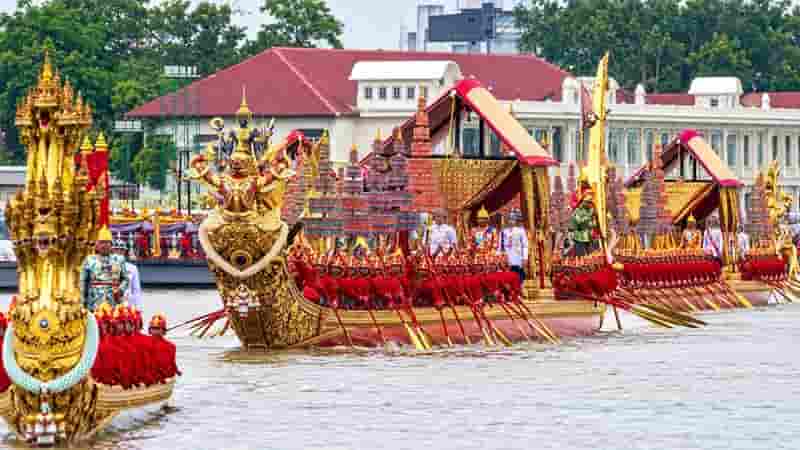
There are grand entrances, and then there is Bangkok’s Royal Barge Procession.
On Friday, 6 November 2026, the Chao Phraya River will surrender its everyday bustle to one of Thailand’s rarest and most magnificent ceremonial spectacles: 52 royal barges, 2,200 Royal Thai Navy personnel and a waterborne formation stretching approximately 1,280 metres from end to end.
For a city whose river normally carries ferries, hotel boats, commuters, cargo, and the occasional longtail in a hurry, this is Bangkok in an altogether different gear. The River of Kings becomes a ceremonial avenue, paddles rise and fall in disciplined rhythm, and centuries of royal tradition move through the capital not behind museum glass, but very much alive.
The 2026 procession will carry His Majesty the King to Wat Arun Ratchawararam for the Royal Kathin Ceremony, during which Kathin robes are presented to Buddhist monks following the end of Buddhist Lent. This year’s ceremony also forms part of celebrations marking Her Majesty Queen Suthida Bajrasudhabimalalakshana’s fourth-cycle, or 48th, birthday anniversary on 3 June 2026.
For travellers fortunate enough to be in Bangkok, it is the sort of event that makes an ordinary sightseeing itinerary look rather underdressed.
A royal tradition measured in centuries
Thailand’s ceremonial relationship with water reaches deep into its history. Official Thai cultural sources trace the use of royal boats through the Sukhothai period, while great ceremonial fleets became especially prominent during the Ayutthaya Kingdom, when waterways were highways, processional routes and strategic arteries all at once.
The tradition continued into the Rattanakosin era after Bangkok became the capital. Royal barges evolved from functional vessels into extraordinary works of craftsmanship, combining carved timber, lacquer, gilding, glass decoration and elaborate figureheads drawn from Thai religious and mythological traditions.
Among the four principal royal barges taking part in 2026 is Suphannahong, the Golden Swan, perhaps the most instantly recognisable of the fleet. Its present vessel was begun during the reign of King Chulalongkorn, Rama V, and completed in 1911 during the reign of King Vajiravudh, Rama VI. Also in the formation are Anantanakkharat, with its multi-headed Naga prow; Anekkachatphutchong; and Narai Song Suban King Rama IX, created during the reign of King Bhumibol Adulyadej.
These are not decorative replicas wheeled out for a convenient photo opportunity. They are working ceremonial vessels with a living role in Thailand’s royal traditions.
The barges also carry the scars of history. Bangkok’s royal barge collection suffered serious damage during the Second World War, after which restoration became a major conservation undertaking involving the Fine Arts Department and the Royal Thai Navy. Important vessels and ceremonial objects are now on display at the National Museum of Royal Barges in Bangkok Noi, well worth visiting before the procession if you want to appreciate the artistry beneath all that gold.
Fifty-two barges, one remarkable formation
The scale of the 2026 operation is formidable.
The latest Royal Thai Navy information confirms 52 ceremonial barges arranged in five columns and three lines, supported by 2,200 Navy personnel. The formation is approximately 1,280 metres long and 90 metres wide.
That matters because the visual impact is not simply about one spectacular royal vessel. It is the geometry of the entire fleet: the central royal line, escort craft, animal-headed barges, and outer ranks maintaining a precise formation as they move down a living river.
The choreography is matched by sound. Traditional barge chanting matches the rhythm of the oarsmen, turning the procession into something heard as much as seen.
Anyone expecting the frantic theatrics of a regatta has chosen the wrong sport entirely. This is measured, deliberate and ceremonial — pageantry with discipline rather than pageantry with a stopwatch.
The River of Kings becomes the royal road
The procession will depart from Wasukri Pier and travel along the Chao Phraya, passing Phra Sumen Fort, Somdet Phra Pinklao Bridge, Siriraj Hospital, the Grand Palace and the Royal Thai Navy Auditorium before reaching Wat Arun Ratchawararam.
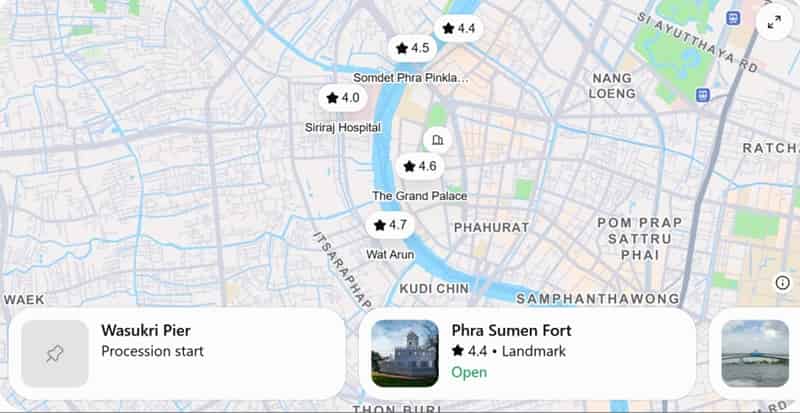
Bangkok’s River of Kings charts a regal course through centuries of tradition.
The route offers spectators several riverside areas from which to watch, although official security arrangements and access controls on the day will always take precedence.
The Tourism Authority of Thailand says members of the public can watch rehearsals from areas along both banks between Krung Thon Bridge and Wat Arun, with the same stretch also providing opportunities to witness the procession itself on 6 November.
For atmosphere, the old-city side around Phra Sumen and the Grand Palace is difficult to beat. Around Tha Tien, the approach towards Wat Arun produces the sort of composition photographers dream about: ceremonial barges on the Chao Phraya with the Temple of Dawn rising beyond.
The catch, naturally, is that several thousand other people may have dreamt about exactly the same photograph.
Arrive early, travel light and expect security screening, crowd controls and possible transport changes. Bangkok traffic requires precious little encouragement to become theatrical; on a royal ceremonial day, sensible planning is not optional.
October rehearsals offer a second chance
Travellers unable to attend on 6 November still have valuable opportunities during October.
The Royal Thai Navy scheduled 10 minor rehearsals and two full-dress rehearsals. As of 7 October, the remaining minor rehearsals are on 8 and 15 October, while full-dress rehearsals are scheduled for 21 and 28 October. The Tourism Authority of Thailand says rehearsals are expected to begin at approximately 2.30 pm.
The full-dress rehearsals offer the closest preview of the final spectacle and are likely to attract substantial crowds. Public viewing is available along designated sections of the riverbanks, subject to official instructions and security arrangements.
The Royal Thai Navy also offered designated ticketed seating for the full-dress rehearsals and the 6 November ceremony. Reservations were accepted from 8 to 16 September, with ticket collection from 21 to 25 September, so that application period has now closed. Official seating locations included the Royal Thai Navy Club and Royal Thai Navy Convention Hall, with the Royal Naval Institute Building available for the rehearsal dates.
Anyone without a ticket should therefore rely on the latest official advice rather than assume access to a favourite patch of riverbank.
That distinction matters. A spot that looks wonderfully public on an ordinary Bangkok afternoon can become considerably less negotiable once royal ceremonial security enters the picture.
Why the procession matters
It would be easy to describe the Royal Barge Procession simply as a tourism spectacle. It is unquestionably spectacular, and it will unquestionably attract visitors. But that description rather misses the point.
At its heart is the Royal Kathin tradition, a Buddhist merit-making ceremony following the end of Buddhist Lent. When performed by the monarch, the presentation of robes brings together Buddhist observance, royal tradition and centuries of state ceremony.
That is why the procession deserves to be watched with more than a camera lens.
The carved prows, uniforms, gilding and glittering ornament are the visible surface. Beneath them lies a much older story involving Thailand’s river culture, traditional craftsmanship, religious practice, naval discipline and continuity across generations.
For Thailand’s tourism industry, another intriguing dimension emerges. Travellers increasingly say they want “authentic” experiences, a word now sprinkled across tourism marketing with such enthusiasm that even hotel bathrobes occasionally risk becoming culturally significant.
The Royal Barge Procession requires no such marketing varnish.
It is not staged for tourists.
Tourists are coming because the ceremony exists.
And that is precisely why it retains such power.
On 6 November, Bangkok’s famously busy river will become something rarer than quiet. It will become ceremonial space. Fifty-two barges will advance towards Wat Arun, crowds will gather along the banks, and for a few extraordinary hours the modern capital will reveal an older rhythm beneath its traffic, towers, shopping centres and rooftop bars.
Gold will catch the afternoon light. Oars will rise together. Chants will carry across the water.
Bangkok has never been shy about putting on a show.
This one, however, has had centuries of rehearsal.
By: Supaporn Pholrach – © 2026.
Read Time: 6 minutes.
Author Bio:
 Supaporn Pholrach came up in advertising when deals were sealed with a handshake, and deadlines lived on scraps of paper, not dashboards. She learned early that people mattered more than process, and it stuck. With solid training and a stubborn work ethic, she built a reputation for delivering results without turning hard or hollow.
Fifteen years at Bangkok Shuho would test anyone’s stamina. Supaporn stayed the distance. These days, as Sales Manager at EGT Media, she helps tourism brands cut through the noise with common sense, good humour and genuine warmth.
She doesn’t chase quick wins. She earns trust, builds loyalty and keeps her word. In an industry that rarely slows down, Supaporn is someone you’re quietly glad to have on your side.











