

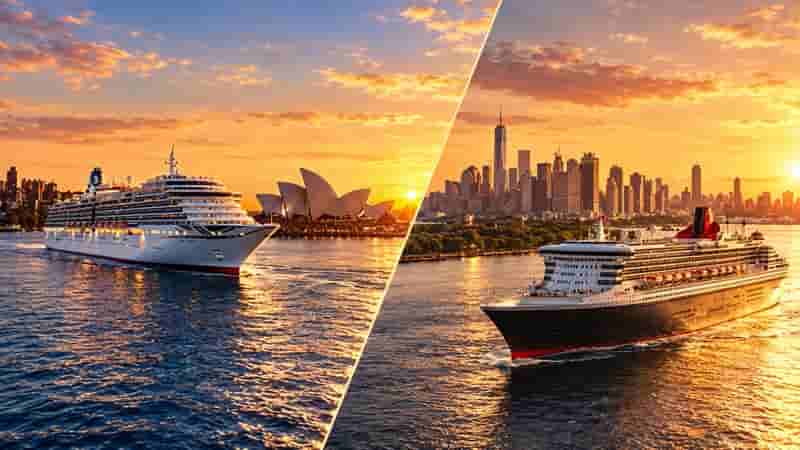
Carnival Corporation has delivered one of the most unexpected fleet reshuffles in recent cruise history, confirming that Cunard’s newest ship, Queen Anne, will leave the famous British line in 2029 and transfer to sister brand P&O Cruises, while P&O’s veteran Arcadia will head in another corporate direction to Holland America Line.
It is an extraordinary piece of maritime musical chairs. One ship is barely out of the wrapper; the other has been sailing for more than two decades. Yet, viewed through the lens of ship design, brand positioning and corporate history, the manoeuvre is not quite as eccentric as it first appears.
Queen Anne entered service with Cunard in May 2024. She will remain with the line through her 2028/29 World Voyage before undergoing what Carnival UK describes as an extensive “reimagining”. She will also receive a new name before entering P&O Cruises service in May 2029.
Carnival UK, P&O Cruises and Cunard president Paul Ludlow said the decisions reflected “a careful, long-term view of our portfolio and where the individual strengths of each ship can best support guest demand and the future direction of our two cruise lines”.
That is corporate language for a very substantial repositioning.
Queen Anne changes course
Queen Anne was deliberately conceived as a more contemporary interpretation of Cunard. Ludlow said her modern design, broad dining and entertainment offering and flexible public spaces give her a “natural affinity with the modern P&O Cruises holiday experience”.
Following her conversion, the approximately 3,000-guest ship will introduce an entirely new class of vessel to P&O Cruises.
Exactly what will change aboard and, perhaps more tantalisingly, what Queen Anne will be called after surrendering her royal Cunard name remains to be announced.
Before that happens, however, she has some serious Cunard business to attend to.
Queen Anne is scheduled to take part in the historic Four Queens Celebration in Liverpool on 16 May 2028, when Queen Mary 2, Queen Victoria, Queen Elizabeth and Queen Anne are due to gather together on the River Mersey.
It will be the first time all four current Cunard Queens have assembled in Liverpool, a city intertwined with the company’s history since its foundation in 1840.
Queen Anne is then expected to undertake her final Cunard World Voyage from January 2029.
For Cunard, her subsequent departure is remarkable.
The transfer will leave the company with Queen Mary 2, Queen Victoria and Queen Elizabeth. Ludlow said the change would create a “more closely unified fleet” centred on those three ships, each carrying a deeply established Cunard identity.
He also stressed that the decision does not diminish Carnival’s commitment to Cunard.
That reassurance is notable because moving a ship that entered service only in 2024 is hardly routine housekeeping. It represents a substantial rethink of where Carnival believes Queen Anne fits most effectively within its portfolio.
It does not prove that Cunard is unprofitable, nor has Carnival said financial weakness at Cunard prompted the transfer.
Those conclusions would be speculation.
Carnival has said it believes Queen Anne’s characteristics align better with the future direction of P&O Cruises, while Cunard will become more tightly centred around its three established Queens.
Queen Mary 2 remains the crown jewel
Queen Mary 2, meanwhile, remains very much at the heart of Cunard’s future.
A major upgrade is planned for 2027, with Ludlow describing the vessel the world’s only ocean liner providing regular transatlantic service as a “one-of-a-kind asset”.
The investment, he said, is intended to ensure she continues to delight guests “for decades to come”.
So, while Cunard will become numerically smaller when Queen Anne departs, Carnival is clearly signalling that it won’t haul down the famous red-and-black funnel.
Quite the opposite: the strategy appears designed to sharpen what Cunard represents.
Arcadia finally heads home, sort of
If Queen Anne’s move is surprising, Arcadia’s is almost poetic.
Arcadia entered P&O Cruises service in 2005, but her family tree has always pointed towards Holland America.
The ship was originally ordered in 2000 as a fifth vessel based on Holland America Line’s Vista-class platform. During development, Cunard reassigned her and intended to name her Queen Victoria, but she was ultimately allocated to P&O Cruises and emerged as Arcadia.
Her unusual development history also explains some of the Cunard-influenced elements incorporated into her design.
More than two decades later, she is finally heading to Holland America.
Arcadia shares her Vista-class platform with Holland America’s Oosterdam, Noordam, Westerdam and Zuiderdam, making her technically a far more natural addition to HAL than her present P&O badge might initially suggest.
Holland America has confirmed Arcadia will join its fleet in August 2029, following a celebratory farewell season with P&O Cruises.
Her addition will increase Holland America’s fleet from 11 ships to 12 and add capacity for more than 2,000 guests.
Holland America Line president Beth Bodensteiner said the company continues to see strong demand from guests seeking immersive travel experiences, genuine hospitality and what HAL describes as “perfectly sized ships”.
She described Arcadia as a “natural fit”.
And on the hardware alone, it is difficult to argue.
Holland America Evolution awaits
Arcadia will also become part of Holland America Evolution, the line’s multiyear fleet-enhancement programme.
Oosterdam is scheduled to debut its Evolution changes in the northern autumn of 2027, with Zuiderdam following in April 2028. Holland America says the specific venues and features destined for Arcadia are still being determined.
There is some delicious symmetry here.
Arcadia was conceived from Holland America DNA, wandered through Cunard’s development plans, spent more than two decades wearing P&O colours and will now, at last, join the brand from which her original design lineage sprang.
Cruise ships do not often get the opportunity to complete a corporate circle quite so neatly.
What should not be inferred, however, is that Arcadia’s age automatically makes the transfer a retirement move in disguise.
She will be about 24 years old when she joins Holland America, but Carnival has explicitly framed the transfer as a capacity, deployment and fleet-development decision.
HAL is investing in its Vista-class ships rather than simply steering them towards the scrapyard.
What about Aurora?
The same care is required when discussing the future of P&O Cruises’ Aurora.
Aurora entered service in 2000 and is undoubtedly one of P&O Cruises’ older vessels, but no retirement or sale has been announced in this week’s fleet changes.
Any assertion that Aurora’s “days are numbered” therefore goes beyond the currently available evidence.
Age makes her long-term future a legitimate subject for industry discussion. It does not make her departure a confirmed fact.
Was Queen Anne simply too modern for Cunard?
Another irresistible question remains: did Queen Anne stray too far from what loyal Cunard passengers expect?
Cruise enthusiasts have unquestionably debated whether her more contemporary interiors have enough traditional “Cunardia”.
Passenger reaction has not been uniformly negative, but Queen Anne has always presented a noticeably more contemporary interpretation of the Cunard experience than her fleetmates.
Carnival, however, has not said passenger dissatisfaction caused the transfer.
That distinction matters.
Maritime historian Chris Frame has highlighted the historic nature of the decision, describing Queen Anne as destined to become the “shortest-lived Cunard Queen in history” when she leaves the brand.
That description is important. It does not mean Queen Anne will be the shortest-serving vessel in Cunard’s entire history, which stretches back to 1840 and encompasses hundreds of ships.
The move unquestionably demonstrates Carnival Corporation’s willingness to shift major assets between brands when management believes another badge can extract greater strategic value.
P&O isn’t actually losing a ship
An important piece of arithmetic also risks getting lost amid the drama.
P&O Cruises presently operates seven ships: Arvia, Iona, Britannia, Azura, Ventura, Arcadia and Aurora.
Queen Anne’s scheduled arrival in May 2029 would temporarily increase that total to eight.
When Arcadia transfers to Holland America in August 2029, the P&O fleet would return to seven ships, assuming Carnival announces no other fleet changes in the meantime.
So, based on the plans announced so far, this is not a net contraction of P&O Cruises.
It is a significant change in its fleet composition.
The age spread will remain broad. Aurora entered service in 2000, Ventura in 2008, Azura in 2010, Britannia in 2015, Iona was delivered in 2020 and entered passenger service in 2021, while Arvia followed in 2022.
Into that mix will come a substantially reworked ship delivered to Cunard in 2024, effectively giving P&O Cruises one of Carnival Corporation’s youngest major vessels.
Cunard is the brand making the numerical retreat, moving from four ships to three.
Yet Carnival’s explanation suggests the goal is greater brand clarity, rather than simply fewer Cunard berths: Queen Mary 2 as the singular transatlantic ocean liner, alongside the more traditionally established Queen Victoria and Queen Elizabeth.
Carnival plays fleet chess
For Carnival Corporation, the exercise may prove a clever bit of fleet chess.
Queen Anne gets a home where her contemporary character could sit more naturally with the product. Arcadia joins four close Vista-class relatives at Holland America. Cunard tightens around three ships with deeply established identities.
And P&O Cruises trades a veteran 2005 vessel for a ship that entered service less than five years before its scheduled transfer.
There are still unanswered questions.
What will Queen Anne be called?
How dramatic will her P&O transformation be?
Where will she sail?
What will Holland America do to Arcadia?
And, inevitably, what does all this tell us about Carnival Corporation’s longer-term plans for each of its British cruise brands?
Those answers will come.
For now, Carnival has produced one of the more fascinating fleet manoeuvres seen in years.
Unusual? Absolutely.
Illogical? Perhaps not.
And in an industry where ships are expected to work hard for decades, Carnival has apparently decided that sometimes the smartest way to build the future is not to build another ship at all but to move the pieces already on the board.
By: John Alwyn-Jones – © 2026.
Read Time: 7 minutes.
Author Bio:
 John Alwyn-Jones is one of those rare figures who can make the business of travel sound positively adventurous.
A lifelong communicator with the polish of a broadcaster and the curiosity of a journalist, he’s spent decades shaping stories and strategies across tourism, aviation, and the cruise world. He’s led from the front as CEO, director, mentor, and advisor, and still brings warmth and wit to every boardroom and microphone.
Known for his sharp insight into global cruise lines and destinations, John has an old-school belief in professionalism, tempered with the sparkle of someone who’s genuinely seen the world. He’s not just in the travel business; he’s made it an art form.











