

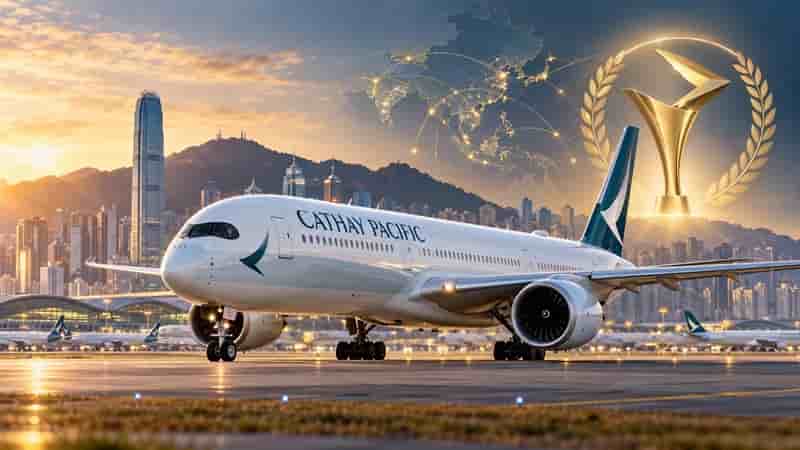
Cathay Pacific’s remarkable journey from pandemic-era aviation casualty to Asia’s strategic standout has received one of the region’s most significant industry endorsements, with CAPA Centre for Aviation naming the Hong Kong carrier its 2026 Asia Airline of the Year.
The honour, announced at the CAPA Airline Leader Summit Asia in Chitose, Hokkaido, is rather more substantial than another shiny object for the corporate trophy cabinet.
CAPA determines its awards through independent research by an international judging panel and CAPA analysts, rather than passenger voting or sponsorship arrangements. In an industry where awards can occasionally multiply faster than airport surcharges, that distinction matters.
And Cathay did not merely scrape home.
According to CAPA, the airline was a rare unanimous choice among the judges.
The panel pointed to the strength of Cathay Pacific’s post-pandemic recovery, its network and operational performance, continued product investment and increasingly ambitious plans for the next chapter of Hong Kong’s development as an international aviation hub.
It is quite a turnaround.
From aviation survival story to Asian leader
Cathay’s pandemic experience was unusually brutal.
Hong Kong’s prolonged border restrictions placed extraordinary pressure on an airline whose business model depends heavily on international and connecting passengers. Unlike airlines with large domestic networks to fall back on, Cathay had comparatively few places to hide.
What followed was a disciplined rebuilding of capacity, connectivity and customer confidence rather than a mad dash to put every available aircraft back in the sky.
CAPA said the airline had expanded in a considered fashion while strengthening worldwide connectivity and supporting profitable growth. Judges also highlighted extensive work on cabins, lounges and passenger-facing products, as well as initiatives intended to improve the customer experience when operations are disrupted.
That last point deserves more attention than it generally receives.
Champagne, lounges and lie-flat seats are all very pleasant. Getting passengers where they paid to go and treating them sensibly when the timetable goes pear-shaped remains aviation’s less glamorous but considerably more important trick.
Cathay appears to understand both sides of the equation.
More than 100 aircraft and Hong Kong has room to grow
Cathay’s ambitions are also growing considerably.
CAPA noted that the airline has more than 100 aircraft on order, while the wider Cathay Group has committed substantial investment to fleet renewal, cabins, lounges and digital technology.
That expansion dovetails neatly with Hong Kong International Airport’s three-runway system, which gives the hub considerably more long-term capacity.
Cathay chief executive Ronald Lam has described the system as creating “immense potential” for strengthening Hong Kong’s role as a leading international aviation hub.
The strategic logic is straightforward.
Extra runway capacity means little without airlines that can fill it intelligently. Cathay enters this next phase with an established intercontinental network, sizeable aircraft commitments, a recognised premium proposition and Hong Kong’s enviable geographic position between North Asia, Southeast Asia, Australia, Europe and North America.
The CAPA award suggests Cathay’s recovery phase is steadily giving way to something altogether more interesting.
Expansion with intent.
VietJet’s astonishing rise continues
Cathay may have collected the headline prize, but the 2026 CAPA awards also provided a revealing snapshot of where Asian aviation is heading.
VietJet Air was named Asia Low Cost/Hybrid Airline of the Year after an extraordinary 15-year rise.
CAPA credited the Vietnamese carrier with combining extremely rapid expansion with an increasingly integrated aviation ecosystem encompassing training, maintenance, ground handling and technology.
And its ambitions are anything but modest.
CAPA says VietJet has an order book of more than 600 aircraft and intends to expand its international network rapidly through 2030.
Six hundred aircraft is no longer simply an airline order book. It is practically a postcode.
More importantly, VietJet’s expansion mirrors Vietnam’s emergence as one of Asia’s increasingly important manufacturing, investment, trade and tourism economies.
Airlines frequently describe themselves as economic enablers. VietJet is attempting to make the expression quite literal.
Walter Cho honoured as Korean Air approaches historic merger
Walter Cho, chairman and chief executive of Korean Air and Hanjin Group, was named Asia Airline Executive of the Year.
His award arrives at an extraordinarily important moment.
Korean Air is preparing to absorb Asiana Airlines in one of the most consequential restructurings Asian aviation has seen in years.
The legal merger date is scheduled for 16 December 2026, with the integrated Korean Air expected to formally launch on 17 December 2026.
CAPA expects the combined operation to rank among the world’s top 10 airlines by available seat kilometres and the top 20 by passenger numbers. The group is expected to integrate its low-cost airline businesses in 2027.
Cho acknowledged the people behind the transformation.
“This recognition belongs to the entire Korean Air team for their dedication in navigating recent industry challenges and driving forward our successful integration.”
The sentiment may be polished enough for an awards ceremony, but the task awaiting Korean Air is enormous.
Airline mergers are not completed simply because lawyers have finished signing documents.
Aircraft, reservation systems, schedules, airport operations, frequent-flyer programs, staff, maintenance operations, and perhaps most delicately, corporate cultures must all be brought together without leaving passengers trapped inside the machinery.
Korean Air has already started preparing customers for the transition, including migrating Asiana reservation information and changing flight numbers before the December integration.
Incheon joins aviation’s billion-passenger club
Airports featured prominently among the CAPA winners.
Seoul Incheon International Airport was named Asia Large Airport of the Year after achieving two substantial milestones.
CAPA reported that Incheon passed one billion cumulative passengers since opening in March 2001 and became the world’s third-largest airport by international passenger traffic.
Incheon has long managed an enviable combination of scale and passenger experience.
That is worth emphasising because airports occasionally become so enthusiastic about terminals, runways, retail space and automated machinery that somebody forgets passengers have to use the place.
Incheon’s transfer proposition, technology, infrastructure and customer experience have helped establish it as both South Korea’s principal international gateway and one of Asia-Pacific’s major connecting hubs.
The Korean Air-Asiana combination should make it still more strategically important.
Penang proves smaller airports can punch above their weight
Penang International Airport received the Asia Small/Medium Airport of the Year award.
CAPA highlighted the Malaysian airport’s combination of rapid traffic growth, customer service and operating efficiency, along with an infrastructure program designed to double its maximum annual passenger capacity.
The development includes terminal and airside upgrades together with plans for Malaysia’s first remote digital virtual tower.
Penang’s importance stretches well beyond leisure travel.
The airport serves one of Asia’s important electronics and semiconductor manufacturing regions, making efficient air connectivity particularly valuable to the local economy and international supply chains.
Aviation, in this case, is not simply bringing tourists to the beach. It is helping keep a sophisticated industrial economy moving.
Izham Ismail receives lifetime honour
CAPA’s Lifetime Achievement Award went to Datuk Captain Izham Ismail, who retired from Malaysia Aviation Group in January 2026 after more than four decades in aviation.
His career spanned both the cockpit and the boardroom.
After extensive operational and managerial roles with Malaysia Airlines, he led MASwings before becoming chief operating officer and later Group CEO and Managing Director of Malaysia Aviation Group.
He subsequently guided the business through restructuring, COVID-19 and Malaysia Airlines’ post-pandemic recovery while also serving in senior international industry positions, including on the oneworld governing board and IATA Board of Governors.
It is an impressive career by any measure and considerably more demanding than collecting frequent-flyer status.
Sustainability moves firmly into aviation’s mainstream
The sustainability awards provided another important signal.
KLM Royal Dutch Airlines received the Global Airline Sustainability Award, with CAPA recognising what it described as a whole-of-business approach to decarbonisation involving sustainable aviation fuel, fleet modernisation, technological innovation and industry partnerships.
Air New Zealand took the Asia Airline Sustainability Award following its 2026 strategic reset, Te Pae Hou – Our Future.
That award is particularly interesting because it comes against a difficult financial backdrop.
Air New Zealand reported a NZ$336 million loss before tax for FY2026, with elevated fuel prices, engine maintenance problems and rising aviation system costs contributing heavily to the result.
That makes its sustainability challenge more credible, not less.
Decarbonisation strategies must survive unpleasant years as well as profitable ones.
Under its revised framework, Air New Zealand is targeting a 25 to 30 per cent reduction in well-to-wake net greenhouse gas emissions by 2030, against a 2019 baseline.
It also remains committed to sustainable aviation fuel representing 10 per cent of jet fuel uplift by 2030. CAPA says SAF accounted for approximately 1.2 per cent in FY2026.
Those figures demonstrate both progress and the formidable distance aviation still has to travel.
Stansted wins global airport sustainability award
London Stansted Airport was named Global Sustainability Airport of the Year.
The Manchester Airports Group-owned airport is targeting net-zero carbon operations for Scope 1 and Scope 2 emissions by 2038.
Its strategy includes renewable energy, lower-emission ground vehicles and on-site solar generation.
Significantly, Stansted’s solar farm was reported fully operational in September 2026, adding substance to what might otherwise remain another collection of aviation sustainability promises.
That distinction is increasingly important.
The aviation industry has become extraordinarily good at announcing environmental aspirations. Investors, governments and travellers are becoming considerably more interested in what has actually been built, bought, changed or reduced.
What the awards really tell us about Asia’s aviation race
Taken together, CAPA’s 2026 winners reveal how profoundly the definition of aviation excellence is changing.
Growth still counts.
Profitability certainly matters.
Network reach remains vital.
But increasingly, the strongest airline and airport businesses are being judged simultaneously on resilience, passenger experience, infrastructure, technology, environmental performance and the quality of strategic decision-making.
That helps explain why Cathay Pacific’s award carries particular weight.
This is not simply a story about an airline restoring what it once had.
Cathay has rebuilt itself into an aviation market that is more competitive, more expensive, more operationally demanding and more geopolitically complicated than the one that existed before COVID-19.
It is now attempting to turn recovery into long-term competitive advantage.
For Hong Kong, the timing is favourable.
The airport has additional runway capacity. The Greater Bay Area provides an enormous economic catchment. Cathay has a sizeable aircraft pipeline that can support years of network development.
There are, naturally, risks.
Aircraft deliveries remain vulnerable to global manufacturing bottlenecks. Fuel prices can change from manageable expense to financial migraine with astonishing speed. Geopolitical uncertainty continues to complicate network planning, while airlines across Asia are fighting hard for premium travellers, connecting passengers and skilled aviation workers.
No award removes any of those problems.
An award of this kind can indicate which businesses industry experts believe are navigating them particularly well.
In 2026, CAPA’s judges have placed Cathay Pacific at the front of that queue.
For an airline that only a few years ago was fighting through one of the harshest operating environments in commercial aviation, being named Asia Airline of the Year represents considerably more than a handsome plaque.
It suggests the comeback has moved beyond recovery.
Cathay Pacific is flying forward again.
By: Sandra Jones – © 2026.
Read Time: 8 minutes.
Author Bio:
 Sandra has spent a working lifetime quietly rescuing journeys, one itinerary, one anxious caller, one impossible connection at a time. Years in Australia’s finest travel agencies taught her the art of calm, how to find a flight in a fog of cancellations, how to soothe a traveller when luggage wanders, how to turn nine frantic days in Europe into something resembling sense. Qualified, seasoned, endlessly patient, she learned that good travel advice is part logistics, part listening.
But the storyteller in her was always waiting its turn. Writing offered a new map, a way to turn experience into reflection, detail into delight. At EGT Media, Sandra now writes the truths only insiders know: the mishaps, the laughter, the grace found between gates and goodbyes. She reminds us that travel, for all its fuss, is still one of life’s better ideas.











