


An Australian snake expert has offered some life-saving advice to campers as new data reveals the Queensland camping hotspots with the highest risk of venomous snake contact in Australia.
The study by OCAM 4X4 Accessories weighs the number of local campsites against local annual snake sightings, and found Queensland’s camping hotspot, Longreach, has a high human-to-snake danger rating, higher than any camping region in the state.
According to the study, the outback town boasts five local campsites and 170 reported snake sightings, mostly comprised of the mulga (king brown) snake, hooded/curl snake, and whip snake, all of which compounds its danger index score of 94. With a population of just 2,738 (as of 2021 Census data), that’s roughly one snake sighting for every 16 residents*.
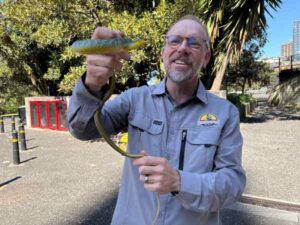
Sydney Snake Catcher founder Chris Williams said “snakes go where the food and shelter are, and that is exactly what a campsite looks like to them.

“In these areas, cleared land near water, woodpiles, long grass, sheds and outbuildings all pull in rodents and frogs, with snakes following their prey.”
Mr Williams said rural hotspots like Longreach and Dayboro have a mix of farmland, waterways and disturbed ground that rodents love.
“It is not that these areas are unusually snake-heavy; it is that the conditions created by farming, camping and tourism are ideal for both the prey and the snake,” he noted.
One area in Queensland’s Gold Coast hinterland ranked among the state’s most snake-dense, with Currumbin Valley recording more than 690 venomous snake sightings despite just six campsites in the area, only ranking sixth due to the species of snake in the area being less likely to cause severe harm.
Near the Bunya Mountains and in the Southern Downs, both popular camping and touring regions, Bell and Killarney ranked fourth and fifth in the state with Danger Index scores of 77 and 75.9, respectively.
Marsh snakes and red-bellied black snakes have been frequently spotted in these areas. In Killarney, 210 venomous snakes have been spotted across nine campsites in the area, more than 23 sightings per site.
Queensland’s most common dangerous snakes
Mr Williams said campers should “be most aware” of crowned snakes, which were commonly sighted in six of Queensland’s ten most snake-prone camping regions.
“They are shy and mostly nocturnal, tending to hide in leaf litter and under logs, so most encounters happen when campers disturb ground cover rather than spot them out in the open,” he said.
Red-bellied blacks, another commonly sighted snake, are generally shy and will retreat given the chance, according to Mr Williams.
“Brown snakes sit in between,” he said. “They are fast and alert, and more prone to standing their ground if cornered, especially in Queensland’s drier inland regions.”
Mr Williams noted that none of these species was aggressive by nature, and every one of them would rather escape than engage.
“The danger comes from surprise encounters, stepping too close, or cornering them without realising it,” he said.
What to do in a snake encounter
In the event of an encounter with a venomous snake, Mr Williams said the first thing to do was stop moving and back away slowly the same way you came.
“Do not run, do not make sudden movements, and do not try to herd it off the track,” he said.
“Most bites happen when someone tries to touch, catch or kill a snake, not from walking past one.”
Keep other people and pets well back, and give the snake room and time to move away on its own. According to Mr Williams, most snakes will move on within a minute or two.
How to reduce your chances of a snake encounter
There are also a number of preventative measures campers can take to reduce their chances of encountering a venomous snake.
Mr Williams says the biggest mistake campers make is leaving gear, shoes, tents and firewood stacked on the ground overnight without checking it in the morning.
“Snakes will use whatever shelter is available, so keep the site clear and tidy,” he said.
“Stack firewood off the ground and away from tents, do not leave rubbish or food scraps out overnight, and give sheds, woodpiles and long grass a wide berth.”
According to OCAM 4×4 Accessories director Peter Gorgievski, snakes can find their way into your vehicle or tent more easily than you may think.
“They will follow warmth and shelter into a wheel arch, an open door, a swag or a pile of gear left on the ground overnight, so keep everything zipped, sealed and off the dirt where you can,” he said.
“Avoid parking directly near long grass, dense brush, log piles, or standing water where snakes actively hunt or seek shelter,” he said, “add a rooftop tent to stay off the ground, and try to ensure any dogs have a safe area to play, whether that’s with a lead, cage or camp fencing.”
How QLD Ranks Nationally
Longreach topped Queensland’s list of most venomous camping hotspots, though its Danger Index score of 94 was not enough to break into the national top ten.
Unlike New South Wales, Victoria, Western Australia and South Australia, Queensland did not have a single camping region feature in the national top ten.











