

Tourism has always been a business of movement, but in 2026 the bigger question is whether it can also become a business of momentum economic, diplomatic and social momentum strong enough to carry destinations through an increasingly uncertain world.
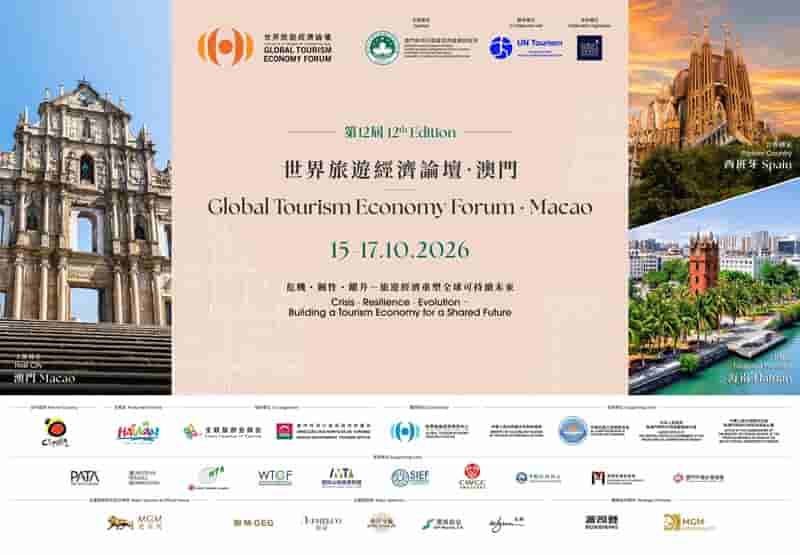
That question will sit squarely on the table when the 12th Global Tourism Economy Forum (GTEF) returns to Macao from 15 to 17 October 2026 under the theme “Crisis • Resilience • Evolution – Building a Tourism Economy for a Shared Future”. Macao is the Host City, Spain is the Partner Country, and Hainan Province is the Featured Province.
The gathering comes at a time when the travel industry is once again being asked to do more than simply fill aircraft seats, hotel rooms and restaurant tables.
Geopolitical tensions, climate-related disruption, economic uncertainty and rapidly changing traveller expectations are forcing governments and tourism businesses to rethink how growth is managed, where investment is directed and what resilience really means.
For an industry famous for selling escape, there will be very little escaping the serious issues in Macao.
Tourism’s enormous numbers bring enormous responsibility
The numbers certainly justify the attention.
UN Tourism estimated that 1.52 billion international tourists travelled worldwide in 2025, up about four per cent from 2024 and representing almost 60 million additional international arrivals.
UN Tourism said the result reflected strong travel demand, improving connectivity and the continued recovery of destinations across Asia and the Pacific.
The sheer scale of that movement confirms tourism’s enormous economic reach. It also sharpens some uncomfortable questions.
How much tourism can a destination comfortably absorb? Who benefits from growth? How quickly can an industry recover when war, weather, disease or economic shocks intervene? And can technology deliver greater efficiency without removing the human service that remains at the heart of hospitality?
Those questions carry extra weight as the industry approaches 2027, which the United Nations has officially proclaimed the International Year of Sustainable and Resilient Tourism.
The UN General Assembly adopted the resolution on 26 February 2024, calling for international cooperation and action that uses sustainable and resilient tourism to advance economic, social and environmental development.
That makes the timing of the Macao forum particularly relevant.
From conference hall to commercial opportunity
Founded in Macao in 2012, GTEF has developed into an international platform connecting government, tourism businesses, academics and global industry organisations.
According to the Forum, its previous editions have attracted more than 15,500 participants from 88 countries and regions, with hundreds of speakers drawn from the public, private and academic sectors.
This year’s event will focus on five broad areas: Resilient Governance, Technology and Innovation, The New Traveller, Culture and Identity, and Sustainable Growth.
They may sound like conference headings, and conferences certainly know how to manufacture a heading, but behind each sits a very real commercial challenge.
Technology is the obvious one.
Artificial intelligence is already changing travel planning, distribution, revenue management, marketing and customer service. The argument is no longer about whether tourism businesses will use AI. They already are.
The question is how quickly they can use it without sacrificing trust, service standards, or the useful ability to find an actual human being when a flight disappears from the departures board.
Then there is the new traveller.
Today’s customer wants value, flexibility, authenticity, personalisation, sustainability and instant digital service — preferably all at once and, ideally, before breakfast.
For airlines, hotels, cruise companies, tour operators, travel advisors and destinations, meeting those expectations while protecting margins is becoming one of tourism’s defining commercial battles.
Spain brings destination-management lessons
Spain’s role as Partner Country is particularly timely.
The country remains one of global tourism’s major destinations, while attention is increasing on spreading tourism benefits beyond established visitor hotspots and managing growth in ways that better balance economic returns, local communities and environmental pressures.
GTEF says Spain’s participation will highlight its experience in regional tourism development, destination management and sustainable transformation.
The wider industry has a lesson in this.
Destination success can no longer be measured simply by counting arrivals, producing a record number and breaking open the celebratory champagne.
A destination can be busy and profitable while still facing pressure on housing, transport, public spaces, infrastructure and resident goodwill.
Managing success may prove every bit as difficult as creating it.
Hainan puts ‘Tourism+’ on display
Hainan Province, meanwhile, arrives as GTEF’s Featured Province with a different proposition.
The tropical Chinese island is developing its tourism economy alongside wider Free Trade Port reforms and a “Tourism+” strategy linking travel with culture, health and wellness, sport, environmental conservation and rural development.
GTEF says Hainan’s island-wide special customs operations began in December 2025, while its expanded visa-free arrangements and international links are helping position the province as a more accessible gateway for international travellers and businesses.
For Australian travel businesses, that deserves attention.
Improved access, aviation links, destination investment and broader commercial reform could create opportunities for airlines, wholesalers, travel advisors, hotel companies, events businesses and tourism marketers looking towards the Chinese market.
Business matching joins the big conversations
Importantly, Macao 2026 is not being designed solely around speeches.
The official program includes business matching, a trade exhibition, travel-trade presentations and industry panels, including a session developed with UN Tourism titled “The Road to 2027: Building a Resilient Tourism Economy”.
Spain will feature in a Partner Country luncheon and presentation, while Hainan has dedicated program activity and a Featured Province dinner.
The program will also move beyond the conference floor.
On 17 October, registered delegates can join Macao cultural and tourism programs covering the city’s UNESCO-listed historic centre and its gastronomy credentials.
It is a useful reminder that tourism policy makes considerably more sense when delegates can see, taste and experience the product rather than simply admire it on another PowerPoint slide.
Macao has skin in the game
Macao is itself an appropriate stage for the debate.
Long known internationally for gaming, the destination has spent years broadening its visitor economy around gastronomy, cultural heritage, entertainment, conventions, exhibitions and major events.
Its position within the Guangdong-Hong Kong-Macao Greater Bay Area also places Macao inside a much larger discussion about transport links, investment and multi-destination tourism.
That regional element could become increasingly important.
Tourism growth across Asia may depend not only on destinations competing for visitors, but on neighbouring cities and regions cooperating to make travel easier.
Better air and ground links, simpler entry arrangements, shared itineraries and coordinated events can turn nearby destinations into complementary products rather than competitors fighting over the same suitcase.
The real test comes after Macao
GTEF 2026 therefore arrives with an ambitious brief: connect policy with commerce, resilience with investment and tourism growth with benefits that communities can actually see.
There is, of course, no shortage of international conferences promising transformation.
The tourism industry has accumulated enough declarations, strategies, frameworks and closing communiqués over the decades to wallpaper a respectable airport lounge.
The real test is what happens after the speeches.
If governments, destinations and businesses can turn discussions into practical cooperation on technology, investment, sustainability, connectivity and crisis planning, Macao 2026 may achieve something considerably more useful than another collection of conference photographs.
It could help answer the central question hanging over tourism as the sector heads towards 2027:
How can an industry serving more than 1.5 billion international travellers use that extraordinary scale not simply to recover from crises, but to evolve into something stronger, smarter and more sustainable?
Tourism has repeatedly demonstrated that it can bounce back.
The challenge now is making certain it bounces forward.
The 12th Global Tourism Economy Forum • Macao 2026 will be held from 15–17 October 2026. Official information, registration details and program updates are available from the Global Tourism Economy Forum.
By: Bridget Gomez – © 2026.
Read Time: 5 minutes.
Author Bio:
 Bridget has never been built for stillness. Of Portuguese heritage, she began as a nurse, tending veterans at the Repatriation Hospital, listening to stories as colourful as the life she was yet to live. It was worthy, steady work, but wanderlust, as always, proved louder than routine.
So, she traded starch for a backpack and disappeared for a year, chasing trains, sunsets and the occasional regrettable glass of wine. She wrote everything down: the dust, the laughter, the missteps, the magic. Those notebooks became a travel blog, then a habit, then a calling.
Eventually she found Stephen’s EGT Media, or perhaps it found her.
Today Bridget writes with heart, humour and a dash of mischief, still travelling, just now with words.











