

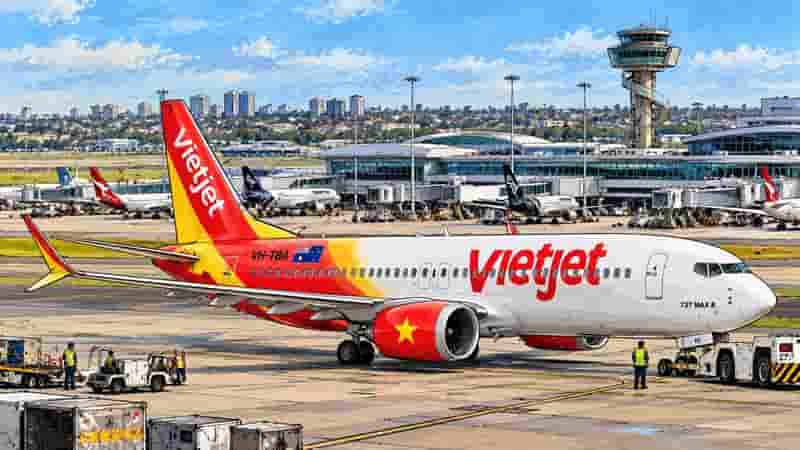
A brand-new Boeing 737 MAX has appeared on Australia’s aircraft register with Vietjet as its owner, adding considerably more substance to reports that the Vietnamese low-cost heavyweight is preparing an assault on Australia’s domestic airline market.
Aviation rumours, regulatory breadcrumbs and then there is an aeroplane.
Vietjet’s ambitions in Australia have suddenly become rather more tangible following the registration of a new Boeing 737 MAX 8 on the Australian aircraft register, providing the strongest physical evidence yet that something substantial may be taking shape behind the scenes.
The aircraft, registration VH-T8A and manufacturer serial number 63879, appeared on the Civil Aviation Safety Authority register on 23 September 2026.
Australian Aviation reports that CASA records identify Vietjet Aviation as the aircraft’s owner, with Melbourne-based Cherrie Aviation listed as its registered operator. The aircraft was manufactured in 2026.
That alone does not create a new Australian airline.
But it certainly gives the speculation wings.
Vietjet confirms Australian regulatory move
More importantly, Vietjet has confirmed an Australian operation is moving through the regulatory process.
In a statement provided to Australian Aviation, a Vietjet spokesperson said the airline had “agreed to lease the registered aircraft to an Australian entity”.
The spokesperson added: “The Australian entity is currently seeking regulatory approval to operate aircraft in Australia.”
Those two sentences are significant.
They stop well short of confirming the launch of a Vietjet-branded Australian domestic carrier, but they establish that VH-T8A is not simply an aircraft that happens to have acquired an Australian registration.
An Australian entity is involved, and it is seeking regulatory approval.
That fits with reports circulating since June that Vietjet was preparing a possible Australian domestic operation.
CAPA reported on 30 June 2026 that Vietjet had begun initial regulatory steps to establish an Australian subsidiary. It also reported that the carrier had been allocated slots at Sydney Kingsford Smith Airport for the 2026 northern winter season, although it would need an Air Operator’s Certificate before it could use those allocations.
Australian Aviation has subsequently reported earlier claims that Vietjet had applied for an Australian AOC.
An aircraft registration is not an AOC, of course, and until the required regulatory approvals are secured, there is no operational Australian domestic airline.
That distinction is crucial.
Ten aircraft or fewer than five?
One of the more interesting questions concerns just how large Vietjet’s Australian ambitions might be.
Earlier reports suggested an eventual operation involving 10 Boeing 737 aircraft.
CAPA reported in June that Vietjet had reportedly proposed commencing operations with 10 Boeing 737s.
However, separate reporting by The Australian suggested something more modest initially: fewer than five aircraft, operating between Sydney, Melbourne and Brisbane.
Vietjet has not publicly confirmed either fleet plan.
The safest conclusion, therefore, is that an Australian Boeing 737 operation is being contemplated and regulatory work is underway, but the precise launch fleet, network and timetable remain unconfirmed.
For Australia’s travel industry, however, even four or five aircraft could be significant if they were deployed intensively across the country’s busiest routes.
And Sydney-Melbourne-Brisbane is where things could become particularly interesting.
The golden triangle beckons
The Australian reported that the proposed operation could initially connect Sydney, Melbourne and Brisbane.
Again, Vietjet has not publicly confirmed those routes.
But commercially, it is not difficult to see why they’re attractive.
Sydney-Melbourne is among Australia’s most important domestic aviation markets, while Brisbane provides the third point of the country’s principal east-coast aviation triangle.
A low-cost newcomer attacking those markets would inevitably attract the attention of Qantas, Virgin Australia and, perhaps most directly, Jetstar.
For Australian travellers and travel advisors, that could mean additional capacity and another competitor fighting for the price-conscious passenger.
Whether it produces lower fares over the long term would depend upon the scale and sustainability of the operation.
Australia has been down this runway before.
Australia is littered with airline cautionary tales
Bonza entered voluntary administration in April 2024, abruptly suspending operations after attempting to establish a network largely connecting underserved Australian markets.
Rex followed with its own crisis in July 2024, entering voluntary administration and withdrawing its Boeing 737 services between major capital cities, although its regional Saab operations continued.
And long before either came Tigerair Australia, another low-cost challenger that ultimately disappeared.
The lesson is fairly straightforward: starting an airline in Australia is difficult. Challenging established airlines with enormous networks, frequent-flyer ecosystems, corporate contracts, airport infrastructure and considerable financial muscle is harder still.
Vietjet, however, would arrive with an important difference.
It isn’t an aviation start-up learning how to run an airline.
It is an established Asian low-cost aviation group with extensive operational experience, an international network and a substantial aircraft pipeline.
That doesn’t guarantee success in Australia.
It does mean a Vietjet-backed Australian operation is a different proposition from an undercapitalised newcomer starting with little more than a business plan and an optimistic press release.
Cherrie Aviation enters the picture
Then there is Cherrie Aviation.
The Melbourne-based company is listed as the registered operator of VH-T8A.
Public company records cited by Flight Hacks indicate Cherrie Aviation Pty Ltd was registered with ASIC on 20 August 2026, just over a month before the Boeing appeared on Australia’s aircraft register.
Exactly what role Cherrie Aviation will ultimately play has not been publicly explained by Vietjet.
That means caution is necessary.
It would be premature to describe Cherrie Aviation as “Vietjet Australia” or assume that the company will necessarily become the holder of any future domestic AOC.
What can be said is considerably simpler: a newly established Melbourne company is the registered operator of a Vietjet-owned Boeing 737 MAX 8, while Vietjet confirms an Australian entity is seeking regulatory approval to operate aircraft.
For aviation watchers, that’s enough to keep the binoculars polished.
Western Sydney changes the equation
Another reason Vietjet’s Australian strategy deserves close attention is that it’s already moving ahead.
Its international expansion here is already moving ahead.
On 10 August 2026, the Australian Government announced that Vietjet would commence flights between Ho Chi Minh City and Western Sydney International Airport in January 2027.
The service is scheduled to operate twice weekly before increasing to three flights a week from March, using Vietjet Airbus A330 aircraft that can carry up to 377 passengers.
Vietjet Thailand also plans to launch four weekly Bangkok-Western Sydney services from November 2027, subject to regulatory approvals.
Those international services are separate from the prospective domestic operation.
No one has confirmed that VH-T8A will operate from Western Sydney, or that the new airport would form part of an Australian domestic network.
Nevertheless, strategically, the possibilities are difficult to ignore.
A domestic operation that could feed passengers into Vietjet’s international services could eventually create something more powerful than an isolated Australian low-cost carrier.
That remains analysis, not an announced Vietjet strategy.
But it is precisely the question Australia’s travel industry should be asking now.
Could Vietjet succeed where Bonza and Rex stumbled?
The potential advantage is scale.
A Vietjet-backed operation could draw on airline expertise, aircraft purchasing power, technology, and management experience already developed elsewhere in the group.
Vietjet also knows Australia.
The airline already operates international services linking Vietnam with Sydney, Melbourne, Brisbane and Perth, while Western Sydney is now firmly on its expansion map.
Australian Aviation also reports that Vietjet had previously considered acquiring Bonza following that airline’s collapse.
That suggests Vietjet’s interest in Australia’s domestic aviation market did not suddenly begin when VH-T8A appeared on the register.
There has apparently been smoke around this particular runway for some time.
Now an aeroplane sits in the middle of it.
Why travel advisors should watch closely
For Australian travel advisors, the immediate issue isn’t whether Vietjet can topple Qantas or Virgin Australia.
It is whether another credible competitor could change the domestic airfare and capacity equation.
If the proposed airline receives regulatory approval and enters the Sydney-Melbourne-Brisbane market, its most obvious competitive confrontation may be with Jetstar, rather than the full-service end of the market.
Low fares would presumably be central to the proposition.
The greater question is whether those fares could be sustained while building the frequency, reliability and network breadth Australian passengers expect.
Plenty of questions remain unanswered.
What will the Australian carrier be called?
Who ultimately controls the operating company?
How many aircraft will it launch with?
Which airports will it serve?
When could ticket sales begin?
And most importantly: will CASA approve the operation?
Until those answers arrive, talk of a new Australian airline must remain conditional.
But something has unquestionably changed.
Three months ago, the story largely consisted of regulatory reports, airport slots and industry speculation.
Now there is VH-T8A.
A new Boeing 737 MAX 8.
Australian registration.
Vietjet ownership.
An Australian-registered operator.
And Vietjet confirmed that an Australian entity is seeking regulatory approval to operate aircraft here.
None of that proves a new domestic airline will ultimately take off.
But if Vietjet is really preparing to challenge Australia’s entrenched airline establishment, Qantas, Virgin Australia and Jetstar may soon discover that the latest competitor in their rear-view mirror is far more than another ambitious start-up.
This one has an established Asian airline group behind it.
And, importantly, it now has an Australian-registered Boeing.
By: Jill Walsh – © 2026.
Read Time: 7 minutes.
Author Bio:
 Jill Walsh has always kept a pen close and a suitcase closer. She started in media releases, then learned the trade by escorting press trips around the world, discovering which stories travel well and which need a sharper edit.
Before long, she wasn’t just promoting destinations; she was representing them, translating civic ambition and local pride into words people actually wanted to read. These days, semi-retired and happily so, Jill has traded departure boards for deadlines, joining old friend and colleague Stephen at Global Travel Media on a casual basis.
Her patch is the business end of wanderlust: balance sheets, route maps, tender wins and the numbers that quietly decide where travellers go. She writes with dry humour, clean prose and an old-school respect for facts a steady voice when the market starts shouting.











