

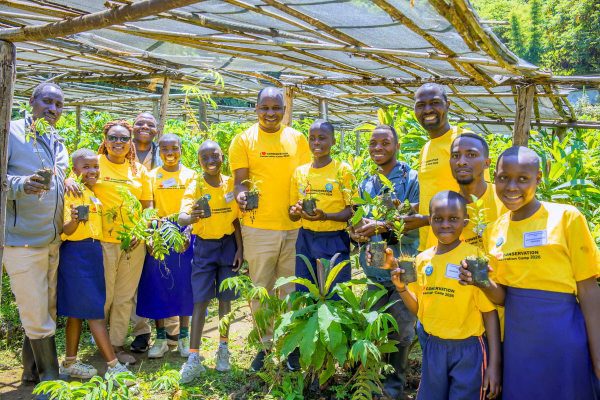
One hundred young learners from the communities bordering Rwanda’s Volcanoes National Park (VNP) spent four days discovering the wild on their doorstep, at 2026 Conservation Camps organised by Children in the Wilderness (CITW) Rwanda and partners. Hosted across two sessions in early August at the The Ellen DeGeneres Campus of the Dian Fossey Gorilla Fund (DFGF) and at Wilderness Bisate, the camps have grown from 40 children and four schools in one district in 2019, to 100 children from 10 schools across four districts.
Organised by CITW Rwanda in partnership with the Dian Fossey Gorilla Fund (DFGF), Muhisimbi Voice of Youth in Conservation, and Conservation Heritage-Turambe (CHT), the camps were run in the first two weeks of August 2026. The participants, all Grade 5 learners who were selected as the most motivated members of their Environmental Clubs, were bussed in each morning with their teachers, from their schools across the Musanze, Burera, Nyabihu and Rubavu districts bordering the park.
‘We are proud that the programme continues to expand and reach more children, from more districts,’ said Aline Umutoni, CITW & Community Manager for Wilderness Rwanda. ‘What made the camps especially significant was inviting the parents to join us on the closing days, so they could see for themselves what their children have been learning.’
Workshops opened with energiser games before moving into the ‘Web of Life’ and ‘Food Chain’ games – including lessons on how ecosystems function as interconnected systems. From there the children explored gorilla behaviour and ecology, Rwanda’s national parks, the role of birds in healthy ecosystems, and the threats facing biodiversity in VNP and beyond.
Guest mentors joined the sessions to share their knowledge and experience, among them Gorilla Doctors, the Rwanda Development Board’s (RDB) Community Conservation Warden for VNP, Wilderness Bisate guides, and Wilderness Rwanda staff. Between workshops there was time for arts and crafts, games and songs, and shared meals.
On the closing day of each camp the children travelled to Wilderness Bisate, where the lodge’s agronomists walked them through the indigenous tree nursery, from seed to sapling to tree. The children had no shortage of questions, which continued during the nature hike that followed. Each child then chose an indigenous sapling of their own to take home and plant, after the agronomists demonstrated how to care for them.
The first Conservation Camp in Rwanda took place in 2019. Including this year’s two camps, CITW Rwanda and partners have now hosted 480 learners in total.
Manzi Kayihura, Wilderness Rwanda Executive Chairman, joined the children on the camps’ closing days. ‘When a child grows up respecting nature and carries these values throughout their life, that is when you create a strong and sustainable system,’ he said. ‘We hope these children will go on to support conservation, understand its value, and make it part of their own lives, because tourism without the participation and support of local communities has little meaning.’
He encouraged the parents present to work alongside their children and put the lessons into practice, so that what they learnt becomes everyday behaviour rather than theory, and thanked all those involved in preparing the camps, as well as the donors whose support made them possible.
‘By educating these children from an early age, we help them understand the relationship between people, wildlife and the environment,’ said Felix Ndagijimana, Country Director of DFGF Rwanda. ‘They will go on to play an important role in conserving and sustainably managing Rwanda’s natural resources for the future.’











