

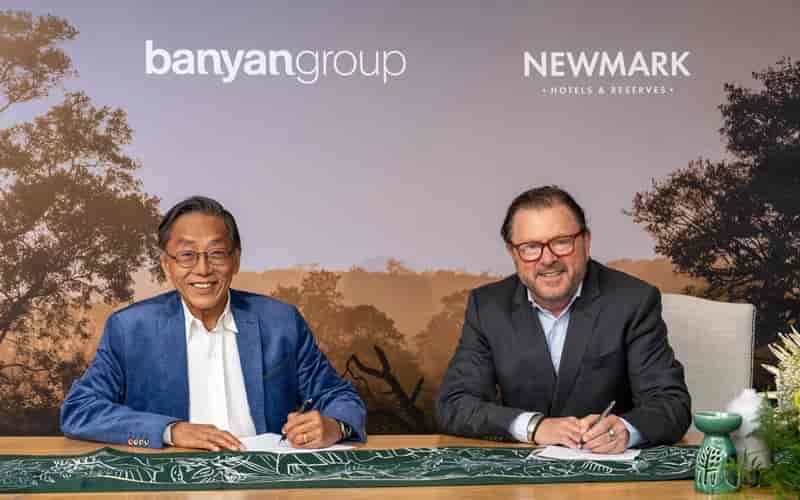
Banyan Group has planted a considerably larger flag across Africa, taking a majority stake in Cape Town-based Newmark Hotels & Reserves in a deal that adds 26 hotels, lodges and reserves across seven countries to the global hospitality group’s expanding portfolio.
The transaction, announced on 17 September 2026, is more than tidy corporate housekeeping. It is a strategic bet on Africa’s rapidly growing tourism economy, its appetite for distinctive nature-led accommodation and, perhaps most importantly, the value of local operating knowledge in a continent where hospitality is never one-size-fits-all.
Under the agreement, Banyan Group is acquiring an initial majority interest in Newmark under a phased structure intended to lead to full ownership over time. Newmark will continue to trade under its own name, with founder and chief executive Neil Markovitz and the existing management team remaining in place. Its property brands, owner relationships, commercial arrangements and day-to-day operating model are also set to remain unchanged.
That continuity matters.
Hotel acquisitions can occasionally arrive with all the subtlety of a bulldozer entering a botanical garden. Banyan’s approach, at least on the terms announced, appears considerably more measured: acquire the platform, preserve local expertise, then add international distribution, development muscle and a larger commercial network.
Twenty-six properties and considerable African reach
Newmark joins Banyan Group as a collection brand, bringing a managed portfolio spread across Mauritius, Namibia, Nigeria, South Africa, Tanzania, Uganda and Zimbabwe.
With the addition, Banyan says its enlarged portfolio will comprise nearly 130 hotels, resorts and reserves, more than 30 branded residences and over 140 spas and galleries across 14 hospitality and residential brands in 28 countries.
For Banyan Group founder and executive chairman Ho Kwon Ping, the attraction is as much philosophical as geographic.
“We welcome Newmark to Banyan Group with confidence in the strength of the business it has built in Africa and the entrepreneurial spirit that has shaped it. We see in Newmark many of the qualities that shaped Banyan Group from the beginning: independence of thought, a long-term view and the conviction to build something distinctive. We look forward to what we can build together across Africa.”
That final phrase is worth lingering over.
Africa is no longer a peripheral growth story for international hospitality groups. Increasingly, it is a strategic one.
According to UN Tourism data for 2025, Africa welcomed 81 million international tourists, an 8 per cent increase on the previous year and the strongest growth recorded among global regions.
The World Travel & Tourism Council says Travel & Tourism contributed US$228 billion to Africa’s economy in 2025, equivalent to 7 per cent of regional GDP. WTTC forecasts the contribution will increase to approximately US$241 billion in 2026, with the sector expanding by 5.4 per cent.
That sort of growth curve tends to get hotel executives reaching for maps.
More than dots on a map
Yet the Newmark acquisition gives Banyan something rather more useful than additional dots.
It adds operating depth across city hotels, safari lodges, private game reserves, island retreats, wellness properties and nature-based accommodation segments that fit neatly with Banyan’s established emphasis on design, sustainability and experiential travel.
Newmark was founded in 2007 by Neil Markovitz, whose Cape Town hospitality career stretches back to 1990. One of the group’s early properties was the Victoria & Alfred Hotel at Cape Town’s V&A Waterfront, a converted 1904 warehouse overlooking the harbour and Table Mountain.
Since then, Newmark has developed a portfolio with a distinctly African sense of place.
In South Africa’s Waterberg region, QWABI Private Game Reserve spans 11,000 hectares within the Waterberg Biosphere and combines Big Five safari tourism with rehabilitating land formerly used for agriculture.
In the Greater Kruger ecosystem, Motswari Private Game Reserve marks its 50th anniversary in 2026 and has been part of the Newmark portfolio since 2013.
Further north, Gorilla Heights Lodge sits on the edge of Uganda’s UNESCO-listed Bwindi Impenetrable National Park, home to endangered mountain gorillas. Newmark also operates island and coastal properties in Zanzibar and Mauritius, while Future Found Sanctuary on the slopes of Table Mountain adds a regenerative wellness dimension to the collection.
Markovitz said joining Banyan Group would broaden Newmark’s international reach without stripping away the identity that has underpinned its growth.
“Over nearly two decades, Newmark has built its business through strong teams, trusted owner and partner relationships and a portfolio where each property retains its own identity. Joining Banyan Group gives us greater international reach and access to a wider network of expertise while retaining what has made Newmark successful. It also gives us greater scope to introduce travellers around the world to the destinations and experiences across our portfolio.”
What the deal means for travellers and advisors
For travel advisors and industry partners, that point may prove one of the most commercially significant elements of the deal.
Newmark’s properties will remain bookable through their existing channels, with confirmed reservations honoured under existing terms.
Over time, however, Newmark properties are expected to become available through Banyan Group’s booking platforms and participate in withBanyan, the group’s guest-recognition program.
That should give Newmark access to a broader international customer base, while Banyan gains a ready-made African management platform with established owners, local teams and destination expertise.
In other words, Banyan does not have to learn every market from scratch, while Newmark does not have to construct global distribution from the ground up.
For travel advisors, the gradual distribution integration could also make previously less familiar African properties more visible through an international hospitality ecosystem, particularly for clients seeking safari, conservation, wellness and experiential travel.
Africa becomes a long-term play
Banyan Group president and chief executive Eddy See described Africa as a long-term growth market and highlighted Newmark’s management platform, owner relationships and development pipeline as important additions to Banyan’s “asset-right” growth strategy.
“Africa is a long-term growth market for Banyan Group. Newmark brings an established management business, long-standing owner relationships and strong operating capabilities that deepen our presence in the region and strengthen our asset-right model. Its local market knowledge and development pipeline, combined with Banyan Group’s international sales, distribution and development network, give us a stronger platform to pursue the right opportunities across Africa.”
The acquisition also arrives at a telling point in Banyan Group’s evolution.
The company grew from its first Banyan Tree resort in Phuket, developed on rehabilitated former tin-mining land, into an international multi-brand hospitality company.
In November 2025, it opened its 100th hotel, Mandai Rainforest Resort by Banyan Tree in Singapore, a symbolic homecoming for a group that had spent more than three decades building much of its reputation beyond its home market.
Africa had already been moving higher on Banyan’s development agenda.
Before the Newmark transaction, the group’s African footprint included four hotels and four spas across Morocco, Mauritius, South Africa and Tanzania, including Banyan Tree Tamouda Bay, Marrakech Riads, Angsana Heritage Collection and Ubuyu, a Banyan Tree Escape, its first safari lodge.
The company is also preparing to enter West Africa with Dhawa Ouidah in Benin. Newmark immediately extends Banyan’s operational presence into Namibia, Nigeria, Uganda and Zimbabwe.
Scale without losing the safari soul
The strategic logic is therefore fairly clear.
Banyan gains scale, specialist safari and nature-hospitality expertise, new owner relationships and a development pipeline across some of Africa’s most compelling travel markets.
Newmark gains global distribution, sales support, development expertise and access to a substantially larger hospitality ecosystem.
The delicate part will be integration.
Banyan has stressed that Newmark will retain its leadership, identity, direct channels and local operating model. Deputy chief executive Ho Ren Yung said preserving the individual character of the properties would be central to the partnership, particularly where communities, culture and the natural environment are intrinsic to the guest experience.
“Newmark’s hotels, lodges and reserves are closely connected to the places in which they operate. We want to preserve that local approach, particularly in nature-based and wildlife hospitality, where culture, communities and the natural environment are integral to the guest experience. As we grow together, we want each property to retain the character and sense of place that have shaped its success.”
That is sensible.
Travellers booking a private reserve in the Waterberg or a gorilla-focused lodge beside Bwindi are not generally looking for an experience lifted from a corporate template in Singapore, London or New York.
They are buying place, story and authenticity three commodities remarkably easy to dilute once the branding department becomes overexcited.
If Banyan can provide international scale without sanding off those local edges, the partnership could become an instructive model for expansion in experience-led hospitality.
A broader hotel industry shift
It also reflects a broader change in international hotel strategy.
Major hospitality groups are increasingly using management platforms, collections and strategic partnerships to expand without imposing one rigid operating formula on every property.
That flexibility is particularly relevant in destinations where ownership structures, conservation responsibilities, community partnerships, and cultural relationships can be just as important as the number of rooms on the inventory sheet.
For Banyan Group, Newmark is therefore not merely an acquisition of 26 properties.
It is an acquisition of regional knowledge, operating relationships and access to a tourism economy growing faster than the global average.
For Newmark, the attraction is equally straightforward: remain recognisably Newmark while gaining the reach of a much larger international hospitality organisation.
And for travellers?
Ideally, very little changes at check-in except that some of Africa’s more distinctive hotels, lodges and reserves may soon become considerably easier to discover, book and return to.
By: Octavia Koo – © 2026.
Read Time: 7 minutes.
Author Bio:
 Octavia Koo arrived in Australia in the early eighties with little fuss and a good eye. Sydney suited her. At UNSW, she studied Arts, then found her footing in graphic design before drifting, quite naturally, into the digital side of things, building websites and shaping words that made people want to stay.
Singapore followed, and with it, the fast pace of tourism platforms and ITB Asia. Long before SEO became a buzzword, Octavia understood how stories travelled online. That’s where she met Stephen, and the seed for something more was planted.
A few years later, she joined Global Travel Media.
Today, Octavia works with quiet assurance, blending art, instinct and experience to produce stories that don’t shout; they simply work and linger.











