

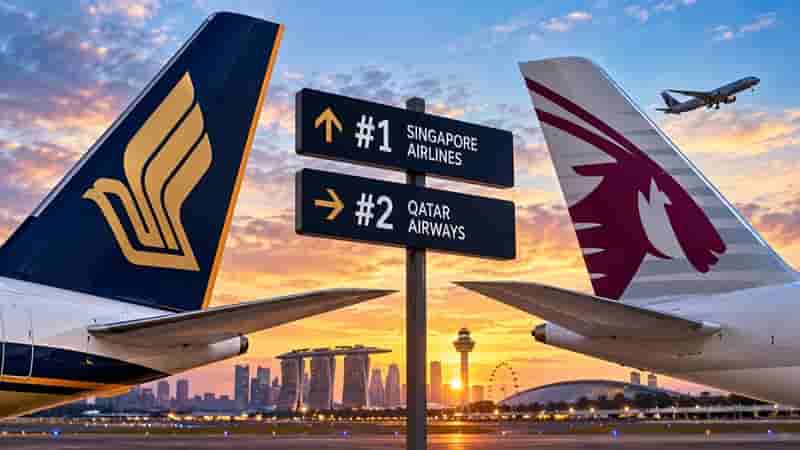
Singapore Airlines has reclaimed aviation’s most coveted passenger-voted crown, knocking Qatar Airways from the top of the Skytrax World Airline Awards and putting Asia firmly back in the premium-travel spotlight.
Singapore Airlines has been named the World’s Best Airline for 2026, ending Qatar Airways’ two-year run at the top and claiming the prestigious Skytrax title for the sixth time.
Announced at London’s Langham Hotel on 18 September, the result saw Singapore Airlines rise from second place in 2025 to first, while nine-time winner Qatar Airways slipped to second. Cathay Pacific retained third place, ANA All Nippon Airways climbed to fourth, and Turkish Airlines completed the top five.
It was hardly a decision made around a small table over tea and biscuits. The 2026 Skytrax awards were based on a global survey of more than 24.8 million travellers, who rated more than 300 airlines between September 2025 and August 2026.
For Singapore Airlines, the win goes beyond bragging rights.
The carrier also collected Best Airline in Asia, World’s Best Economy Class and World’s Best Economy Class Onboard Catering, while low-cost subsidiary Scoot was named Best Long Haul Low-Cost Airline for the sixth consecutive year.
Singapore Airlines chief executive Goh Choon Phong credited the result to the carrier’s staff and passengers, saying the award reflected their dedication and professionalism and their commitment to service and operational excellence.
Qatar loses the crown, but certainly not the jewels
Anyone tempted to interpret Qatar Airways’ fall to second place as evidence of a serious stumble should probably keep the champagne cork in the bottle.
The Doha-based carrier collected four major awards and retained its Skytrax 5-Star Airline rating.
Qatar Airways was named World’s Best Business Class for the 13th time, Best Airline in the Middle East for the 14th time and World’s Best Business Class Lounge for the eighth time, for its Al Mourjan Business Lounge – The Garden.
It also won the inaugural World’s Best Onboard Wi-Fi award, reflecting its rapid deployment of Starlink connectivity.
Qatar Airways says Starlink is now installed on more than 150 widebody aircraft, with more than 25 million passengers connected on more than 96,000 flights. The airline says it can operate up to 340 Starlink-enabled flights a day.
So, while Singapore has taken possession of the crown, Qatar remains very much in the palace.
Asia dominates the sharp end
Perhaps the bigger story for the travel industry is the extraordinary strength of Asian airlines in the 2026 rankings.
Singapore Airlines, Cathay Pacific and ANA occupy three of the world’s top four positions. Hainan Airlines ranks eighth, Japan Airlines ninth, Korean Air tenth, EVA Air 11th and STARLUX Airlines 13th.
STARLUX produced one of the year’s more notable rises, climbing from 18th in 2025 to 13th this year and taking the title of World’s Cleanest Airline.
Cathay Pacific, meanwhile, was named World’s Best Cabin Crew.
The Middle Eastern heavyweights remain formidable. Qatar sits second overall and Emirates sixth, although Emirates has slipped from fourth place in 2025. Emirates nevertheless retained considerable product prestige by winning World’s Best Airline Inflight Entertainment.
The results illustrate just how fiercely contested the premium international market has become. No single recipe now defines the world’s best airline.
Singapore has emerged on top overall and in economy class. Qatar continues to dominate business class and has established a formidable position in high-speed onboard connectivity. Cathay leads in cabin crew, Emirates in entertainment, and STARLUX in cabin cleanliness.
For passengers, that’s good news. For airline executives trying to keep up with one another, it may be less relaxing.
Qantas climbs the global ladder
A significant Australian story is also buried among the international heavyweights.
Qantas has climbed from 14th globally in 2025 to 12th in 2026, putting the Flying Kangaroo immediately behind EVA Air and one position ahead of STARLUX.
Qantas was also named Best Airline in Australia/Pacific, ahead of Air New Zealand in second place and Virgin Australia in third.
Virgin Australia ranked 37th globally, down from 34th in 2025.
For Qantas, the improvement provides a useful international measure of passenger perceptions as the airline continues investing in fleet renewal, lounges and long-haul products.
What does “world’s best” actually mean?
There is an important distinction for travellers and travel advisors.
Skytrax’s World Airline Awards measure passenger opinion across the airline experience. They should not be confused with airline safety rankings or other “best airline” awards produced using different methodologies.
That distinction matters because no universally recognised scientific measure can objectively declare one airline “the best” in every respect.
A corporate traveller buying business class between Sydney and London may value privacy, lounges, connectivity and schedule frequency. A family travelling economy to Europe may care considerably more about fares, seat comfort, baggage, catering and connections.
Skytrax nevertheless provides one of aviation’s largest passenger-survey snapshots, and 24.8 million responses make the 2026 result difficult for the industry to ignore.
Singapore Airlines can therefore enjoy its sixth Skytrax world title.
Qatar Airways, meanwhile, still owns the world’s highest-rated business class according to the same passengers.
In premium aviation’s increasingly expensive game of musical chairs, Singapore has grabbed the best seat for 2026.
And judging by the company sitting right beside it, Qatar will want that seat back.
By: Michelle Warner – © 2026.
Read Time: 4 minutes.
Author Bio:
 Michelle Warner has always carried stories the way others carry passports lightly, faithfully, and with purpose. She learned her craft in newsrooms, shaping sentences with care, before swapping deadlines for departures as a flight attendant with some of the world’s great airlines. Years aloft sharpened her eye for character and deepened her fondness for the small, dignified rituals of travel, the quiet kindness of strangers, the poetry of arrival, the patience learned between time zones.
Now grounded by choice, Michelle has come home to writing with the same calm authority she once brought to turbulent cabins. Her prose blends an editor’s discipline with a traveller’s wonder, tinged with humour and reverence for travel’s golden age. Each piece feels like a handwritten boarding pass, gracious, observant, and unmistakably alive.











