

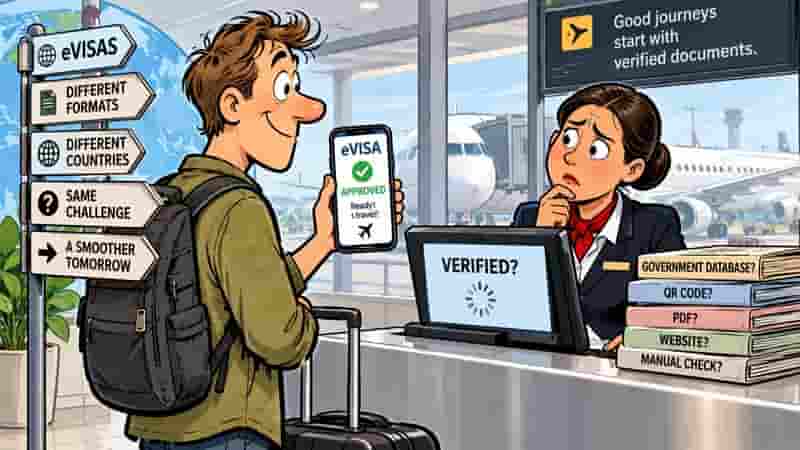
The humble visa sticker is rapidly becoming another relic of international travel.
Governments are embracing electronic visas; passengers can increasingly obtain permission to travel without visiting a consulate, and smartphones have replaced yet another piece of paper in the traveller’s increasingly empty wallet.
However, there is a rather sizeable catch.
The visa may have gone digital, but the airline standing between the passenger and the aircraft still needs to know whether that electronic permission is genuine.
It sounds straightforward. In practice, it can be anything but.
The International Air Transport Association (IATA) says more than 100 countries now issue eVisas, yet airlines still lack standardisation in how they verify them.
Proof might arrive as an email, PDF or QR code. It might require a query of a government website, a direct connection to an immigration database or, in some cases, manual inspection of supporting documentation.
Welcome to one of aviation’s more peculiar digital-age problems: the visa has moved online, but the verification systems have not all moved together.
Getting it wrong can cost airlines dearly
For passengers, the process can appear beautifully simple. Apply online, pay the fee, receive approval and head for the airport.
For airlines, things are considerably more complicated.
Before allowing someone to board an international flight, the carrier must determine whether the passenger has the documentation required for the destination.
And an incorrect decision can carry a considerable price.
IATA says airlines can face fines and removal costs averaging US$9,000 per passenger when they transport inadequately documented travellers.
Suddenly, the check-in agent asking to see that visa again does not seem quite so bureaucratic.
The problem is not necessarily the passport itself.
IATA said in June 2026 that problems in automated document checking are more likely to involve visas, residence permits, eVisas, travel authorisations and the eligibility rules attached to them.
Technology can already examine security features, detect signs of tampering and feed validated information into airline systems. The bigger challenge is ensuring the many different government authorisations and airline processes can communicate reliably.
In other words, this is increasingly an interoperability problem rather than simply a document-scanning problem.
Airlines need an answer governments can confirm
IATA believes greater international standardisation is the way forward and has highlighted two mechanisms that could make electronic travel authorisations considerably easier for airlines to verify.
The first is interactive Advance Passenger Information, or iAPI.
During check-in, an airline sends passenger information electronically to the destination government and receives a real-time response. This lets the government confirm whether the passenger meets the relevant requirements for the journey.
IATA says airlines report documentation-compliance rates up to 20 times higher for countries with comprehensive iAPI systems than for those relying on manual checks.
One major problem: according to IATA, fewer than 30 countries currently operate iAPI systems.
The second mechanism is the International Civil Aviation Organisation Digital Travel Authorisation, or DTA.
IATA describes the DTA as providing standardised, digitally signed proof that an electronic authorisation has been issued. Instead of every country producing a different confirmation form, essential information can be presented in a consistent, authenticable format.
The two mechanisms can work together. iAPI enables an airline to verify a passenger’s status directly with a government in real time, while a DTA can provide standardised proof of the authorisation, including where an iAPI check is unavailable.
The technology is therefore hardly science fiction.
Getting governments around the world to adopt compatible systems is the considerably larger assignment.
ICAO builds another piece of the digital puzzle
There has also been significant progress this year.
In March 2026, ICAO launched its next-generation Public Key Directory, or PKD, designed to help governments, airlines and other trusted parties authenticate electronic passports and digital travel documents.
The system allows participating states to exchange the digital security certificates used to establish whether an electronic document is genuine and whether its information has been altered.
Importantly, ICAO says the upgraded system can support a broader range of travel credentials, including digital visas and electronic IDs.
At its March launch, the PKD included 107 of ICAO’s 193 Member States, with ICAO encouraging wider participation.
That development matters because digital travel requires something more sophisticated than replacing a paper document with a screen.
It requires trust and a reliable way to establish that the information on that screen came from the authority that issued it.
Australia shows how electronic checks can work
Australia provides a useful example of a mature electronic visa environment.
The Department of Home Affairs says an Australian visa is electronically attached to the passport used for the visa application.
Australia’s Advance Passenger Processing system also enables international airline crew to check a passenger’s visa status before a flight departs for Australia.
Home Affairs provides an important safeguard where electronic verification does not go according to plan. If a passenger is certain their visa is valid, but the airline cannot verify the visa status, the department advises the carrier to contact Home Affairs to confirm the traveller’s immigration status.
That is an important distinction.
Electronic systems can greatly simplify the process, but a reliable escalation path is still needed when the computer says something other than what the passenger expects.
It is also a useful reminder for travellers to keep the passport information linked to their visa current and to travel with the appropriate valid documentation.
Britain puts eVisas centre stage
The United Kingdom provides another timely case study.
Britain has transitioned to a digital immigration system in which an eVisa provides a digital record of a person’s identity and immigration status.
On 1 July 2026, UK Visas and Immigration stopped issuing visa vignette stickers to successful new applicants, who generally now receive an eVisa instead.
The UK Government tells travellers to ensure their current passport or travel document is correctly associated with their UKVI account and that the details supplied to their carrier exactly match their immigration record.
There is good reason for that advice: the government warns that a carrier may not allow a passenger to travel if the details are incorrect.
The system also demonstrates what sophisticated airline verification can look like.
UK carrier guidance says that where a passenger holds a digital eVisa, a “0A – Valid Permission to Travel Found” response delivered through iAPI messaging, Direct REST or web interfaces constitutes satisfactory evidence of permission to travel.
And if automated verification fails, UK guidance provides alternative mechanisms through which travellers can demonstrate their status and carriers can seek assistance.
That’s why it would be misleading to say airlines simply cannot verify eVisas.
Many can.
The problem is that methods vary between countries, immigration systems and different forms of travel authorisation.
The visa has changed. The responsibility hasn’t
There is a delicious irony in all this.
International travel spent decades relying on one of the simplest verification systems imaginable: open the passport, find the visa and inspect it.
Digital immigration promises something far more sophisticated, secure and convenient.
But until systems become more interoperable, airline staff may continue navigating an international assortment of government databases, QR codes, PDFs, websites and electronic responses.
IATA is therefore urging governments to think beyond issuing visas digitally and consider how airlines thousands of kilometres away will authenticate those visas.
That is the real challenge.
Nobody seriously wants a return to queues outside consulates, passport stickers and folders bulging with photocopies. Digital visas can make international travel faster, simpler and more secure.
But digitisation alone is not the finishing line.
For the traveller, an eVisa can mean permission to travel arriving conveniently on a screen.
For the airline, it must mean something more important: permission that can be reliably authenticated before the aircraft leaves the gate.
Until those two sides of the equation connect more consistently around the world, the eVisa revolution will remain a remarkably modern system with one decidedly old-fashioned complication.
Someone still has to check the paperwork.
By: Jill Walsh – © 2026.
Read Time: 5 minutes.
Author Bio:
 Jill Walsh has always kept a pen close and a suitcase closer. She started in media releases, then learned the trade by escorting press trips around the world, discovering which stories travel well and which need a sharper edit.
Before long, she wasn’t just promoting destinations; she was representing them, translating civic ambition and local pride into words people actually wanted to read. These days, semi-retired and happily so, Jill has traded departure boards for deadlines, joining old friend and colleague Stephen at Global Travel Media on a casual basis.
Her patch is the business end of wanderlust: balance sheets, route maps, tender wins and the numbers that quietly decide where travellers go. She writes with dry humour, clean prose and an old-school respect for facts a steady voice when the market starts shouting.











