

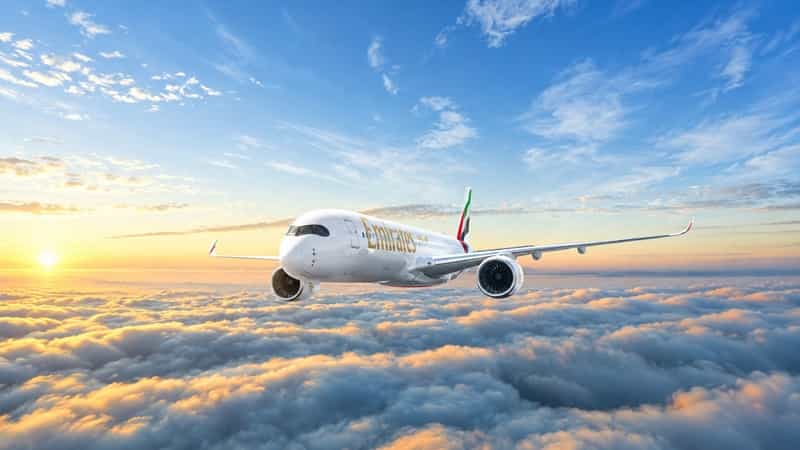
Emirates has turned Arabian Travel Market 2026 into something resembling a global matchmaking bureau for the travel industry, only with considerably more aircraft, considerably fewer awkward introductions and a very clear commercial purpose.
Across the opening days of ATM in Dubai, the airline announced a broad sweep of partnerships spanning tourism boards, cruise, online travel, retail, banking, sports tourism, business councils and destination marketing.
Seven tourism-board agreements led the opening salvo, followed by three more destination partnerships and a string of commercial tie-ups designed to connect Emirates with more travellers, more often, and at more stages of the booking journey.
The strategy is striking less for the number of signatures than for the range of audiences Emirates is trying to reach.
This is not simply a collection of ceremonial Memoranda of Understanding. The agreements stretch from destination promotion in Africa and the Indian Ocean to Chinese digital distribution, cruise-passenger logistics, Finnish and Vietnamese business networks, sports packages, airline loyalty and airport retail.
For the travel trade, that matters.
Airlines have always sold seats, but the largest network carriers increasingly want influence over the whole travel funnel: inspiration, search, booking, packaging, loyalty, ground experience and repeat purchase. Emirates’ ATM activity is a particularly vivid example of that shift.
According to Emirates, its first major round of ATM 2026 agreements involved tourism organisations representing the Seychelles, Mauritius, Madagascar, Sharjah, Malaysia, Finland and Western Norway. The airline says the partnerships are intended to build awareness in source markets across a network of nearly 140 destinations and convert that interest into bookings and visitor flows.
Indian Ocean islands get a bigger global shop window
The Indian Ocean featured prominently.
Emirates renewed its partnership with the Seychelles Tourism Board and the Ministry of Tourism and Culture, extending a relationship first established in 2013.
The airline currently operates two daily flights to Mahé. Emirates said Seychelles visitor arrivals rose 13 per cent in 2025 to nearly 400,000, from 353,000 a year earlier.
Tourism Seychelles had already reported strong year-on-year growth during 2025, with arrivals surpassing the previous year’s total before the end of November.
The refreshed agreement will cover joint marketing and familiarisation trips for media and travel-trade partners.
That may sound familiar: famils are as old as the tourism brochure, but the modern version is increasingly data-led, market-specific and designed to convert reach into measurable sales.
Mauritius is receiving similar attention.
Emirates and the Mauritius Tourism Promotion Authority renewed their agreement after more than two decades of cooperation. Emirates said Middle East arrivals to Mauritius rose 10.5 per cent in the first half of 2026 compared with the same period in 2025.
The carrier currently offers three daily flights and says total weekly seat capacity to and from Mauritius stands at 19,096 in both directions.
Madagascar, meanwhile, is looking further ahead.
Its Ministry of Tourism and Handicrafts will work with Emirates on advertising, trade incentives, tailored packages and familiarisation travel as the destination pursues a target of one million tourists by 2028.
It is a classic aviation-tourism equation: an attractive destination product is only half the battle if consumers cannot find convenient, saleable air access.
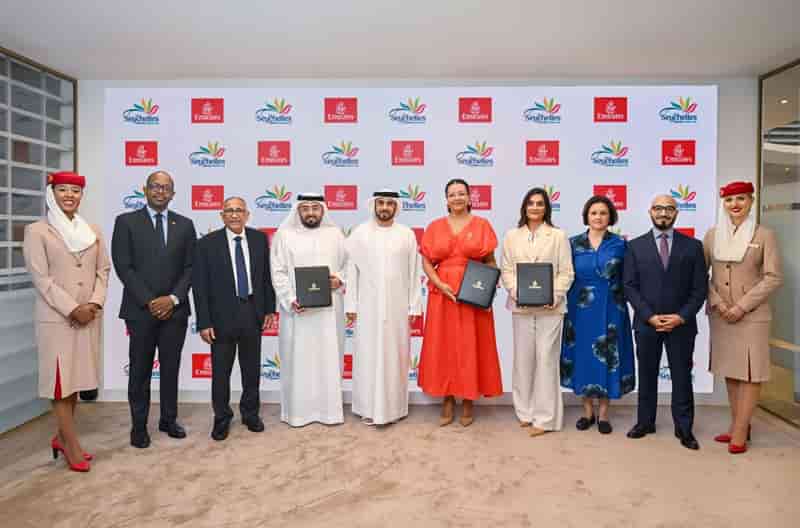
ATM 2026 – Emirates Seychelles
Sharjah, Malaysia and a wider UAE tourism play
Closer to Emirates’ home base, the airline renewed its partnership with the Sharjah Commerce and Tourism Development Authority.
The relationship includes joint sales calls, workshops, roadshows, familiarisation trips and trade support across markets including the GCC, India, China, East Asia and Europe.
Emirates also supports Sharjah in markets where the emirate lacks local representation.
Khalid Jasim Al Midfa, Chairman of the Sharjah Commerce and Tourism Development Authority, described the renewal as “a strategic step in advancing Sharjah’s tourism agenda”.
That cooperation also points to a broader UAE proposition.
Emirates works with Dubai’s tourism authorities and Abu Dhabi’s Department of Culture and Tourism, while the Sharjah agreement gives the airline another reason to encourage travellers to see the UAE as more than a single-stop city break.
For agents and tour operators, that creates room for multi-emirate itineraries: Dubai for the gateway and headline attractions, Sharjah for heritage and culture, and Abu Dhabi for another major layer of leisure, arts and events.
In a market where travellers increasingly ask what else they can add to a long-haul trip, geography becomes product.
Malaysia is another major volume play.
Emirates and Tourism Malaysia renewed a one-year MoU supporting the Visit Malaysia 2026 campaign. Tourism Malaysia has publicly set a target of 47 million international visitor arrivals for 2026.
Emirates says its contribution includes 21 weekly flights between Kuala Lumpur and Dubai, plus onward connectivity through a codeshare with Batik Air.
The logic is straightforward: Malaysia wants scale, Emirates wants demand, and the trade wants inventory it can package and sell with confidence.
Finland gets a new route and a new global sales story
One of the most commercially interesting agreements is with Visit Finland.
Emirates will begin daily Dubai–Helsinki services on 1 October 2026 using the Airbus A350.
The airline says the service will be the only year-round direct link between Finland and the UAE. The route also brings Emirates Premium Economy to the Finnish market from launch.
The Visit Finland MoU is designed to promote the country across East and Southeast Asia, West Asia, Australasia, the Middle East and Africa.
For Australian sellers, that last-but-one word is worth circling in red pen: Australasia is explicitly part of the target map.
Finland’s national tourism strategy for 2025–2028 aims to lift total tourism demand to €20 billion by 2028 and increase the economic value generated by international visitors. Its strategic priorities include accessibility, sustainability, digital change and competitiveness.
Emirates and Visit Finland will promote the country across four broad tourism regions: Lakeland, the Coast and Archipelago, Lapland and Helsinki.
That creates a year-round proposition rather than leaving Finland to rely on the familiar winter formula of snow, Santa and a suitcase full of thermals.
Western Norway is also on the list.
Emirates and Fjord Norway, the region’s official tourist board, have agreed to cooperate on inbound tourism promotion.
The opportunity is obvious: dramatic scenery sells beautifully, but long-haul demand grows faster when aviation, destination and distribution pull in the same direction.
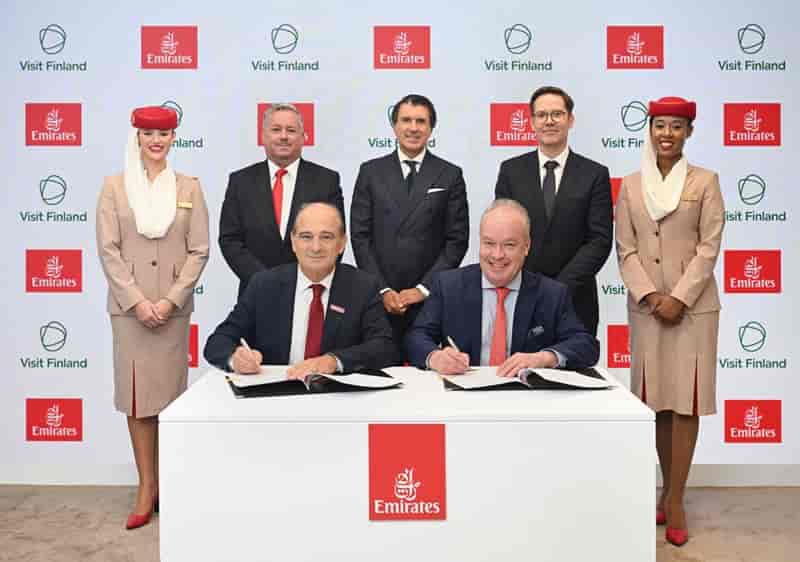
ATM 2026 – Emirates Visit Finland
Three more destination deals widen the map
By 16 September, Emirates had added three more destination-focused partnerships.
The airline partnered with Mozambique’s National Agency for Tourism Development and Investment, ANDITUR, to explore ways to promote the country in international markets and improve connectivity through airline partnerships across Africa.
Emirates highlighted Mozambique’s roughly 2,500 kilometres of coastline, beach and ocean experiences, culture, food and city tourism as key parts of its visitor proposition.
The Kenya Tourism Board also signed a partnership agreement with Emirates to strengthen inbound tourism.
Emirates already describes Kenya as one of the most consistently in-demand destinations on its African network. The new arrangement is intended to support growth from both established and emerging markets.
Then there is Spain.
Emirates Holidays and the Spain Tourism Office signed an MoU to increase inbound tourism from the Middle East through campaigns, seasonal promotions, and packaged holidays combining Emirates flights, accommodation, local experiences, and added benefits.
That matters because it moves beyond brand advertising into something the trade can actually sell.
Awareness is pleasant. A bookable package with air, bed nights and experiences is considerably more useful.
China: distribution meets digital loyalty
Emirates’ ATM push also has a strong Chinese digital component.
The airline signed an MoU with Alibaba Fliggy, one of China’s largest online travel platforms.
The collaboration covers co-branded marketing, customer engagement and potential links between Emirates Skywards and Fliggy’s membership ecosystem.
It also renewed its long-running strategic partnership with Huawei.
Emirates has worked with Huawei since 2020, including integrating the Emirates App into Huawei’s ecosystem. The renewed relationship will focus on marketing, digital innovation, personalised travel solutions and new media opportunities in China.
Taken together, the two agreements show how airline distribution is changing.
A traveller may still visit an airline website and type in a city pair, but increasingly the sale can begin inside an ecosystem, a membership platform, a mobile device or an online travel marketplace.
Being visible at the right digital moment can matter almost as much as adding another billboard on the road to the airport.
Emirates and MSC Cruises push fly-cruise deeper
One of the more substantial commercial agreements is Emirates’ expanded MoU with MSC Cruises.
The two companies have worked together for more than a decade. Their latest agreement broadens cooperation across fly-cruise distribution, air-sea product integration, crew travel and loyalty.
Emirates and MSC Cruises plan to develop through-fares, open-jaw itineraries and new gateway opportunities aligned with MSC’s seasonal homeport strategy.
They are also focusing on MSC Grand Voyages and repositioning cruises.
Those itineraries often begin in one region and end in another, making one-way aviation central to the sale rather than an afterthought.
The partners will explore extending elements of the Port Rashid model in Dubai to other cruise ports.
That could include terminal check-in, through-baggage arrangements, coordinated transfers and joint protocols for disruption and repatriation.
That last point is not glamorous, but it is commercially important.
The best travel partnerships are often judged not when everything runs to timetable, but when a ship is late, a flight is disrupted, or a guest needs to be moved quickly.
Smooth recovery can turn a potential customer-relations disaster into a reason to book again.
Crew mobility is another new area.
Emirates is set to be positioned as a preferred carrier for seafarer rotations, with dedicated fares, increased baggage allowances and specialised servicing channels.
For cruise sellers, the message is clear: air and sea are becoming less separable.
The more integrated the journey, the fewer cracks there are for customers and their luggage to fall through.
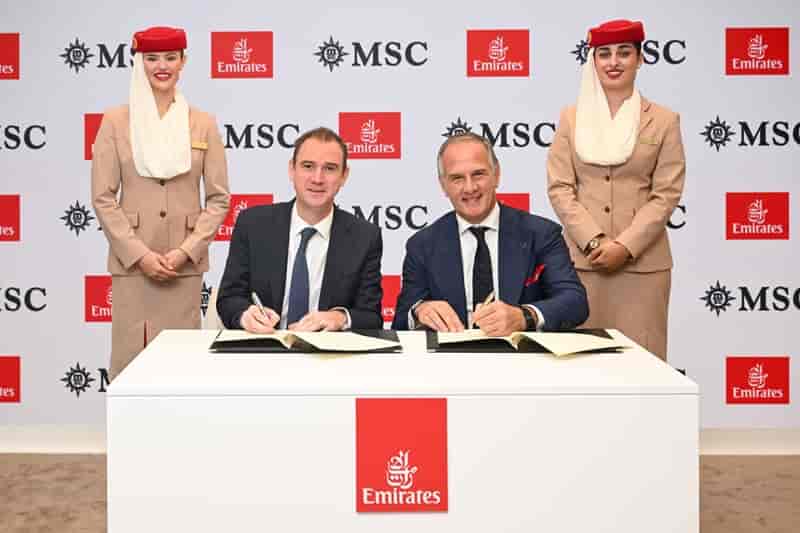
Emirates-MSC-Signing
Business communities, sporting fans and airport shoppers
Emirates also used ATM to go after clearly defined customer segments.
The Finnish Business Council in the UAE signed an agreement with Emirates ahead of the 1 October Helsinki launch.
Members will receive exclusive benefits while the council will help Emirates build relationships with Finnish businesses and professionals.
A similar partnership with the Vietnamese Business Council follows Emirates’ announcement of additional winter services to Hanoi and Ho Chi Minh City.
The arrangement gives Emirates another direct channel into a business community already closely connected with the UAE.
Sports tourism is another target.
Emirates partnered with Cutting Edge, a travel management company specialising in international sports tourism, to develop packages around major fixtures in cricket, football, motorsport, golf and tennis.
The concept combines Cutting Edge’s event access with an Emirates network of close to 140 destinations.
It is a neat fit.
Emirates already has an enormous sponsorship presence in global sport. Turning sponsorship visibility into packaged travel gives the airline a clearer path from logo exposure to revenue.
At Dubai International Airport, Emirates and Dubai Duty Free also signed an agreement offering Emirates passengers travelling to or through Dubai exclusive offers at Dubai Duty Free outlets in Terminal 3.
The partnership brings the retail experience into the airline’s wider customer proposition and, not coincidentally, gives passengers another reason to open their wallets between boarding passes.
Eighteen years of loyalty and counting
Emirates Skywards and Emirates Islamic also renewed an 18-year strategic relationship.
The partnership now spans three Emirates Skywards co-branded cards, including the metal Emirates Islamic Skywards Black Card, as well as a co-branded savings account, salary-transfer proposition and Miles exchange product.
Emirates says the relationship began in 2008 with what it describes as the region’s first Islamic co-branded airline credit card.
The 2026 agreement will focus on new products and more personalised benefits for cardholders.
Loyalty programmes have long since moved beyond free flights.
They are increasingly financial ecosystems, data platforms and customer-retention machines. A banking partnership gives Emirates another everyday touchpoint with travellers even when they are nowhere near an airport.
What the Emirates ATM deal blitz means for travel sellers
The real story is the sheer breadth of Emirates’ ATM programme.
A tourism-board agreement can create destination demand. A digital platform can capture that demand. A holiday arm can package it. A bank can reward it.
A cruise line can extend it. A business council can introduce a new corporate audience. A sports specialist can give fans a reason to travel. Airport retail can monetise the journey even before the passenger leaves the terminal.
That is vertical integration without necessarily owning every part of the chain.
For travel advisers and tour operators, the opportunity is equally practical.
More coordinated destination marketing should create fresh campaign material. Better air-sea integration can make cruise bookings easier to manage. Promoting new routes can open unfamiliar itineraries. Packaged products can shorten the distance between inspiration and a confirmed sale.
However, an important distinction remains.
An MoU is still a promise to cooperate, not a guarantee of commercial success.
The meaningful measures will come later: bookings, visitor spend, route performance, campaign conversion, trade engagement, package uptake and repeat business.
That is where the handshakes made under the bright lights of ATM must eventually meet the considerably less glamorous world of spreadsheets, sales reports and load factors.
But at ATM 2026, Emirates has made its direction unmistakable.
The airline is not waiting for customers simply to choose a flight.
It is building partnerships designed to meet them in the destination search, the digital marketplace, the cruise terminal, the corporate network, the stadium, the bank account and the duty-free aisle.
That is a lot of ground for one airline to cover.
Then again, when your business is built on connecting the world, staying politely in your lane was never really the plan.
By: May Marclay – © 2026, on location at ATM Dubai
Read Time: 9 minutes.
Author Bio:
 May Marclay’s career hasn’t followed a straight line, and she’s better for it. She began in real estate, then moved into hospitality, finding her rhythm with Centara in the Maldives. There, she worked the Asian markets the old-fashioned way: building trust, closing deals, and turning conversations into lasting business.
The UAE sharpened its focus. At IHG, supporting an Area General Manager, she saw the machinery of a major travel hub from the inside, no gloss, just how things actually get done.
Now, with her sights set on healthcare, May brings a broader lens than most. She speaks three languages, reads widely, travels with intent, and writes with the calm assurance of someone who understands both the detail and the bigger picture without needing to say so too loudly.











