

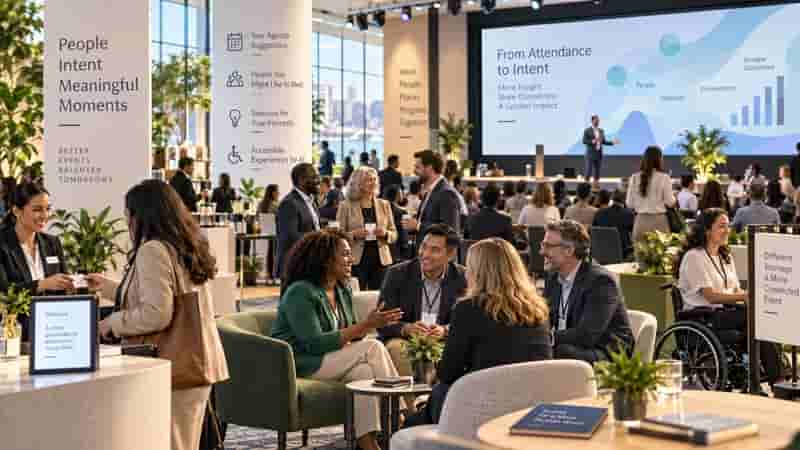
Event planners have spent years perfecting the art of counting heads. FCM Meetings & Events says the next big step is understanding what’s happening inside them.
Personalisation is fast becoming standard practice rather than a conference-room extra. Forrester’s Q1 2025 State of B2B Events Survey found 79 per cent of event leaders were prioritising personalisation. That was four percentage points higher than a year earlier. Yet delivery still trails ambition. Research reported by PCMA in May found 53 per cent of planners offered only basic personalisation. Just 16 per cent personalised networking, while 15 per cent recommended sessions to individual attendees.
That gap was at the heart of a recent Spice Knowledge Sessions panel. Katie Fraser, General Manager Operations and Customer at FCM Meetings & Events, said too many organisations collect attendee data before deciding what to do with it.

Katie Fraser (GM Ops & Customer of FCM Meetings & Events)
“Attendees don’t leave their everyday expectations at the door,” said Fraser. “They increasingly expect an event to recognise that not everyone in the room is there for the same reason, in the same way they expect the apps on their phone to already know what they need.”
It sounds simple, but it changes the job.
Registration forms have long been built to answer basic questions: name, company, dietary needs, access needs and perhaps a workshop choice. Useful? Certainly. Enough to shape a better event? Not always.
“Most registration forms are still designed to get someone through a door, but it’s also important to understand why they walked through it,” Fraser added.
“If you’re only asking who’s coming, you’ll only ever be able to react to your event. Ask why, and you can start designing the event before the door even opens, not after it closes.”
For planners, that means moving past attendance as the main measure of success.
A packed ballroom may look splendid in the post-event photographs. But a full room does not tell an organiser whether delegates met the right people, found the right content or left with a reason to return.
Satisfaction scores only tell half the story
Fraser also questions the industry’s heavy reliance on post-event satisfaction scores.
“A five-out-of-five satisfaction score can hide someone who attended one session all day. A neutral score can hide someone who attended five. If we’re only measuring how people felt, we’re missing half the story of what they actually did.”
There is, of course, a line between useful personalisation and making delegates wonder whether the conference badge has started reading their diary.
That line increasingly comes down to trust.
Qualtrics’ 2026 Global Consumer Experience Trends research covered more than 20,000 consumers across 14 countries. It found 64 per cent wanted tailored experiences. However, only 41 per cent felt the benefits justified the privacy costs, while just 39 per cent believed organisations used personal information responsibly.
That difference matters. People may want personalisation, but trust is never automatic.
Fraser’s advice is practical.
“Before you ask for a piece of data, ask yourself what decision it will actually inform. And before you use it, ask whether the person in front of you would reasonably expect you to know it. That’s the line between personal and unsettling.”
Technology should know when to leave the stage
That is also where event technology earns its place.
The best systems, Fraser argues, should make an event easier without becoming the event itself.
“The best event technology is almost invisible. It removes friction, makes useful connections and then gets out of the way, because no one flies across the country to stare at an app. They come for the people and the room, not the screen.”
The wider industry data backs that human focus.
PCMA’s reporting on the 2026 Experience Design Report, based on responses from 447 event professionals, found that 72 per cent of event organisers ranked face-to-face networking as the strongest trust builder. Shared peer experiences came next at 62 per cent.
It is a useful reminder for an industry currently surrounded by AI platforms, apps, analytics dashboards and enough acronyms to fill a convention centre.
Technology can help find the right session. It can suggest the right contact. It can remove queues, smooth registration and help organisers understand behaviour.
But it still cannot shake a hand.
Less data, more purpose
For conference organisers, corporate travel managers and tourism suppliers, the commercial lesson is clear.
Personalisation should not become a hunt for more data simply because new technology makes that possible. The smarter approach is to collect less, understand more and use it with purpose.
That also gives planners a stronger basis for judging return on investment. Attendance remains important, but intent can reveal whether an event actually delivered what delegates came seeking: knowledge, contacts, business opportunities, recognition, inspiration or simply the chance to meet someone face-to-face rather than through another glowing rectangle.
Fraser’s closing point neatly explains why events still offer something technology cannot produce on demand.
“Personalisation makes someone feel seen. But it’s the shared experience, watching a room shift its thinking together, that gives an event its real power. That’s not something an algorithm can create. That’s still the job of the people in the room.”
So, yes, the future of events may be data-rich, AI-assisted and far more tailored.
But the winning formula remains reassuringly old-fashioned: know why people came, give them something worth sharing and never let the technology become the loudest guest in the room.
By: Soo James – © 2026.
Read Time: 4 minutes.
Author Bio:
 There’s nothing rehearsed about Soo James, and that’s precisely the point. Malaysian by heritage, Sydney by schooling, she arrived at UNSW to study Arts, then took a left turn into IT, not out of ambition, but curiosity. Somewhere among systems and schedules, she worked out what really held her attention: people, language, and the quiet spaces between them.
Writing followed naturally. Travel and lifestyle gave her room to observe, to listen, to notice the details others rush past. Soo writes the way good travellers move, watching the room before admiring the view, catching the gesture before chasing the headline.
At Global Travel Media, her stories don’t shout or sell. They linger. They slow you down, open a door, and gently suggest there’s more to see if you’re willing to look.











