

Australia’s two biggest airline groups have proved they can still make serious money when fuel prices turn nasty.
Qantas Group and Virgin Australia have posted strong 2025–26 earnings despite a sharp jump in jet fuel costs, according to the Australian Competition and Consumer Commission’s latest Domestic Airline Competition in Australia report.
While the balance sheets remain reassuringly robust, the message for passengers is less comforting: fewer seats, high demand and expensive fuel could put further upward pressure on domestic airfares.
Qantas Group reported underlying earnings before interest and tax of about $2.35 billion, down 11 per cent on the previous financial year. Virgin Australia reported underlying EBIT of $753 million, up 13.4 per cent.
Those numbers are striking because the second half of the year was far from smooth flying.
Conflict in the Middle East pushed energy prices higher and disrupted fuel markets. In the week ending 28 August 2026, jet fuel prices were 48.8 per cent higher than in the week ending 27 February.
Even so, Australia’s two dominant airline groups stayed firmly in the black.
“Despite significantly higher fuel costs, both the Qantas Group and Virgin Australia continued to generate substantial earnings in 2025–26,” ACCC Chair Gina Cass-Gottlieb said.
“These results highlight the financial resilience of the two largest operators in Australia’s highly concentrated domestic aviation market.”
And concentrated it certainly is.
Qantas Group and Virgin Australia carried 98.5 per cent of domestic passengers in July 2026, with no third airline group operating anywhere near the same scale.
For travellers and travel advisors, that is the part worth watching. The question is no longer whether the big two can make money. Clearly, they can.
The more important question is what happens next to airfares, capacity and competition.
Fuel shock, but earnings remain strong
Several factors helped protect airline earnings.
Passenger demand held up. Fares increased. Capacity was adjusted. Both groups also used fuel hedging to reduce their short-term exposure to rapidly rising fuel prices.
Qantas reported total fuel costs of $5.7 billion for 2025–26, up 14.4 per cent. It estimated elevated fuel prices added about $610 million to its second-half fuel costs after hedging.
Qantas then used pricing, capacity changes and other measures to soften the blow. Those actions reduced the estimated net earnings impact to about $420 million. Qantas’ own FY26 results also reported a $420 million net impact from the Middle East disruption.
Virgin Australia had a rather different experience.
It reported fuel costs of $1.09 billion, fractionally lower than the previous year. The ACCC said Virgin benefited from stronger hedging of both crude oil and the jet fuel refining margin, together with its newer, more fuel-efficient Boeing 737-8 aircraft.
Aviation finance jargon underpins much of this.
The simpler translation is that both carriers used pricing, capacity and fuel hedging to defend their earnings.
Aviation economics may occasionally require a calculator, but the principle is an old one: when one cost rises sharply, find somewhere else to recover it.
Unfortunately for passengers, that “somewhere else” can include the ticket price.
Fuel protection will not last forever
The ACCC warns that both airline groups expect fuel costs to climb again during the first half of 2026–27 as older hedge protection expires and replacement hedging becomes more costly.
Qantas forecasts first-half fuel costs of about $3.6 billion, almost 40 per cent above the same period a year earlier.
Virgin Australia expects fuel costs of about $700 million, up around 26 per cent.
At the same time, domestic capacity is heading in the opposite direction.
Qantas Domestic expects capacity to fall 4 per cent in the first half of 2026–27. Jetstar Domestic expects a 2 per cent reduction, while Virgin Australia has forecast a 3 per cent fall.
Both groups also expect to generate more revenue from the seats they do fly.
Virgin Australia has forecast revenue per available seat kilometre, or RASK, growth of 6 to 8 per cent. Qantas Group forecasts total revenue per available seat kilometre growth of 8 to 10 per cent across its domestic and international operations.
In plain English, airlines expect fewer seats and more revenue from each one.
That equation seldom ends with cheaper tickets.
Australian airfares already moving higher
The ACCC found average domestic fares were generally higher than a year earlier during the latest quarter.
In real terms, average fare revenue per passenger was 3.5 per cent higher in May and 4 per cent higher in June before moderating in July.
“With resilient demand and high load factors, the announced capacity reductions may place upward pressure on airfares, depending on airlines’ commercial decisions and fuel prices,” Ms Cass-Gottlieb said.
That qualification is important.
The ACCC is not predicting that every fare on every Australian route will rise.
Airline pricing changes by route, season, departure date, booking window and demand. Sales will continue. Airlines will still discount when they need to stimulate leisure traffic or fill quieter flights.
But the broader picture is hard to ignore.
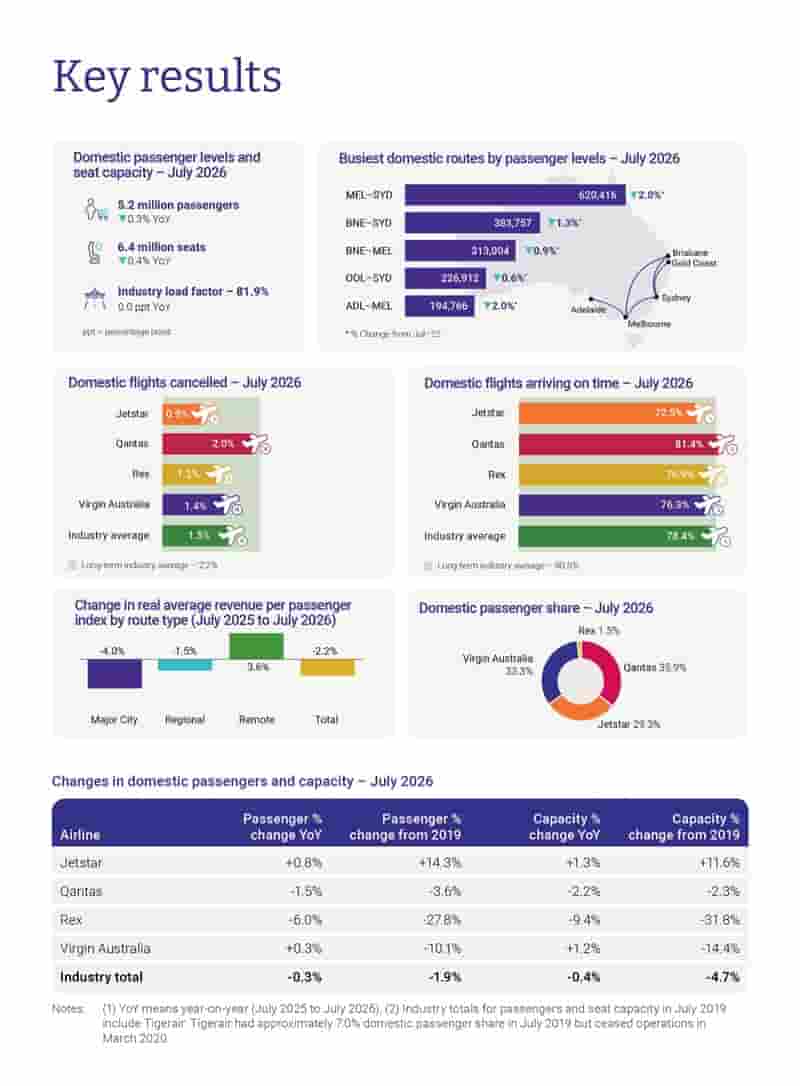
Domestic passenger volumes remained broadly steady in the quarter to July. Airlines carried more than 5.2 million passengers in July, just 0.3 per cent fewer than a year earlier.
Capacity fell faster.
It dropped 2.3 per cent year-on-year in both May and June, with June recording the lowest capacity for that month since 2022. July capacity fell 0.4 per cent.
That kept airline load factors above 80 per cent throughout the quarter.
Put another way, airlines offered fewer seats while still filling most of them.
Good news if you run an airline revenue-management department.
Slightly less exhilarating if you are a family looking for four cheap seats during the school holidays.
On-time performance loses altitude
The operational picture was mixed.
Industry-wide on-time arrivals dropped from 82.1 per cent in May to 78.4 per cent in July, taking the July result below the long-term industry average of 80.5 per cent.
Qantas was the strongest performer among the monitored airlines for a sixth consecutive month, recording an on-time arrival rate of 81.4 per cent in July.
Rex recorded 76.9 per cent, Virgin Australia 76.3 per cent and Jetstar 72.5 per cent.
Cancellations were considerably better news.
Only 1.5 per cent of flights were cancelled in each of May, June and July, below the long-term industry average of 2.2 per cent.
The ACCC said this was the longest consecutive period with cancellation rates below that long-term average since 2018.
For travel advisors, the distinction matters.
A delayed aircraft is annoying. A cancelled aircraft can dismantle an itinerary with remarkable efficiency.
Western Sydney may eventually shake things up
The biggest long-term competitive shift may not come from another airline.
It could come from Western Sydney International Airport.
The new airport commenced freight operations on 26 July 2026. Domestic passenger flights are scheduled to begin on 25 October, followed by international passenger operations on 26 October.
Jetstar will initially be the only domestic airline operating from Western Sydney, with services to Melbourne, the Gold Coast and Brisbane.
Air New Zealand will launch Auckland services from 26 October, while Singapore Airlines is scheduled to begin daily flights to Singapore from 23 November.
Qantas services are due to commence in March 2027. Virgin Australia had not announced services from the airport when the ACCC completed its report.
Western Sydney also has one particularly valuable advantage: 24-hour operations.
Unlike Sydney Airport, it will not operate under the same overnight curfew. It also has substantial spare capacity and greater access to take-off and landing opportunities.
The ACCC believes those features could, over time, make it easier for new airlines to enter or existing carriers to expand.
But expectations should remain realistic.
The regulator says the competition benefits are likely to develop gradually as Western Sydney attracts airlines and builds scale. Existing carriers have valuable slots, established customers and extensive connections at Sydney Airport. They are unlikely to surrender those advantages without a compelling commercial reason.
So Western Sydney may open a new door to airline competition.
It probably will not blow the old one off its hinges overnight.
What it means for the travel trade
For travel advisors, corporate travel managers and tourism operators, the ACCC report delivers a fairly clear message.
Demand remains resilient. Qantas Group and Virgin Australia remain financially strong. Fuel prices remain high. Domestic capacity is being trimmed. Average fares have already risen at times this year.
That combination points towards continued fare pressure, particularly on busy routes and during peak travel periods.
It does not mean travellers need to panic-book.
It does suggest advisors have good reason to encourage clients to book earlier when dates are fixed, compare Qantas, Jetstar and Virgin Australia carefully and keep a close eye on the new services opening at Western Sydney.
The Australian airline industry has shown it can absorb a serious fuel shock and still deliver substantial earnings.
For the airlines, resilience is the headline.
For passengers, the smaller print may be rather less cheerful: fewer seats, fuller aircraft and a very good reason to watch the fare before it takes off.
By: Christine Nguyen – © 2026.
Read Time: 6 minutes.
Author Bio:
 Christine’s story is one of quiet courage, told without fuss and lived with remarkable grace. She arrived in Australia as a young refugee from Vietnam, carrying little more than hope, family, and a curiosity that refused to be extinguished. Sydney became home, built patiently, brick by careful brick.
She studied Tourism at TAFE and soon found her place in inbound travel, working with one of the city’s leading destination companies. Christine loved showing visitors the Australia that lives beyond postcards, warmer, truer, and far more interesting.
When the sea began to whisper, and life asked for a gentler rhythm, she listened. Designing brochures, writing blogs, she discovered storytelling waiting quietly inside her.
Today, at Global Travel Media, Christine writes with warmth and wisdom, reminding us, softly and persuasively, why travel still matters.











