

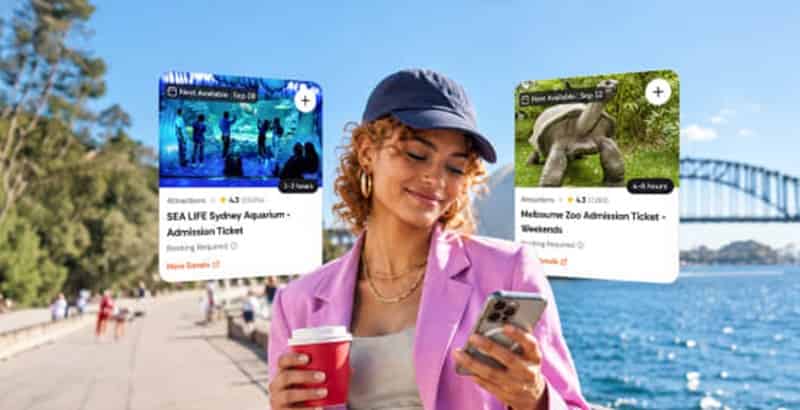
The traditional city pass has long asked travellers to buy first and compromise later. Alike wants to flip that model.
The AI-powered travel marketplace has expanded into Australia with new Sydney Tourist Pass and Melbourne Tourist Pass products. Both use Alike’s Build Your Own Pass model. Instead of buying a fixed bundle, travellers choose the attractions and experiences they actually want.
The idea is simple, and the timing looks sound.
Booking.com’s 2026 Travel Predictions research surveyed 29,733 travellers across 33 countries and territories, including 1,005 Australians. The research found that personal interests, passions and individuality are playing a greater role in travel choices. In short, travellers increasingly want holidays that feel like their own, rather than somebody else’s checklist.
Alike is applying much the same thinking to city sightseeing.
With its Build Your Own Pass, travellers select their preferred attractions and combine them into one purchase. Alike says the Sydney pass currently offers a choice of 11 attractions, including the Sydney Opera House, Taronga Zoo Sydney, SEA LIFE Sydney Aquarium and Sydney Tower Eye.
In Melbourne, the company says travellers can choose from 17 attractions. The line-up includes Melbourne Zoo, Melbourne Museum, Peninsula Hot Springs and Melbourne SkyDeck.
That means visitors are not forced to pay for an attraction simply because somebody in a product department decided it belonged in the package. Pick what appeals, skip what does not, and spend precious holiday hours where they matter most.
“Travel has become far more personal, but much of the way cities are sold to travellers hasn’t caught up,” said Ashish Sidhra, Co-founder of Alike. “People don’t necessarily want a pre-decided list of things to do. They want to choose what matters to them, leave room for discovery, and build a trip that feels like theirs. That’s what we’re bringing to Sydney and Melbourne.”
A pass that follows the traveller
The Australian launch adds to Alike’s existing tourist-pass markets, which include London, Singapore, Paris, Dubai and Abu Dhabi. Its wider tourist-pass platform offers both build-your-own products and ready-made bundles.
Alike’s platform describes Build Your Own Pass as an option that lets travellers select their preferred attractions and experiences, rather than starting with a fixed itinerary. It also promotes digital access and greater savings as you add more experiences.
Sydney and Melbourne are logical places to start in Australia.
Sydney has the famous icons. The Opera House, harbour, wildlife attractions, cruises and observation decks give first-time visitors an obvious wish list. Day trips beyond the city can widen the menu further.
Melbourne sells itself rather differently. Museums, wildlife, family attractions, food, culture and regional escapes all play their part.
Peninsula Hot Springs adds another option for travellers who believe a strenuous day’s sightseeing should occasionally involve the heroic act of sitting perfectly still in warm water.
That difference between the cities matters. A good city pass should fit the destination rather than force every destination into precisely the same mould.
AI moves beyond simply suggesting a holiday
Alike also wants its passes to form part of a broader travel journey.
Its AI tool, Eia, is described by the company as an “AI Travel Twin”. Alike says Eia can develop personalised plans around a traveller’s interests, budget and travel style, while the broader platform brings together stays, experiences, transport and other trip services.
For travel advisors and tourism businesses, that is where the launch becomes particularly interesting.
The contest is no longer merely about who sells the ticket. Increasingly, it is about who makes the whole journey easier.
Travellers still value expert advice, and when an itinerary becomes complicated, they often need it more than ever. At the same time, consumers increasingly expect digital tools to remember preferences, reduce repetitive searching and make the booking process less of an expedition in its own right.
Alike says it has also used its technology for destination partnerships. One example is the Official Abu Dhabi Pass, which the company says was developed with Abu Dhabi’s Department of Culture and Tourism using Alike’s Infinity platform.
Alike claims it deployed the product in eight weeks, compared with what it describes as an industry norm of 18 to 24 months. That timing comparison is an Alike claim, rather than independently verified industry data, but it illustrates the company’s proposition: build tourism products quickly and make them easier to tailor.
The Official Abu Dhabi Pass does currently offer a Build Your Own Pass product, supporting the broader model described by Alike.
Meanwhile, Alike’s website states that its platform has served more than 425,000 travellers worldwide.
Flexibility will ultimately face the traveller test
Of course, travellers will judge the Australian passes on more than a clever concept.
Price will matter. Clear terms will matter. Easy redemption will matter even more. And promised flexibility must survive contact with real-world opening hours, capacity limits and attraction booking requirements.
A flexible pass is only truly flexible if it remains easy to use after the credit card has done its duty.
Nevertheless, the basic idea makes a lot of sense.
For years, the travel industry has preached personalisation. Alike is now asking a fairly practical question: why should a personalised holiday begin with a fixed sightseeing bundle?
Sydney and Melbourne are unlikely to be transformed overnight by another digital pass. But giving visitors greater control over what they buy is hardly a bad place to start.
In an age when algorithms increasingly want to plan everything, handing part of the itinerary pencil back to the traveller may be the smartest move of all.
By: Maria D’Souza – © 2026.
Read Time: 4 minutes.
Author Bio:
 Maria D’Souza brings a suitcase of experience to the travel industry, shaped by Victoria, Queensland and New South Wales. A seasoned traveller, she has explored, collecting the sort of practical insight no brochure, however glossy, can provide.
Maria studied communications at RMIT University and also holds a Bachelor of Arts, giving her a foundation in storytelling, people and the fine art of getting a message across clearly. Her professional journey has included roles with various travel agencies, where she developed a sound understanding of customers, destinations and the occasional itinerary determined to misbehave.
Away from the office and airport lounge, Maria plays netball, bringing the same teamwork, energy and sharp eye she applies to travel. Warm, capable and endlessly curious, she combines industry knowledge with genuine enthusiasm for helping others discover the world and return home with stories worth telling.











