

Australia’s love affair with cruising is not cooling. Quite the opposite: Australians are cruising in record numbers. The problem is that an increasing share of that demand is colliding with fewer locally deployed ships, constrained capacity and a familiar menu of itineraries.
That contradiction is becoming increasingly visible at the travel agency counter.
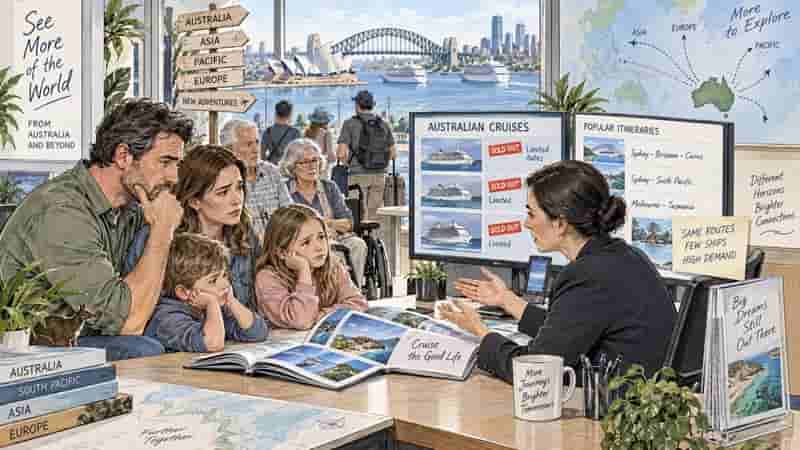
Belle Goldie, founder of The Cruise & Travel Store and a cruise specialist with more than 26 years’ experience, says some clients are arriving ready to book only to discover that the voyage they want is already sold out.
Goldie told Cruise Passenger that one recent enquiry involved a family of five, including two children with accessibility needs, looking for a 28-day Princess round-Australia cruise in the latter half of 2027. According to Goldie, the sailing they wanted was already fully booked, leaving the family considering 2028 instead.
For Goldie, the human impact was obvious: “seeing the disappointment on that mother’s face was heartbreaking”.
For that family, the issue was not merely finding another holiday. Cruising can be particularly attractive to travellers who value the ability to unpack once, keep accommodation, meals and entertainment together and reduce the logistical burden of moving between hotels and transport.
Goldie said that combination is especially important for families, older travellers, multi-generational groups and some passengers with accessibility requirements.
The anecdote is significant, but it should not be mistaken for evidence that Australians are losing interest in cruising.
The latest Cruise Lines International Association figures tell the opposite story.
A record 1.45 million Australians took an ocean cruise in 2025, up 9.5 per cent from 1.32 million in 2024 and above the previous record of 1.35 million set in 2018. Australia remained the world’s fourth-largest cruise source market.
Of those travellers, 1.16 million cruised within Australia, New Zealand and the South Pacific, up 8 per cent. Another 286,000 Australians cruised outside the local region, up 17 per cent, while the proportion choosing long-haul cruise destinations rose from 18.5 per cent to 19.7 per cent.
In other words, Australia has no shortage of cruise customers.
The more uncomfortable question is whether Australia is giving them enough compelling reasons to cruise from home.
The billion-dollar warning
Australia’s cruise economy remains substantial, but its most recent economic figures show a clear retreat from the previous record year.
The joint CLIA and Australian Cruise Association economic assessment found that cruise tourism generated $7.32 billion in total economic output during 2024–25, down 13.2 per cent from about $8.4 billion in 2023–24.
That represents a fall of more than $1 billion in annual economic output an important distinction from saying the entire Australian cruise industry itself has simply “lost $1 billion”.
Supported employment also fell from 26,370 full-time equivalent positions to 22,720, while direct wage income declined from $1.3 billion to $1.1 billion.
The study says the deterioration was not caused by a collapse in passenger demand. Instead, it pointed to reduced ship deployments, fewer turnaround visits and lower capacity, alongside a less competitive operating environment in which higher costs, regulatory uncertainty and global competition are influencing deployment decisions.
The number of cruise ships operating in Australian waters fell 9.3 per cent, from 75 in 2023–24 to 68 in 2024–25. Passenger capacity also declined.
Those figures provide important context to the frustration now being reported by some travel agents.
Same sea, same story
Capacity is only half the challenge. For repeat cruisers, product variety matters.
Goldie says many established cruise clients have already travelled the South Pacific, New Zealand and Australia’s familiar coastal itineraries several times. Some are not rejecting cruising; they are rejecting repetition.
That distinction matters.
A customer who has sailed to the South Pacific nine times may still be an enthusiastic cruise passenger, but another similar itinerary may no longer be enough to secure the booking.
According to Goldie, this is encouraging some Australian clients to look farther afield to Europe, Japan, Singapore and the United States, taking not only their cruise fare but also their pre- and post-cruise spending with them.
The national data supports the broader direction of that argument. Australians cruising outside Australia, New Zealand and the South Pacific region increased by 17 per cent in 2025.
For Australian ports, hotels, tour operators, transport companies, attractions, travel advisers and suppliers, that leakage matters.
Cruise tourism is not simply the value of a cabin sold aboard a ship. It is an ecosystem of spending before, during and after a voyage.
And when the ship and the passenger start the holiday overseas, a sizeable portion of that spending goes with it.
New product still moves the needle
Fresh product can still generate enthusiasm.
Goldie pointed to Royal Caribbean’s Royal Beach Club Lelepa in Vanuatu as an example of something different enough to attract client attention.
Royal Caribbean says the destination will open in October 2027, with the first sailings calling from late that month. Cruises visiting Lelepa are already on sale from Sydney and Brisbane.
Sydney and Brisbane will serve as Australian homeports for Lelepa itineraries, giving local cruisers a new South Pacific proposition rather than simply another lap around a familiar circuit.
The timing deserves clarification. Earlier reporting referred to groups being booked to Lelepa over the coming year, but guests will not begin visiting the Royal Beach Club until October 2027.
The important point is that bookings for those future cruises are already being made.
And that reinforces Goldie’s broader argument: new destinations, new ships and genuinely different itineraries can stimulate demand in a mature Australian cruise market where many passengers have already visited traditional ports several times.
Deployment decisions matter
Cruise lines decide where to place ships by comparing markets worldwide, and Australia is competing for those vessels.
Carnival Cruise Line provided one of the clearest recent examples in February 2026, when it announced that Carnival Adventure would move to seasonal Australian operations from April 2028, relocating to North America for the northern hemisphere summer.
Carnival said the decision reflected more favourable market conditions elsewhere and what it described as an “uncertain regulatory environment” in Australia and New Zealand.
That does not mean Carnival is abandoning Australia.
The company has said it will continue year-round operations in the region through other ships and has promoted an expanded range of Australian and New Zealand homeports for 2027–28. Carnival previously announced more than 200 cruises across four ships in that program, covering 39 destinations.
Carnival has also said it expects to welcome about 1.2 million guests across roughly 400 voyages over the two years leading to the change.
Nevertheless, the decision illustrates the competitive reality confronting Australia.
A cruise ship deployed here cannot simultaneously earn revenue in another market.
If operating costs, port charges, regulation, infrastructure constraints or commercial returns compare unfavourably with Asia, Europe, the Caribbean or North America, Australia risks losing deployment even when Australian passenger demand remains strong.
The cabins may be full. The challenge is persuading cruise lines that Australian waters are still the best place to put the ship carrying them.
Industrial relations need careful treatment
Industrial relations have also entered the debate, but this part of the story demands a clear separation between documented events and allegations.
Goldie raised concerns in her Cruise Passenger interview about union activity involving Carnival and argued that industrial relations uncertainty could influence future cruise deployment decisions.
A documented incident on 9 March 2026 involved representatives of the Maritime Union of Australia and SafeWork NSW attempting to board Carnival Adventure at Sydney’s Circular Quay.
The MUA maintained that its representatives and safety officials had lawful rights to enter. Carnival disputed the union’s authority to board, and refused the representatives access.
Accordingly, that incident should not be characterised as MUA representatives successfully boarding Carnival Adventure.
Claims appearing elsewhere that union representatives posed as passengers or accosted a captain have not been independently established by the authoritative material reviewed for this article and are therefore not presented here as fact.
The dispute also has another side.
On 30 June 2026, the MUA lodged a formal complaint with the Australian Maritime Safety Authority alleging Carnival was not meeting crew rights relating to collective bargaining under the Maritime Labour Convention.
AMSA confirmed on 2 July that it was reviewing that complaint. The authority said vessels operating in Australian waters must comply with applicable international maritime safety and labour standards and that it has zero tolerance for Maritime Labour Convention breaches.
There is also an important chronological point.
The March union confrontation could not have caused Carnival’s February announcement about Carnival Adventure, because the deployment decision was announced before the confrontation.
The dispute does, however, demonstrate the broader and increasingly contested regulatory and industrial environment surrounding cruise operations in Australia.
A big industry with a big decision ahead
Australia is not short of cruise passengers.
It lacks certainty that enough ships, capacity and fresh product will remain available locally to satisfy them.
That is the central issue.
The sector still generated $7.32 billion in economic output in 2024–25 and supported 22,720 full-time equivalent jobs. Australians then set a new cruising record in 2025.
Those are hardly the numbers of an industry consumers have abandoned.
But a record source market does not automatically guarantee a strong domestic cruise economy.
If Australians increasingly fly overseas to find new ships, new ports and new experiences, the passenger may remain Australian while much of the associated tourism spending does not.
For travel advisers such as Goldie, the challenge is immediate.
When a client walks in wanting a particular locally based cruise and the sailing is unavailable, or the alternatives feel like a repeat of holidays already taken enthusiasm can quickly become disappointment.
For governments, ports and cruise lines, the challenge is considerably larger.
Australia must remain commercially attractive enough to secure ships while preserving appropriate safety, labour and regulatory standards.
Those objectives need not be enemies.
But achieving both will require a more coordinated approach than simply arguing over who is to blame.
The warning signs are now difficult to ignore: demand is booming, Australian cruise tourism’s economic output has fallen, local ship numbers have contracted, and more Australians are heading overseas to cruise.
For an island nation that loves ships, that is a course worth correcting before still more passengers and their holiday spending sail elsewhere.
By: John Alwyn-Jones – © 2026.
Read Time: 7 minutes.
Author Bio:
 John Alwyn-Jones is one of those rare figures who can make the business of travel sound positively adventurous.
A lifelong communicator with the polish of a broadcaster and the curiosity of a journalist, he’s spent decades shaping stories and strategies across tourism, aviation, and the cruise world. He’s led from the front as CEO, director, mentor and advisor and still manages to bring warmth and wit to every boardroom and microphone.
Known for his sharp insight into global cruise lines and destinations, John has an old-school belief in professionalism, tempered with the sparkle of someone who’s genuinely seen the world. He’s not just in the business of travel he’s made it an art form.











