

Australia’s cruise industry has sailed into one of those peculiar moments when the passenger numbers are sparkling, global demand is booming, and the local deployment picture is considerably less cheerful.
That contradiction sits squarely at the centre of the 28th Australian Cruise Association Conference and AGM in Brisbane from 2–4 September, where ports, cruise executives, tourism operators and suppliers have gathered under the theme “Building Value Beyond the Berth”. The main plenary program is being held on 3 September, putting the economic value of cruising beyond the terminal gates firmly on the industry agenda.
It is an elegant conference theme. It is also a serious business argument.
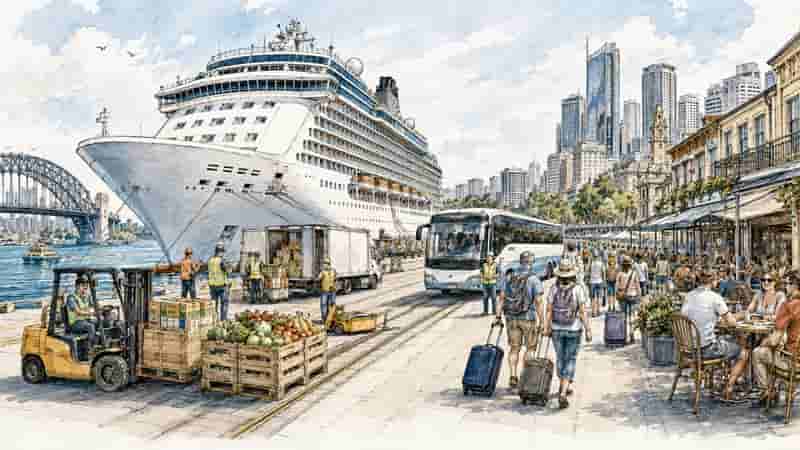
A ship may spend only hours alongside an Australian berth, but the money attached to that visit starts moving long before a mooring line touches the wharf. Australian farmers and producers supply food. Logistics companies move provisions. Hotels accommodate passengers before and after voyages. Coach companies, guides and attractions handle shore excursions. Travel advisers sell cabins. Ports, pilots, baggage handlers, restaurants, retailers and transport operators all take their slice of the activity.
The berth, in other words, is where the ship parks. The business extends considerably further.
Billions Ride on Australian Cruise Tourism
The latest national economic figures make that point forcefully.
Cruise tourism generated $7.32 billion in total Australian economic output during 2024–25, supporting 22,720 jobs and producing $2.36 billion in wages, according to an economic impact assessment commissioned by Cruise Lines International Association (CLIA) and the Australian Cruise Association (ACA).
Those are formidable numbers, but they come with a warning. Total economic output fell by $1.11 billion, or 13.2 per cent, from the previous year’s record result, principally as fewer ships visited Australia.
The Australian Paddock to Port Alliance puts the supply-chain story into even sharper focus. Its figures show cruise lines spend more than $1.5 billion annually in Australia, while passengers spend more than $1.8 billion in Australian destinations. Cruise activity reaches 56 Australian ports and destinations and supports businesses ranging from agricultural suppliers and hotels to transport operators, tourism attractions and local retailers.
That is an economic wake worth following.
Unfortunately, Australia is also watching some ships steer elsewhere.
Current industry reporting puts Australia’s homeported fleet at 11 ships for the 2026–27 season, compared with 18 in 2023–24. The decline matters because homeported vessels create a deeper economic footprint than occasional port calls, driving provisioning, crew movements, aviation, accommodation and pre- and post-cruise spending.
For an industry fond of discussing growth, that is a contraction with teeth.
Australians Are Still Cruising Increasingly Overseas
The problem certainly is not a shortage of Australians wanting to cruise.
A record 1.45 million Australians took an ocean cruise in 2025, up 9.5 per cent from 1.32 million in 2024. Australia remained the world’s fourth-largest cruise source market, behind the United States, Germany and the United Kingdom.
More than one Australian in every 20 took a cruise during the year.
Yet the most revealing figure may be where some of those passengers chose to board.
CLIA says 286,000 Australians cruised outside Australia, New Zealand and the South Pacific during 2025, an increase of 17 per cent. The share of Australian cruisers choosing long-haul destinations rose from 18.5 per cent in 2024 to 19.7 per cent in 2025.
Australians, then, have not lost their appetite for cruising. Increasingly, some are simply taking that appetite and their holiday spending overseas.
Globally, passenger appetite remains hearty. CLIA reports that a record 37.2 million people took an ocean cruise in 2025, up 7.5 per cent on the previous record of 34.6 million. Nearly 90 per cent of cruisers surveyed said they intended to cruise again.
The customers are there. New ships are coming. The question for Australia is whether enough of those vessels will be pointed in this direction.
Bud Darr Puts Australia’s Competitiveness on the Table
That question sharpened this week when CLIA Global President and CEO Charles “Bud” Darr arrived in Sydney as the 2026–27 Australian summer cruise season opened.
Crown Princess sailed into Sydney Harbour after completing a 114-night World Cruise, carrying 2,720 guests and 1,130 crew after travelling 36,000 nautical miles. It was an appropriately handsome backdrop for a cruise sector that still knows how to make an entrance.
Darr described the state of the global cruise industry as “excellent”, but his question for Australia was less comfortable:
“Are we getting our share of the growth?”
At present, the answer appears to be: not enough.
Cruise executives have repeatedly raised concerns over Australia’s operating costs, regulatory environment and the certainty required when planning deployment years in advance. Current trade reporting also points to proposed domestic labour requirements and other regulatory pressures as factors the industry believes could weaken Australia’s competitiveness.
Cruise itineraries and deployment schedules are planned years in advance. Darr has noted that luxury cruise planning can run about 36 months ahead, meaning decisions made or left unresolved today can influence where ships are sailing several seasons from now.
Cruise companies, after all, do not deploy billion-dollar vessels out of sentimentality.
Sydney Harbour may provide one of cruising’s great arrivals, but a chief executive still has to make the numbers work.
Sunsets are persuasive.
Spreadsheets remain stubbornly immune.
Australia Is Competing Against the World
That is why Australia’s cruise debate cannot be confined to whether this season looks busier or quieter than the last.
Australia is competing with Asia, Europe, Alaska, the Caribbean and an expanding field of destinations for ships, passengers and investment. Cruise lines can deploy mobile assets wherever passenger demand, itinerary economics and operating conditions make the strongest commercial case.
Australia unquestionably has the passenger demand. What it needs is a competitive environment that can convert more of that demand into Australian deployment.
ACA Chief Executive Officer Jill Abel has framed the conference theme around the industry’s long-term economic, social and community value and the role cruise plays in supporting destinations, tourism operators and local businesses.
That broader perspective matters.
A cruise arrival should not be measured simply by the number of passengers passing through a terminal. Its footprint can include hotel rooms, restaurant meals, airport movements, food and beverage supply, tours, buses, taxis, port services, retail spending and regional attractions.
For smaller ports and regional destinations, the opportunity can be particularly valuable.
A cruise ship brings a ready-made visitor market directly to the destination. Several thousand potential customers can step ashore in a single morning, without another airline seat, lengthy road journey, or marketing campaign to persuade them to arrive.
The ship brings the market to the doorstep.
The challenge is ensuring enough of that spending remains in the local economy.
Brisbane Demonstrates What Lies Beyond the Terminal
Brisbane is an especially appropriate host for this year’s conference.
The Brisbane International Cruise Terminal opened in June 2022 and has since welcomed hundreds of cruise ships. Port of Brisbane says the terminal is intended to grow Queensland’s cruise tourism sector, support employment and economic activity, and attract more visitors to South East Queensland.
Its latest figures underline the scale of that opportunity. Port of Brisbane says every cruise ship call contributes approximately $1.05 million to the Queensland economy.
That figure captures precisely why “value beyond the berth” matters.
The terminal itself is only the front door.
Passengers can generate hotel stays, dining, shopping, touring and transport in Brisbane, while cruise visitation can also feed business into destinations across South East Queensland and along the state’s coast. Suppliers provision ships. Local staff service calls. Transport providers move passengers and crew.
A successful cruise port therefore does considerably more than provide somewhere deep enough to park a large vessel.
It connects the ship with the wider visitor economy.
Ports Still Have to Earn the Business
None of this means Australian destinations can build a terminal and expect cruise lines to queue politely offshore.
Ports and tourism regions still have to earn their position on itineraries.
That requires reliable infrastructure, efficient passenger processing, suitable transport, compelling shore excursions, competitive port costs and visitor experiences worth leaving the ship to enjoy.
It also requires credible responses to sustainability, emissions, congestion and community expectations.
“Value beyond the berth” cannot simply mean extracting another dollar from each passenger. It must also mean creating greater value for the communities hosting cruise tourism.
That is where the strongest destinations will distinguish themselves.
Australia Has the Assets; Complacency Is the Danger
Australia should be exceptionally well placed for the next chapter of global cruising.
It has Sydney Harbour, the Great Barrier Reef, Tasmania, the Kimberley, tropical northern Australia and regional ports offering experiences that can genuinely differentiate an itinerary.
It also has a domestic population demonstrably keen to cruise.
What it cannot afford is complacency.
The great irony would be for Australians to continue taking cruises in record numbers while an increasing proportion flies overseas to board them.
That would still be healthy business for cruise companies, airlines and travel advisers.
It would be considerably less useful to the Australian hotels, farmers, producers, coach operators, port workers, restaurants, attractions, logistics companies and regional communities whose economic benefit depends on ships actually sailing here.
That is why the conversation in Brisbane matters.
The argument is no longer merely about securing another berth, building another terminal or attracting another ship for an impressive photograph beneath the Harbour Bridge.
Australia needs to decide what sort of cruise economy it wants and establish stable, practical and internationally competitive conditions capable of attracting it.
Because when a cruise ship sails somewhere else, Australia does not simply lose a booking at the wharf.
It risks losing hotel nights, produce orders, shore excursions, transport work, restaurant tables, retail spending, regional visitation and jobs.
For an industry built around journeys, that is one departure Australia can ill afford to miss.
By: Jason Smith – © 2026.
Read Time: 7 minutes.
Author Bio:
 Jason Smith didn’t learn travel from textbooks. He learned it in airports, taxis and hotel lobbies, watching the business unfold long before he played his own part. Half American, half Asian, he grew up around the quiet workings of tourism, where people come and go, and stories rarely stand still.
Bangkok came first, then formal study, then a career that carried him through Singapore, Malaysia and Vietnam. Each place left something behind. In the end, Thailand felt like home, along with a senior role in hotel sales.
Then everything stopped. Borders shut, planes grounded, and Jason found himself back in America with time to reflect.
Now at Global Travel Media, he writes travel as it really is, not polished, not perfect, but human, and all the better for it.











