

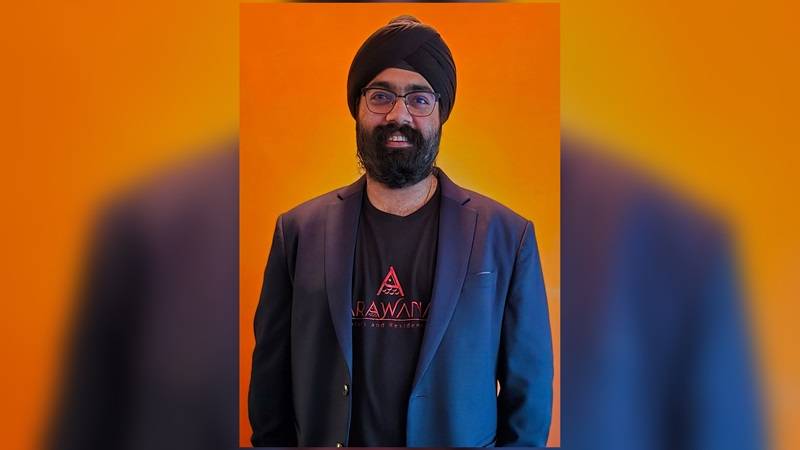
Manmeet Singh Thakralbutra is on a roll. Founder and CEO of Arawana Hotels and Residences (named after the dragon fish said to bring luck), which was established barely six years ago, the company already has 14 hotels in its portfolio, with the latest on Ratchada and Srinakarin roads. “We wanted to get a foothold into the domestic market, which isn’t as seasonal”, Manmeet explains. “This (Ratchada) is also our first property with an event hall on the premises”.
Q: It appears the Arawana Group goes in for existing properties rather than constructing from scratch?
We have lease as well as management agreements, and that’s linked to different reasons, a big one, of course, being capital, but mainly, we started the brand during the pandemic; we wanted to see how to make do and help our assets during that time, with a limited budget. Once we saw that this works, we looked at other hotels that had closed due to resources or whatever, so we went in to add value. When it comes to customers, we’ve already taken a value-driven approach, but we also need to see how to benefit the owner, guests, our stakeholders we have to appease, and then ourselves.
Q: One of your Pattaya properties won the ‘Best Hotel Concept’ award last year. How did you think of marrying diverse categories under one roof?
Yes, we did go against the grain here. This was a rundown property, in really bad shape initially. There are three buildings with a shared pool, so instead of letting the owner split it, we decided to split it ourselves; this way, the ROIs were much healthier, and we mitigated some risks. So we have the 3* Arawana Express, the 4* Arawana Regency Residence (serviced and non-serviced) for long-stay guests, and a hostel for backpackers. Our 4* isn’t so luxurious, while the 3* isn’t so budget; in fact, the 3* is currently outperforming the 4*. We were concerned about guest clashes due to these different segments under one roof, and we did have a backup plan, such as having keycard access only for certain areas, but so far, we haven’t seen any problems. The Srinakarin property will also be multi-brand.
Q: How do you perceive the hostel segment in Thailand?
If I’m being honest, price is the first consideration: cheap, shared accommodation. However, I’m also a Director of the Hostel and Small Accommodation Association Thailand, and this is where I get a lot of input from them: in a country like Thailand, where you can get a room for $30–$40, why would anyone pay $10 for a room without a bathroom? So, hostels aren’t as popular here, but it’s about a shared sense of community; travellers make friends and have some companionship while travelling. AI can’t offer this; you can get answers from a robot, yes, but it’s the togetherness, the community factor, that’s strong.
Q: Since your portfolio spans quite a few categories that mainly cater to the bulk of the visitor segment, what’s your opinion of the tourists who come here?
Thailand’s a great place to vacation – I think we can all agree on that!
From my point of view, there are always going to be bad eggs in every basket, in any group, not just tourists. There’ll always be instances when things go awry. It’ll be good if there’s some way to report this (poor behaviour), although I don’t necessarily agree with cyberbullying either; this taking of videos and screaming at each other on the street. Tourists are going to have fun, and fun can sometimes get out of hand, but there should be no stereotyping of an entire race or nation. In a broader image, Thailand is a country that does need tourism, not just for the hospitality industry – it trickles down everywhere – but there should be a middle ground and balance, no extremes: the tour agents here have accreditation, but do the agents they work with abroad have accreditation as well? The screening process at the start should be stronger. Tourists also need to understand this; you’re coming here to have fun, but this is a *country* – people *live* here!
Q: You are a panel speaker on a lot of forums where you’ve talked about digitalisation and technology quite often. How has this impacted staff efficiency and guest experience?
I strongly feel technology – be it internal with your team or with guests – has to have a *reason*. If you can use AI to help the Front Desk, it would free up their time to actually deal with guests – and that’s how you can maximise guest experience. It also helps staff mentally by reducing boring tasks, so they can have more fun interacting with guests. The number one reason people join hospitality is to meet other people.
Q: You’ve also stated that operational overheads are inherently connected drivers of net profit. Please elaborate.
Basically, the formula is simple: revenue minus overheads equals net profit. You either increase revenue or decrease costs. You have to understand market dynamics. You need certain things, like Housekeeping, but how efficiently you do them matters; you need to find a fine balance. Involving the Housekeeping team in decisions helped me a lot. The first lever – revenue – isn’t always in your hand, but the cost side is definitely in your hand
Q: You are also associated with S.IN.G.H. (Sikhs in Global Hospitality). What form does your mentorship take here?
I’m not directly involved with the organisation, but I’m there for young Sikhs who want to get into hospitality; my door is always open. The flip side of being a minority is that you’re always visible and face challenges, so in that sense, I’m more than happy to help people facing similar challenges.
Q: How will the Thai hospitality industry evolve over the next decade?
It’s still one of the strongest hospitality markets worldwide, with very high service standards! From what I can see, the next step is moving toward higher-paying customers, even if that means fewer customers. That’s a bit of a double-edged thing, though. It’s better for the image, yes, but you also have to look at the mass market. I think, moving forward, the upper end will get more mature; there’ll be more lifestyle hotels. Wellness, for instance, will look at the mid-tier; there’ll be more affordable wellness hotels, while cheaper hotels will move up to the mid-tier. The lifestyle aspect will be the differentiator; everyone needs some uniqueness. You’ll also get more fun-looking hotels, like a Moxy.
There’ll be a lot more room for automation; the push will also be for self-check-ins, like Japan… I don’t think it’s necessarily the best thing for the economy, because it could lead to unemployment. Besides, if people get laid off due to costs because you’re trying to improve your bottom line, then they can’t buy your product: it’s a chicken-and-egg thing! From my point of view, branding is changing how economies of scale work.
By: Punam Bakshi Mohandas – © 2026.
Read Time: 7 minutes.
Author Bio:
 Punam Mohandas is a senior journalist with 30-years of work experience across India, Dubai, Bangkok and Italy. She has been the Editor and Editorial Director of various publications such as Compass (Bangkok), Hotelier India (Mumbai), The Big Project (Dubai), Coordinating Editor with the Times of India (New Delhi) and a reporter with the Khaleej Times (Dubai) Furthermore, she was a weekly columnist for several leading English publications such as the Hindustan Times, the Times of India, The Statesman and the Delhi Midday, which were hugely popular and ran for several years; under her able guidance, the Times of India successfully launched the ET Traveller – a comprehensive travel guide introducing the reader to all the Indian states in depth.
She is an accomplished, accredited travel writer well recognised among the travel trade, tourism boards, and hospitality brands across various countries.
Additionally, Punam has a hospitality background, having been associated with both the Oberoi and Taj Groups. She was also formerly the Director of Communications for PATA, based out of the Association’s head office in Bangkok.
Punam is the author of the book ‘Fallen Angels’ and is currently researching material for her next books, both centred on Thailand.











