

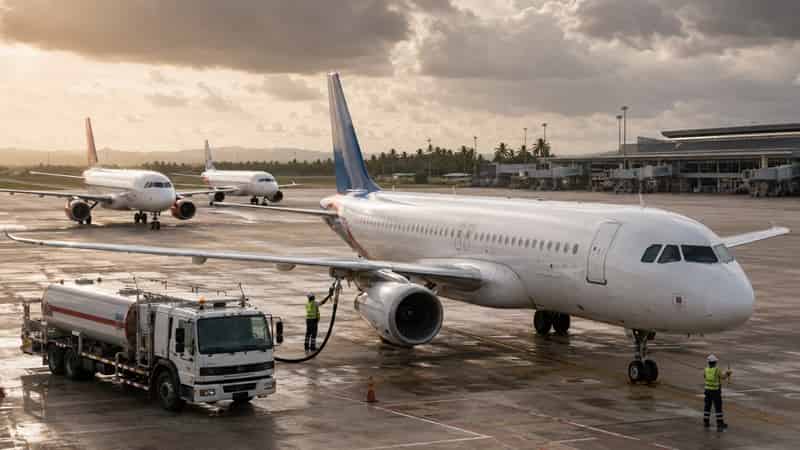
Southeast Asia’s budget airlines are cutting capacity, raising fares, and pruning routes as jet fuel prices squeeze their thin margins. AirAsia, Thai AirAsia, Cebu Pacific and Scoot have all reported material pressure, although the size of the bruise varies by airline, market and hedging policy.
The region’s low-cost carriers built an aviation revolution on cheap seats, quick turnarounds and a firm belief that every cost should mind its manners. Jet fuel, unfortunately, has barged through the front door wearing muddy boots.
This is more than a quarterly earnings squall. Low-cost airlines underpin Southeast Asia’s tourism economy, linking capital cities with islands, provincial centres and emerging destinations that cannot always support a full-service fare. When those carriers cut seats, the effect can travel quickly from the airline ledger to hotel rooms, tour desks and airport shops.
Jet fuel turns the screws
The shock began with the Middle East conflict and disruption to energy flows through the Strait of Hormuz. About 25% of global crude oil passes through that narrow waterway.
IATA says the disruption drove physical crude towards US$150 a barrel and jet fuel above US$200 by mid-April. Its June forecast put the average 2026 jet-fuel price at US$152 a barrel, almost 70% above the 2025 average.
According to IATA’s weekly monitor, the global average jet-fuel price stood at US$163.87 a barrel as at 25 August 2026, up 3.1% from the previous week.
For an industry that likes to describe a 4% margin as respectable, that is not a headwind; it is a flying brick.
IATA expects airlines worldwide to spend about US$350 billion on fuel in 2026, with fuel consuming nearly one-third of operating costs. It forecasts that the industry’s net margin will shrink from 4.2% in 2025 to 2.0% this year.
IATA says airlines have little choice but to try to pass higher fuel costs to passengers, while warning that travellers’ tolerance has limits.
Budget airlines face a particularly awkward equation. Fuel represents a larger share of their deliberately lean cost base, yet their customers often hesitate first when fares rise.
Full-service airlines can lean on premium cabins, corporate travel and larger loyalty programmes. A low-cost carrier has fewer cushions. Its passengers like a bargain and can smell the absence of one from several terminals away.
AirAsia cuts capacity after fuel surge
AirAsia Group’s second-quarter figures show how quickly the equation soured. Revenue held broadly steady at RM5.1 billion despite an 11% capacity reduction, while revenue per available seat kilometre rose 11%.
Yet average jet-fuel prices reached US$183 a barrel, and fuel expenses surged 58% year-on-year. EBITDA fell 56% to RM442.6 million, and the group recorded a net loss of RM830.5 million, including a RM331 million foreign-exchange loss.
AirAsia’s results show it recovered about 70% of the higher fuel burden through fare changes and lower non-fuel unit costs—but 70% recovery still leaves a sizeable hole in the bucket.
The group plans to trim third-quarter capacity by 20% to 25% year-on-year, return 25 older aircraft to lessors during 2026 and focus on routes that meet stricter financial hurdles.
Management expects capacity to return towards pre-conflict levels in the fourth quarter as year-end demand builds. That is an expectation, not a boarding pass stamped “guaranteed”. Fuel, currencies and consumer confidence still have a say.
Thai AirAsia has faced the same arithmetic with a local accent. In the second quarter, it reduced capacity by 13% while lifting average fares 27%.
The average jet-fuel price rose 124% to US$183 a barrel, pushing total fuel expenses up 43% to THB5 billion. The carrier reported a net loss of THB2.326 billion.
It has hedged 13% of its third-quarter fuel requirement at US$89 a barrel and plans to rebuild capacity for the year-end peak.
Thai AirAsia’s financial statement points to disciplined recovery, but one small hedge cannot shelter an entire fleet from a long storm.
Cebu Pacific feels fuel and currency pinch
Cebu Pacific’s second quarter was equally sobering. Revenue rose 7% to PHP35.2 billion, proving that demand for affordable travel remained resilient. Fuel expenses, however, more than doubled.
The airline posted a PHP2.7 billion operating loss and a PHP5.5 billion net loss for the quarter, while an 8% weakening of the Philippine peso amplified dollar-denominated fuel and leasing costs.
Chief executive Michael Szucs called it “one of the most challenging operating environments we have faced post-pandemic”. The company reported the results on 6 August.
The carrier has hedged about 30% of its third-quarter fuel requirement below US$120 a barrel, according to Reuters’ regional analysis.
It has also adjusted its network. Cebu Pacific’s published schedule changes include temporary route suspensions and frequency reductions on services such as Iloilo–Singapore, Manila–Jakarta and Manila–Kuala Lumpur.
These are not abstract spreadsheet manoeuvres. They alter holiday plans, trade connections and the flow of visitors into secondary gateways.
Scoot discovers full aircraft are not enough
Scoot’s experience delivers perhaps the quarter’s most telling number. Its passenger unit costs rose 21.7% in the three months to June, while its operating loss widened to S$32 million from S$17 million a year earlier.
Its break-even passenger load factor reached 100%, compared with an actual passenger load factor of 90.6%. In plain English, even a fully loaded aircraft would have covered only passenger operating costs.
Scoot benefited from the Singapore Airlines Group’s hedging programme, but fare increases still failed to offset the fuel bill.
The parent group’s net fuel cost rose 78.5% to S$2.253 billion in the quarter, despite an S$376 million hedging gain.
Singapore Airlines’ official result recorded a group net loss of S$76 million, even as revenue reached a record S$5.714 billion.
Strong demand, it turns out, is useful but not magical.
Fewer cheap seats could reshape tourism
Capacity data already shows a divided market. OAG’s August 2026 schedules show AirAsia’s scheduled departing capacity down 17% year-on-year and Thai AirAsia’s down 23.4%.
Lion Air’s capacity is down 11.1%, and Vietjet’s is down 5.7%, while Cebu Pacific’s capacity has risen 3.8% and Citilink’s has surged 72.8%.
Across the region, international capacity within Southeast Asia is still 1.2% higher year-on-year, so this is not a universal retreat. It is a selective reshuffling, with carriers pruning weak routes and rivals moving into the gaps.
OAG’s August 2026 data show 176 airlines serving 300 airports across the region.
That distinction matters. The fuel shock is unlikely to end Southeast Asia’s low-cost aviation boom, but it may change where and how quickly it grows.
Large trunk routes can support higher frequencies and stronger yields. Thin routes to secondary destinations are more vulnerable when every sector must clear a higher cost threshold.
For tourism authorities, the lesson is blunt: visitor demand alone does not guarantee air access. Joint marketing funds, airport incentives and well-timed events may become more important in keeping marginal routes viable.
For travel advisers, schedule monitoring and clear explanations of total trip cost will matter as fuel surcharges, fare changes and reduced frequencies ripple through bookings.
Travellers should also resist the old habit of treating every advertised fare as a permanent feature of the landscape. The low-cost model remains robust, but its famous cheap seat is being asked to carry a much heavier fuel bill.
Relief may arrive, but discipline will remain
There are grounds for cautious optimism. Several carriers expect the fourth-quarter holiday peak to support renewed capacity, and fuel has retreated from its April extremes.
Newer aircraft, tighter schedules, better flight planning and smarter hedging can also reduce exposure over time.
Still, the latest IATA price shows that fuel remains painfully expensive. A renewed capacity rush could also drive fares down before costs have normalised, trading one pressure for another.
Airlines therefore face a delicate task: restore enough seats to capture demand without reopening routes that turn every take-off into a charitable donation.
Southeast Asia’s budget carriers have survived pandemics, currency shocks, airport bottlenecks and more than a few gloomy forecasts. They are not about to fold their tray tables and surrender.
But the 2026 fuel shock has reminded the industry of an old aviation truth: a low fare may win the passenger, yet only disciplined costs keep the aircraft flying.
By: Jill Walsh – © 2026.
Read Time: 7 minutes.
Author Bio:
 Jill Walsh has always kept a pen close and a suitcase closer. She started in media releases, then learned the trade by escorting press trips around the world, discovering which stories travel well and which need a sharper edit.
Before long, she wasn’t just promoting destinations; she was representing them, translating civic ambition and local pride into words people actually wanted to read. These days, semi-retired and happily so, Jill has traded departure boards for deadlines, joining old friend and colleague Stephen at Global Travel Media on a casual basis.
Her patch is the business end of wanderlust: balance sheets, route maps, tender wins and the numbers that quietly decide where travellers go. She writes with dry humour, clean prose and an old-school respect for facts a steady voice when the market starts shouting.











