

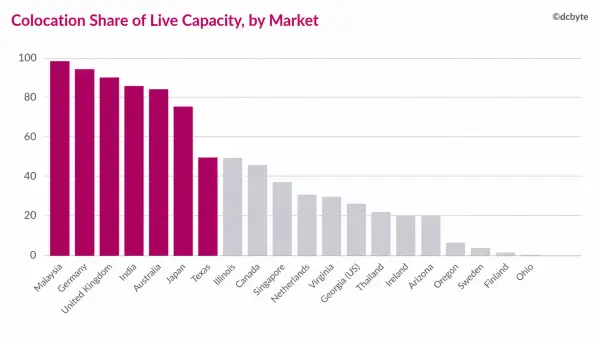
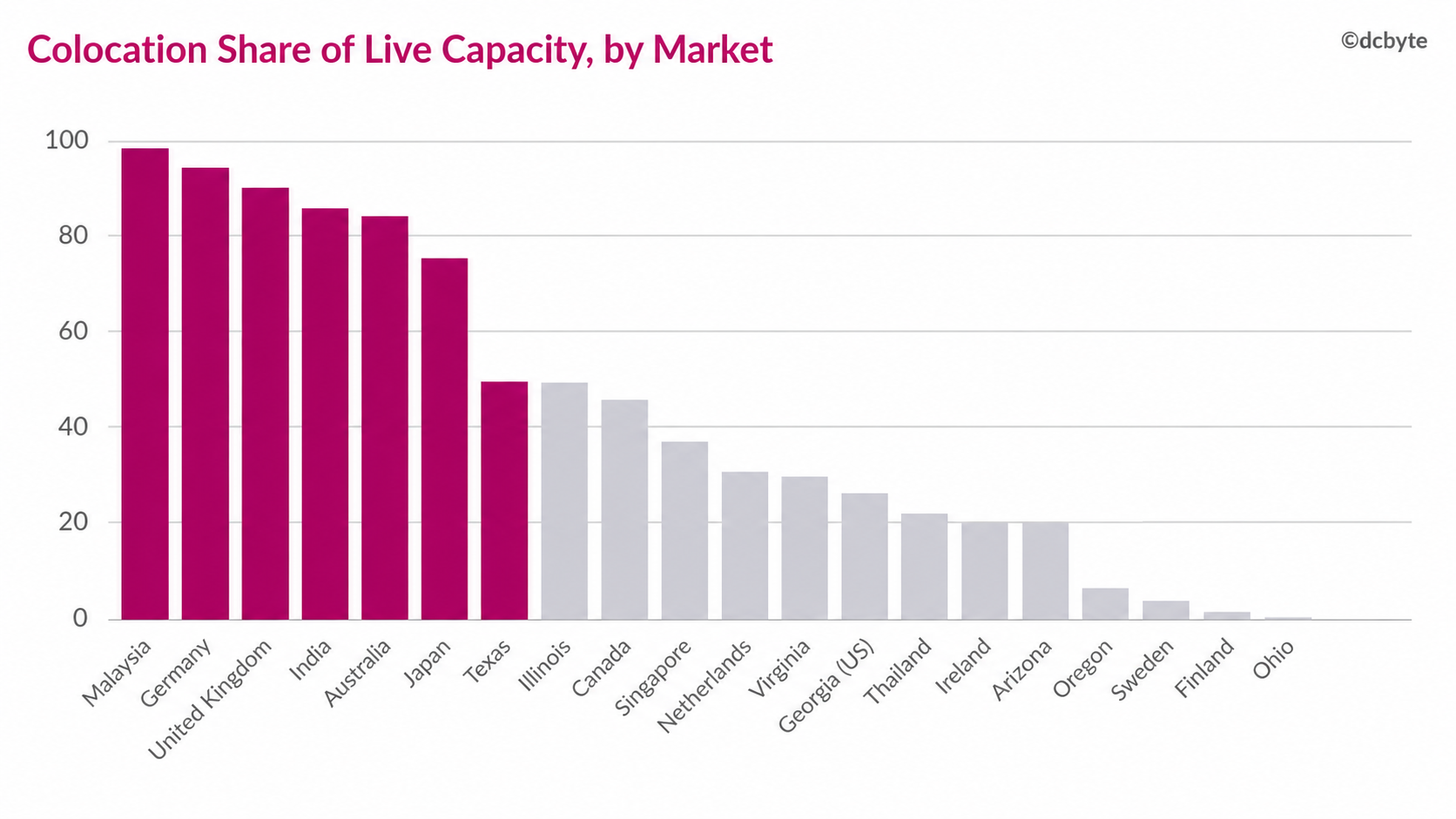
The geography of hyperscale colocation is changing. For years, many of the most colocation-heavy markets were outside the United States, particularly in Asia-Pacific and Europe. Malaysia, the UK, India, Australia, and Japan all built substantial leased hyperscale footprints, while many of America’s largest data center markets remained more closely associated with hyperscaler-owned infrastructure.
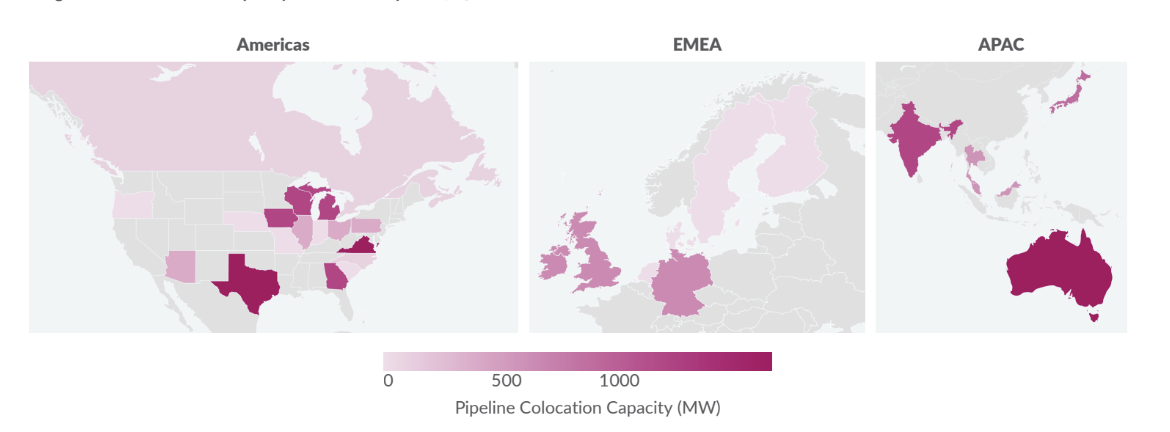
The next wave looks different. DC Byte’s latest analysis of hyperscaler build strategies finds that six of the eight markets attracting the most new hyperscaler colocation capacity are now in the US: Texas, Virginia, Georgia, Iowa, Michigan, and Wisconsin. Only Australia and India interrupt US dominance of the top eight.
This is more than another period of growth in the world’s largest data center market. The geography of colocation itself is being redrawn, with hyperscale capacity appearing at unprecedented scale in parts of the US that, until recently, had little or no hyperscaler-served colocation presence. So why is so much of the next wave landing in the United States?
Hyperscaler Leasing Has Shifted West
The scale of the geographic change becomes clearer when today’s pipeline is compared with the markets that historically led hyperscaler colocation. Established hubs such as Malaysia, Singapore, and the UK are losing relative share of new development, even if their absolute markets remain significant. Malaysia, for example, still has a substantial broader pipeline, meaning its position could change again as projects develop.
But for now, the strongest concentration of new hyperscaler colocation is unmistakably American.
What makes the shift especially notable is that it extends well beyond the country’s established data centers. Texas and Virginia are familiar names in any discussion of US digital infrastructure. Iowa, Michigan, and Wisconsin are different. Each is being propelled into the upper tier of new hyperscaler colocation markets by a single project of around 1 GW. Before those developments, the three markets had effectively no hyperscaler-served colocation presence.
Pennsylvania tells a similar story at a smaller scale. Despite an existing hyperscale self-build base, the state previously had almost no hyperscaler colocation. It now has around 280 MW in the pipeline. The US is therefore not simply growing its established hubs. New hyperscaler colocation markets are being created almost from scratch.
Scale Is Driving the Change
One reason this geographic shift can happen so quickly is the scale of today’s projects. A single 1 GW development can transform the position of a market that previously barely featured on the hyperscale colocation map. The rise of Iowa, Michigan, and Wisconsin illustrates how dramatically the economics of site selection change when individual developments are measured in hundreds of megawatts or even gigawatts.
The International Energy Agency estimates that the United States accounted for around 45% of global data center electricity consumption last year, more than any other country or region. It expects the US to account for by far the largest share of the increase in global data center electricity consumption through 2030, with hyperscalers a major driver of that growth.
In other words, the world’s largest concentration of data center demand is getting larger. The requirement is not merely for more capacity, but for very large blocks of capacity that can be secured across multiple locations, and that changes where data centers are being built.
Rather than expansion being limited to the handful of markets that dominated the previous generation of US data center development, hyperscalers and their infrastructure partners have a strong incentive to find additional locations capable of supporting very large campuses.
The US Expansion Looks Different from Established International Hubs
There is another distinctive feature to the new US geography. Many of the fastest-growing markets are highly concentrated around individual developers.
DC Byte’s research into hyperscaler trends found that US colocation markets are typically single-builder markets, with one operator responsible for essentially the entire pipeline. Established international hubs such as India, Malaysia, and the UK tend to look quite different, with demand spread across a larger number of competing operators.
India is the clearest contrast. Its roughly 1.2 GW of new hyperscaler colocation is distributed across 13 operators, led by domestic players. In emerging US markets, by contrast, one large project can establish both the operator and the location at the same time.
That relationship is visible in the national operator rankings. QTS and Vantage have jumped from outside the top five to become the two largest operators by hyperscale colocation pipeline. Texas provides another example. Its two largest new builders, Galaxy Digital and Rowan Digital Infrastructure, had no prior hyperscaler-serving footprint. Together with DataBank, they account for roughly two-thirds of the state’s colocation pipeline.
This Is Not Simply a Migration from the Coasts to the Interior
It can be tempting to reduce the shift to a simple story of hyperscalers leaving established US hubs in search of cheaper land or power. The data is more complicated.
Texas is booming. Georgia is among the largest markets for new colocation. Iowa, Michigan, and Wisconsin are emerging rapidly. Yet Virginia, the world’s largest market by existing hyperscale capacity, remains one of the largest locations for new colocation in absolute terms, too. At the same time, Virginia provides the report’s clearest counter current. Colocation represents only around 21% of its total hyperscale pipeline, down from around 32% of its live capacity.
The US colocation boom is not the product of a uniform national trend in which every market is developing in the same way. Instead, different US geographies are being selected for different combinations of demand, available development opportunities, and operator-led projects.
The common thread is scale. With US data center electricity consumption expected to rise sharply through the end of the decade, pressure to identify locations capable of supporting that scale is unlikely to disappear.
The Next Hyperscale Map Will Contain More US Markets
Hyperscaler colocation growth was once more strongly associated with established international hubs. Its next phase is increasingly concentrated in the United States, and not just in the markets that dominated the industry’s last cycle.
Texas has moved to the front of the new-build rankings. Georgia is attracting significant capacity. Iowa, Michigan, and Wisconsin have been transformed by individual gigawatt-scale projects. Pennsylvania is gaining a colocation market where almost none existed before.
Behind those developments is a broader change in how hyperscale geography is formed. At today’s project sizes, securing land, power, and a viable development pathway can put a new market on the map remarkably quickly. Operators that can assemble those ingredients are increasingly able to bring hyperscalers with them. It is not simply that America is building more. It is that hyperscaler colocation is expanding the number of places in America where building at enormous scale is possible.
DC Byte’s full Trends in Hyperscaler Build Strategies report examines the changing geography of hyperscaler capacity across the world’s 30 largest markets, alongside the operators capturing the next generation of demand and the evolving balance between leased and owned infrastructure.
Download the full report to explore where the next wave of hyperscaler capacity is being built and who is positioned to deliver it.
If your planning depends on separating announced capacity from deliverable capacity, you need better visibility on data center markets, not bigger bets. Book a demo with our team to explore our Market Analytics, where we capture global data centre capacity by market and development stage.











