

Queensland’s finest night skies are enjoying their moment in the sun, figuratively speaking, of course, as growing interest in astrotourism sends travellers beyond the city glow in search of the Milky Way, meteor showers and a little old-fashioned wonder.
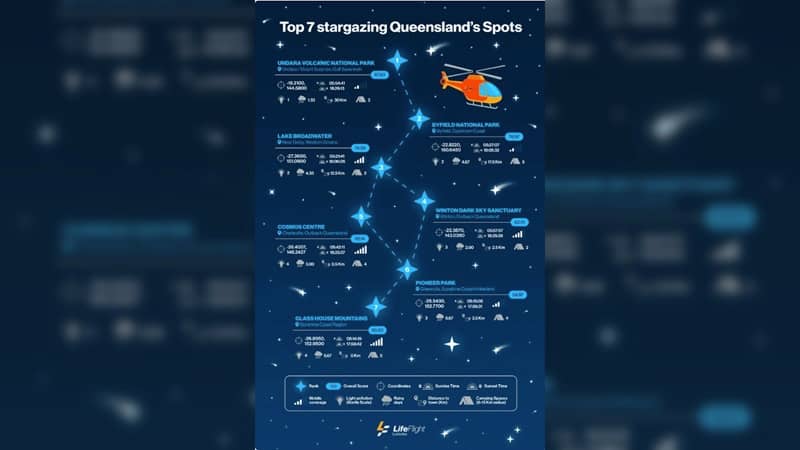
New research from LifeFlight Lotteries has ranked seven of the state’s leading stargazing destinations. Undara Volcanic National Park in the Gulf Savannah claimed first place with 87.63 points out of 100, followed by Byfield National Park and Lake Broadwater.
The study compared publicly available information on light pollution, average spring rainfall, distance from the nearest town, mobile coverage and nearby camping. It is a useful trip-planning guide rather than an official government rating, but its conclusion is difficult to quarrel with: Queensland looks particularly handsome after dark.
LifeFlight’s supplied material also reports a 100 per cent rise in searches for “astrotourism”. However, no search platform, timeframe or underlying volume was provided, so that figure should be viewed as an indicator of interest rather than a settled measure of travel demand.
Undara turns out the lights and turns on the spectacle
Undara’s winning hand included a Bortle rating of 1, the scale’s darkest class, an average of 1.33 rainy spring days and a position about 30 kilometres from the nearest town.
In other words, this is not the place to expect a glowing convenience store on every corner. That, rather neatly, is the point.
The national park also carries serious geological theatre. Queensland Parks says a major eruption about 190,000 years ago sent lava flowing more than 90 kilometres north and more than 160 kilometres north-west, creating the celebrated lava-tube system.
Visitors may watch microbats leave their roosts around dusk before the heavens take over the evening shift. Access to the lava tubes is controlled, so travellers should check current tours, road conditions and park arrangements through Queensland National Parks.
Byfield brings dark skies closer to the coast
Byfield National Park placed second with 76.97 points. Its Bortle rating of 2 and location roughly 17.5 kilometres from the nearest town give it the rare combination of genuinely dark skies and relative accessibility.
Rainforest pockets, tall dunes, waterways and secluded beaches supply an impressive daytime program before the stars clock on for the night.
Some areas require high-clearance four-wheel-drive access, however, and sand tracks are no place for optimism dressed as preparation. Travellers should consult the official Byfield National Park information before leaving.
Lake Broadwater makes weekends wonderfully simple
Third-ranked Lake Broadwater scored 74.56 points. The Western Downs’ only naturally occurring freshwater lake pairs a Bortle rating of 2 with camping, birdwatching, reported mobile coverage and convenient access from Dalby.
That makes it an attractive choice for newcomers who want to sleep beneath a field of stars without staging an expedition worthy of Burke and Wills.
Visitors should still confirm camping arrangements, local fire restrictions, water conditions and road access before departure. Mobile coverage should never be treated as guaranteed, particularly when travelling beyond populated areas.
Winton’s stars carry international credentials
The Jump-Up Dark-Sky Sanctuary near Winton took fourth place with 63.91 points.
The site, at the Australian Age of Dinosaurs Museum of Natural History, became Australia’s first internationally certified Dark Sky Sanctuary in 2019. It is therefore more accurate to call the destination The Jump-Up, rather than simply “Winton Dark Sky Sanctuary”.
Winton’s celestial standing has since grown. In March 2026, DarkSky International designated the township Queensland’s first International Dark Sky Community.
The dinosaur capital can now offer ancient bones by day and ancient light by night—a tourism double act with considerably more staying power than most.
The LifeFlight ranking assigned the destination a Bortle rating of 3 and an average of only two rainy spring days. Book or confirm guided astronomy experiences, museum admission, and operating times before travel.
Charleville puts the cosmos within easy reach
Charleville’s Cosmos Centre finished fifth with 56.14 points. Located about 500 metres from town, it offers guided observing and an approachable introduction to astronomy beneath broad Outback skies.
Its Bortle rating of 4 is brighter than Undara’s, but its convenience is a considerable advantage. Not every budding astronomer wishes to negotiate a remote campsite merely to find Orion.
The centre gives families and first-time observers access to equipment and informed interpretation, with the comforts of town still within sensible reach. That makes Charleville a strong choice for travellers who want the spectacle without quite so much swatting, scrambling or satellite navigation.
Sunshine Coast secures two places and a major accolade
Pioneer Park at Gheerulla ranked sixth with 54.97 points, while the Glass House Mountains completed the list with 50.50 points.
The Sunshine Coast was the only region to place two destinations in the top seven, balancing darker hinterland skies with access, walking trails and nearby camping opportunities.
A timely development also emerged beyond the original study. In June 2026, DarkSky International designated the Sunshine Coast hinterland as Queensland’s first internationally recognised Dark Sky Reserve and Australia’s second.
That recognition strengthens the region’s astrotourism credentials, although travellers should not assume every location across the broader Sunshine Coast offers identical viewing conditions. Local cloud cover, artificial lighting, elevation and the Moon can all affect what appears overhead.
Pioneer Park offers a Bortle rating of 3 and an accessible hinterland escape. The Glass House Mountains, meanwhile, provide striking volcanic silhouettes for night photography.
They are closer to populated areas than Undara or Winton, but their road access, mobile coverage and accommodation choices make them a forgiving first step into astrotourism.
Dark-sky travel demands bright preparation
The romance of a remote night sky should never eclipse common sense.
LifeFlight advises travellers to research their destination, check road and weather conditions and tell a trusted person where they are going and when they expect to return.
Carry plenty of drinking water, food, warm clothing, a first-aid kit, and a dependable torch or headlamp. Temperatures can fall sharply after sunset, even following a warm Queensland day.
Download offline maps because mobile reception can disappear precisely when it would be most convenient for it not to. Travellers heading beyond reliable coverage should consider carrying a registered personal locator beacon or satellite communication device.
Wildlife becomes more active on regional roads after dark. Reduce speed, stay alert and, where possible, arrive before sunset so you can establish camp safely.
Visitors should use designated camping areas, obey fire restrictions, take rubbish home and keep unnecessary lighting to a minimum. A red torch setting helps preserve night vision and generally causes less disturbance than flooding a campsite with bright white light.
Before setting out, check the Bureau of Meteorology, Queensland Traffic and current Queensland Parks warnings. Travellers entering remote country should also respect closures, cultural responsibilities, private property and local advice.
Queensland’s top seven demonstrate that astrotourism can serve both ends of the market. Serious dark-sky devotees can seek Undara’s near-pristine darkness, while families and weekend travellers can begin with Charleville, Lake Broadwater or the Sunshine Coast.
The equipment need not be elaborate. A blanket, patience and the good sense to put the phone away will often do nicely.
The stars have been there for several billion years. Queensland tourism has simply become better at pointing them out.
By: Prae Lee – © 2026.
Read Time: 5 minutes.
Author Bio:
 You can tell a great deal about a person by how they meet a Bangkok morning. Prae Lee doesn’t charge into it; she glides, unhurried, as if time itself has agreed to behave. There is a calm assurance about her, the sort earned by knowing both your roots and your destination.
A graduate of Chulalongkorn University, she took her business degree with quiet pride, then polished it further in Singapore and Australia. Travel didn’t change her. It refined what was already there: curiosity, discipline, grace.
Back in Bangkok, she slipped modern life into the family business, mastering social media with an instinct for listening and selling with Thai gentleness.
Prae never seeks attention, yet everything she touches grows brighter.
Now with Global Travel Media, she writes with authenticity, drawing on culture, travel and a rare, steady confidence.











