

Hawaiʻi has barely had time to clear up after Hurricane Lala. Now the Pacific has sent another sharp reminder that tropical weather keeps its own timetable.
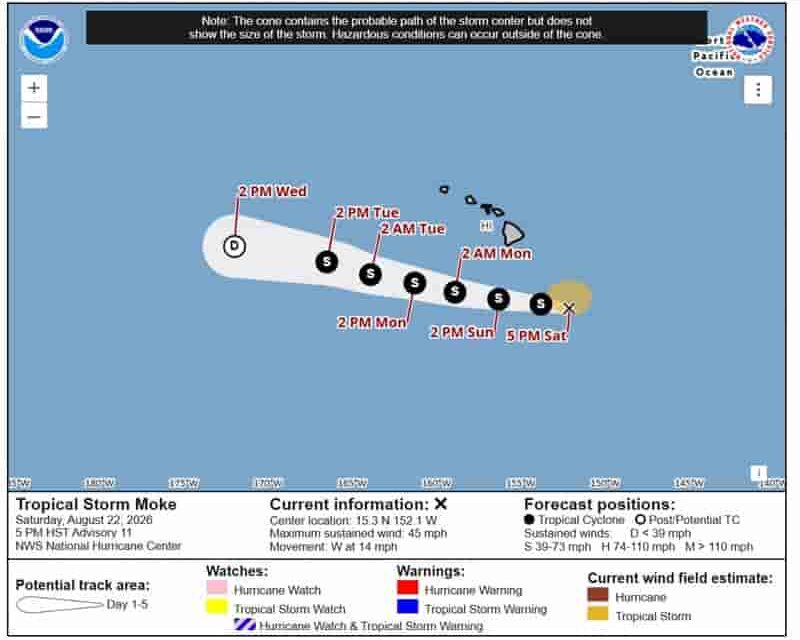
Tropical Storm Moke is moving south of the Hawaiian Islands. Forecasters do not expect a direct hit on the main islands. Even so, Moke can still bring heavy rain, strong gusts, rough seas and fresh travel delays. That is a serious concern for communities already repairing roads, power lines and public facilities.
The latest Central Pacific Hurricane Centre advisory was issued at 5 p.m. HST on Saturday, August 22. It placed Moke about 360 miles, or 585 kilometres, south-southeast of Hilo. Maximum sustained winds had eased to 45 mph, or 75 km/h. The storm was moving west at 14 mph.
Moke is expected to pass south of Hawaiʻi Island on Sunday. It should then track well south of the smaller main islands early next week. Forecasters expect a gradual weakening trend from Sunday.
That is the good news. The catch is simple: a tropical storm does not need to knock on the front door to make a mess.
Heavy rain is the main threat
Hawaiʻi Island faces the highest rain risk. The National Weather Service says windward and south-east slopes could receive 5 to 10 inches. Isolated totals may reach 15 inches.
A Flood Watch runs from midnight HST Saturday night through Monday afternoon. The ground is already wet from Lala. That means less rain may be needed to trigger flash flooding, swollen streams, landslides and road closures. The National Weather Service specifically warns that saturated ground raises the flash-flood risk.
Maui is also in line for heavy weather. Eastern Maui may receive 3 to 6 inches of rain. Western Maui and the rest of the state may see about 1 to 2 inches.
A Wind Advisory remains in force for parts of Maui, Molokaʻi, Lānaʻi, Kahoʻolawe and Hawaiʻi Island until 6 p.m. HST Sunday. East-north-east winds of 25 to 35 mph are expected. Gusts could reach 55 mph in exposed areas, on ridges and on slopes.
For visitors, the message is calm but firm. There is no need for panic. There is every reason to plan carefully.
Route 11 remains a key travel issue
One of the biggest visitor concerns is Māmalahoa Highway, Route 11, through Kaʻū on Hawaiʻi Island. Repairs from Hurricane Lala are still underway between Pāhala and Waiʻōhinu. Hawaiʻi transport authorities have asked that access through the recovery zone be left mainly to residents and disaster-response personnel while work continues.
Travellers going between Kona and Hilo should not blindly follow GPS routes through the south of the island. Current visitor guidance directs travellers away from the affected Kaʻū section, with Route 200 the Daniel K. Inouye Highway or Route 19 through Waimea and Hāmākua providing alternatives.
Yes, the detour may take longer. But that beats reaching a closure and learning that the cheerful blue line on the phone has no talent for disaster recovery.
The Hawaiʻi Department of Transportation has crews working on two major damaged sections of Route 11. It has also been clearing debris from streams and checking drainage before Moke’s rain arrives. Bridges in the affected Kaʻū area were inspected and reported structurally sound.
Volcanoes National Park closes for storm safety
Hawaiʻi Volcanoes National Park is another major issue for holiday plans. The National Park Service announced a temporary closure ahead of the new storm system, including the Kahuku Unit.
The park is still dealing with power, internet and phone outages after Lala. Emergency services are limited, and park programs are cancelled during the storm safety closure.
This is not the weekend to argue with a locked gate. Visitors should check the official National Park Service site before driving to the park.
State parks also remain a moving picture. Hawaiʻi’s Department of Land and Natural Resources says many parks remain closed because of storm damage and utility problems, while a number of sites have reopened. Conditions may change again as Moke passes.
The sensible rule is simple: check the official park notice on the day of travel.
Rough seas add another warning
The sea also deserves respect. National Weather Service forecasts show stronger winds and rougher seas around the islands as Moke moves past. A Small Craft Advisory remains in effect across Hawaiian coastal waters through the weekend.
Surf on east and south-east shores is expected to build as fresh swell from Moke reaches the islands. Conditions may also become more hazardous for swimmers and small craft.
Travellers with boat trips, diving, surfing, fishing or coastal tours should check with operators before leaving their hotel. A sunny patch over the resort pool is not a marine forecast.
Hawaiʻi remains open, but travel needs care
The wider tourism message needs balance. Hawaiʻi is not facing a statewide tourism shutdown. Airports and commercial harbours were reported open, while many hotels, shops, restaurants and visitor businesses continue to operate. Local conditions, however, can change quickly.
Some parts of Hawaiʻi Island are still recovering from Lala. Moke adds another layer of risk. Guests should respect roadblocks, avoid damaged communities and give crews room to work.
That is not merely good manners. It is good destination management.
Hotels, tour operators and travel advisers should keep guests informed with official information. They should also reconfirm tours, transfers and operating hours. Check airlines and accommodation providers directly if plans could be affected by weather.
Visitors should sign up for county emergency alerts for the island they are visiting. Keep phones charged. Know the emergency plan at the hotel or holiday rental. Never drive through floodwater. Allow more time for road trips.
At 5 p.m. HST, no coastal tropical storm watches or warnings were in force for the Hawaiian Islands. Moke was also showing signs of weakening.
Still, the next 48 hours matter. Heavy rain falling on wet ground can cause trouble well after the storm centre has passed.
For Hawaiʻi, this is not a story about a direct strike. It is a story about recovery under pressure, careful travel and good information.
Paradise remains open in many places. It simply has a few more signs directing travellers to take another route.
By: Anne Keam – © 2026.
Read Time: 5 minutes.
Author Bio:
 Anne Keam’s story begins in Queensland, on a grain farm in the state’s wide western reaches, where the days were long and the lessons simple: work hard, look after your own, and don’t make a fuss. Those early years left their mark.
She later studied Arts at the University of Queensland, before doing what felt natural at the time, heading back home to the family property. But the world was calling. Anne packed a backpack and went looking, spending years on the road and finding herself most alive in South America. She wrote everything down along the way. Those notebooks, full of dust, colour, and curiosity, eventually became her blog, a quiet, personal record of seeing the world and learning from it.











