

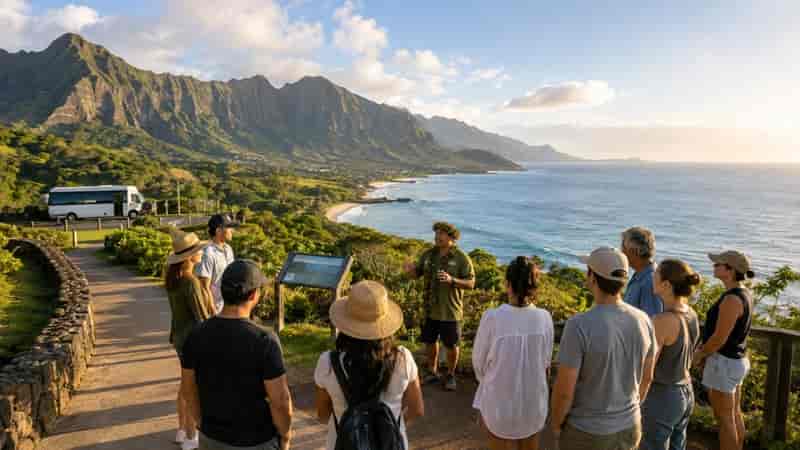
Hawaiʻi has spent generations persuading travellers that paradise is worth crossing an ocean for. Its latest tourism strategy asks a rather more difficult question: how do you keep paradise working for the people who live there once everybody arrives?
That question sits at the centre of the Hawaiʻi Tourism Authority’s new 2026–28 Destination Management Action Plans, or DMAPs, covering Hawaiʻi Island, Kauaʻi, Lānaʻi, Maui, Molokaʻi and Oʻahu.
Released in August 2026, the six plans move destination management away from broad aspirations and towards specific places under pressure, with time-bound actions, defined responsibilities, and island-based managers charged with helping to turn consultation into delivery.
It is an important change of emphasis for one of the world’s most recognisable visitor destinations.
Hawaiʻi is not retreating from tourism. The industry remains economically formidable. Preliminary figures from Hawaiʻi’s Department of Business, Economic Development and Tourism show 9,642,991 visitors arrived in 2025, 0.6 per cent fewer than in 2024, yet total visitor expenditure rose 5.7 per cent to US$21.75 billion.
That combination of slightly fewer people and substantially more spending neatly captures the direction in which destination managers want the conversation to move.
The question is no longer simply how many visitors Hawaiʻi can attract.
The better question is how much value tourism can create, how fairly that value is shared and how carefully the islands can protect the places that make people want to visit in the first place.
Community voices move from consultation to action
The new DMAPs were shaped through island-based engagement running from August 2025 to March 2026.
HTA says that process included in-person and virtual community sessions, island advisory group meetings, visitor-industry discussions, a February 2026 public-comment period and coordination with state and county agencies and ʻāina-based stewardship organisations.
The discussions were deliberately local.
Residents, cultural practitioners, business owners, tourism workers, government representatives and stewardship groups were asked to identify places where visitor pressure is most keenly felt and where management needs to change.
That means roads that cannot comfortably absorb another convoy of hire cars. Beaches where parking and access have become flashpoints. Valleys and cultural places where visitor behaviour needs to be guided by something rather more meaningful than a geotag.
In other words, destination management is being dragged out of the conference room and placed where it belongs: on the ground.
The priority areas illustrate the point.
Hawaiʻi Island’s plan includes a coordinated approach to Keaukaha’s shoreline parks. Kauaʻi has elevated Hoʻopiʻi Falls as a priority for community-led thinking about access and stewardship. Lānaʻi is focusing proactively on the Mānele–Hulopoʻe Corridor.
Maui has placed the Hāna Highway and Keʻanae Peninsula firmly on the agenda. Molokaʻi’s approach to Hālawa Valley centres community authority and cultural protocol. Oʻahu, meanwhile, is targeting visitor access, safety and mobility along the North Shore corridor from Haleʻiwa through the Koʻolauloa coast.
HTA Interim President and CEO Caroline Anderson put the obligation plainly:
“Our kuleana now is to follow through on what we heard, together with the communities, agencies and partners who shaped this work.”
That sentence may prove to be the most important line in the entire exercise.
Consultation is the easy part.
Follow-through is where reputations are made.
Hawaiʻi Island: delighted visitors, more cautious residents
Hawaiʻi Island offers a particularly useful snapshot of the tension.
Preliminary 2025 figures show the island welcomed 1,752,589 visitors, up 1.0 per cent on 2024, while visitor expenditure edged 0.3 per cent higher to US$3.23 billion.
The source material accompanying the new plan also reports average daily visitor spending of US$245.41 and an 88.5 per cent “excellent” visitor-experience rating across major market areas.
Those are enviable results.
Resident sentiment is more restrained.
The Spring 2025 Resident Sentiment Survey cited in the plan found 51 per cent of Hawaiʻi Island residents agreed tourism had brought more benefits than problems.
Forty-seven per cent believed tourism was being better managed on their island, while only 29 per cent agreed they had a voice in tourism-development decisions.
That last figure deserves particular attention.
A destination can have highly satisfied visitors and residents who remain unconvinced that tourism is working as well as it should.
The two things can coexist, which is precisely why resident sentiment has become such an important destination-management metric.
The Hawaiʻi Island DMAP responds with place-specific interventions, stronger visitor orientation and more visible coordination.
Keaukaha, Kealakekua Bay, and Ka Lae are among the areas identified for focused attention, with community-led stewardship and clearer management as recurring themes.
The planning framework itself focuses on identifying “hotspots” under strain and developing measurable, time-gated responses with government and community partners.
For the travel trade, the lesson is straightforward: a five-star holiday cannot be judged solely by the person checking out of the hotel.
Kauaʻi: protecting the value of scarcity
Kauaʻi remains a compelling example of tourism value without Oʻahu-scale volume.
The island received 1,419,943 visitors in 2025, up 1.9 per cent, while visitor expenditure also increased by 1.9 per cent to US$2.93 billion.
The supplied DMAP data puts average daily visitor spending at US$281.25 and shows 87.6 per cent of visitors rating their experience as excellent.
Yet Kauaʻi’s tourism appeal has always depended partly on what it is not.
It is not designed to function like a high-capacity metropolitan resort island.
That makes stewardship more than an environmental talking point. It is an economic necessity.
The new plan calls for clearer rules and communication, stronger on-site safety measures, proactive stewardship and closer interagency coordination.
At Hoʻopiʻi Falls, the intention is to pursue a community-first approach to long-term decisions on access and stewardship.
For advisers and operators, this raises the bar on product knowledge.
Knowing which hotel has the best sunset cocktail is useful.
Knowing whether a popular site has access restrictions, parking pressure, cultural sensitivities or community-led visitor guidance may be considerably more useful.
The better prepared the traveller, the less likely the traveller is to become part of the problem.
Oʻahu: fewer visitors, more visitor spending
Oʻahu produced perhaps the clearest commercial illustration of Hawaiʻi’s value-over-volume argument during 2025.
The island recorded 5,679,047 visitors, down 2.0 per cent from 2024, yet total visitor spending increased 5.3 per cent to US$9.42 billion.
It would be unwise to declare a destination-management victory from one year of economic data.
Spending can be influenced by prices, accommodation rates, length of stay, market mix and numerous other factors.
But the result is nonetheless instructive.
Economic growth did not require growth in visitors.
For a destination wrestling with congestion and infrastructure pressure, that matters.
Oʻahu’s DMAP places particular focus on the North Shore corridor, advancing community-informed approaches to visitor access, safety and mobility from Haleʻiwa through the Koʻolauloa coast.
The goal is not to shut visitors out.
It is to manage a celebrated visitor region as the living community it also is.
That distinction should resonate with travel sellers.
The old approach hand over the rental-car keys and send the client towards whichever beach has accumulated the most social-media posts— is increasingly inadequate.
Timing, mobility, parking, local etiquette and alternative experiences are becoming part of responsible itinerary design.
In practical terms, better destination management may eventually mean fewer unpleasant surprises for clients and fewer headaches for residents.
Maui: recovery demands a different measure of success
Maui requires particular care in both language and policy.
DBEDT says Maui’s tourism continued to recover from the August 2023 wildfires in 2025.
The island welcomed 2,516,163 visitors, up 7.0 per cent from 2024, while visitor expenditure climbed 12.7 per cent to US$5.97 billion.
Those figures are encouraging.
They do not mean Maui’s recovery is complete, nor do they justify returning to an automatic “more is better” model.
The supplied DMAP material shows why.
Only 45 per cent of Maui residents surveyed agreed tourism had brought more benefits than problems.
Forty-two per cent believed tourism was being better managed, while 37 per cent said they had a voice in tourism-development decisions.
The new plan therefore speaks directly to residents’ needs, strained infrastructure, and the ongoing context of recovery.
The Hāna Highway is the obvious case study.
For visitors, it is one of the Pacific’s great road journeys.
For residents, it is also a road to homes, businesses and communities.
That second fact has sometimes been obscured by the first.
Maui’s DMAP prioritises coordinated management of the Hāna Highway and community-led stewardship at Keʻanae Peninsula, informed by local and generational knowledge.
There is a wider principle here.
Respectful visitor management is not anti-tourism.
Done well, it is what keeps tourism viable.
The uncomfortable lesson from the last DMAPs
No serious assessment of the new plans should ignore what happened before them.
In April 2025, Hawaiʻi’s Office of the Auditor issued a sharply critical review of HTA’s earlier destination-management efforts.
The Auditor found the previous DMAP effort was “largely ineffective”.
It concluded that many actions and sub-actions did not address hotspots, were already underway or completed, or were impractical.
The Auditor also criticised weak tracking and found that HTA stopped tracking all DMAP actions and sub-actions in the final year of the previous plans.
The report went further.
It found HTA’s renewed emphasis on destination management was not materially different from several previous efforts and criticised shortcomings in performance measurement and accountability.
That history does not invalidate the 2026–28 plans.
It does, however, change the standard by which they should be judged.
Another polished strategy document will not convince a community if the congested road remains congested, the strained site remains strained and the resident who attended the meeting cannot see what changed afterwards.
The new framework appears designed, at least in part, to address those weaknesses.
Each plan commits to time-bound actions, clearer roles, documentation of material changes and ongoing progress reporting.
Implementation is to be coordinated by island-based destination managers working with government agencies, communities and industry partners.
That is a more disciplined structure.
Whether it succeeds will depend on execution.
No destination in history has ever cleared a traffic jam with an immaculate PowerPoint deck.
Why Australian travel advisers should pay attention
For Australian agents, advisers, wholesalers and tour operators, the DMAPs are more than local policy documents.
They point towards how Hawaiʻi will increasingly expect visitors to travel.
The destination is not telling Australians to stay away.
It signals that access, behaviour, and visitor flow will be managed more deliberately in high-pressure places.
That creates a commercial opportunity for knowledgeable travel professionals.
Clients should increasingly be briefed on where advance reservations may be required, when a guided experience is preferable to independent touring, which areas carry special cultural sensitivities and why an attractive social-media post does not automatically confer a public right of access.
They should also understand that responsible travel does not require sacrificing enjoyment.
Quite the opposite.
A well-briefed client is less likely to spend a holiday circling for parking, arriving at a restricted site, irritating a community or discovering that the “secret local trail” promoted online is neither secret nor necessarily open to them.
Good stewardship and good customer service can be remarkably compatible.
Hawaiʻi’s next great tourism metric is trust
The 2025 numbers offer compelling evidence that Hawaiʻi can increase visitor value without automatically chasing more arrivals.
Statewide visitor numbers fell by 0.6 per cent, while expenditure rose by 5.7 per cent.
Oʻahu welcomed fewer visitors but generated 5.3 per cent more spending.
Maui’s growth in visitor spending substantially exceeded its growth in arrivals.
That does not make visitor numbers irrelevant.
It does suggest they need not be the headline measure of success.
The deeper measure may be trust.
Can residents see that their input changes decisions?
Can visitors understand what responsible behaviour actually looks like?
Can government agencies and tourism businesses work together quickly enough to protect heavily used places before damage becomes irreversible?
And can HTA demonstrate, with evidence rather than aspiration, that this generation of DMAPs has achieved what the last one often did not?
Those are tougher questions than counting arrivals at the airport.
They are also far more important.
Hawaiʻi’s global appeal rests not simply on beaches, surf breaks, volcanic landscapes and warm hospitality.
It rests on living communities, cultural continuity and places whose value cannot simply be recreated once lost.
The new DMAPs recognise that tourism’s social licence matters alongside its economic contribution.
Communities have spoken.
The plans have been written.
Managers have been appointed.
Targets have been set.
Now comes the part that matters: proving that “community-led tourism” means more than holding a meeting and taking excellent notes.
If the 2026–28 plans deliver visible improvements at the places residents have identified, Hawaiʻi may offer the wider tourism industry something genuinely valuable: evidence that a mature destination can protect its visitor economy by first protecting the destination itself.
After decades of asking how many people paradise can attract, Hawaiʻi is beginning to ask a wiser question.
How well can paradise care for everyone once they arrive?
By: Jason Smith – © 2026.
Read Time: 9 minutes.
Author Bio:
 Jason Smith didn’t learn travel from textbooks. He learned it in airports, taxis and hotel lobbies, watching the business unfold long before he played his own part. Half American, half Asian, he grew up around the quiet workings of tourism, where people come and go, and stories rarely stand still.
Bangkok came first, then formal study, then a career that carried him through Singapore, Malaysia and Vietnam. Each place left something behind. In the end, Thailand felt like home, and I took on a senior role in hotel sales.
Then everything stopped. Borders shut, planes grounded, and Jason found himself back in America with time to reflect.
Now at Global Travel Media, he writes travel as it really is, not polished, not perfect, but human, and all the better for it.











