

Corporate travel has always had one awkward blind spot. The invoice shows what a company spent. It rarely shows the money, time and trouble it avoided.
That becomes a problem when finance asks a fair question: what are we getting for the management fee?
Research released by Corporate Traveller and the Global Business Travel Association in September 2024 found that 67 per cent of respondents saw balancing TMC fees against value as their biggest challenge when assessing a travel partner. Half also said proving return on investment was a challenge. The survey covered 299 business travel decision-makers at US-based small and midsize enterprises. So those figures are not just Australian results.
Even so, the issue will sound familiar to Australian travel managers. Savings on a negotiated fare are easy to see. A waived change fee, a hotel inclusion, an unused credit recovered or an employee’s time saved during a disruption can vanish into the background.
Corporate Traveller now wants to put those hidden gains on the same page as the bill.
The direct-booking trap
The problem is easy to understand. A traveller finds a cheaper fare on a consumer site. Within seconds, the management fee is in the firing line.
Tom Walley, Global Managing Director of Corporate Traveller, puts it this way:
“A flight comes in $50 cheaper on a consumer site, a hotel rate looks lower if you book direct, and suddenly the question becomes: why are we paying a management fee?
“What they’re not seeing is the $100 change fee that was waived, the hotel inclusion worth $40 a night, the after-hours call the traveller would have made themselves, or the disruption their employee never had to manage themselves because we handled it at 9 PM.”
There lies the sting. The cheapest fare can look splendid right up to the moment the plan changes.
A flight delay at 9 PM, a missed connection or a sudden rebooking can quickly turn a small price saving into several hours of staff time. That cost does not usually sit neatly on the original invoice. Nor does the value of a consultant fixing the problem while the traveller gets on with the job.
And therein lies one of corporate travel’s oldest accounting tricks not an improper one, mind you, merely the curious habit of making valuable things disappear because nobody put a dollar sign beside them.
A dashboard for the other side of the ledger
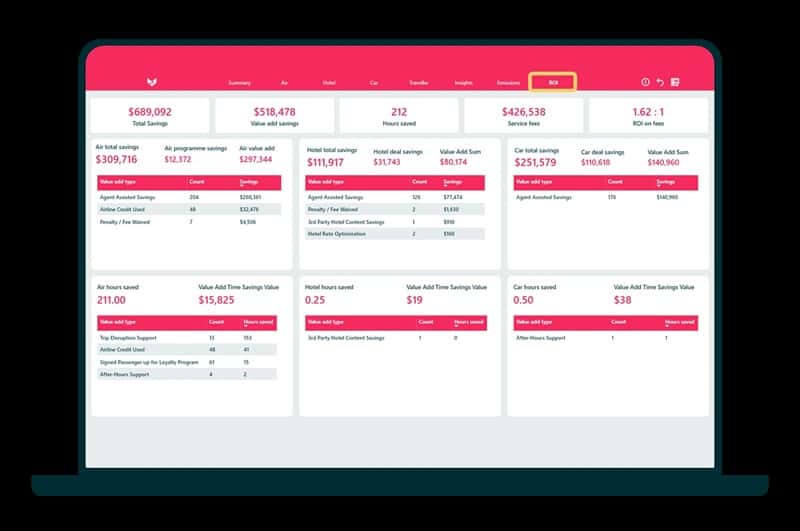
Corporate Traveller says its ROI Dashboard is available through its Your.CT platform. It gives customers a live, transaction-level view of what their travel program returns.
Its Australian site says the dashboard records savings on air, hotel, and car hire for like-for-like bookings. It also tracks waivers, credits and inclusions. These are converted into dollar values. Time savings are recorded too, along with a live fee-versus-savings ratio.
Crucially, the company says the figures trace back to actual bookings rather than broad market benchmarks. Corporate Traveller says the dashboard can therefore show finance and procurement teams the value generated from individual travel transactions, rather than relying solely on estimates or quarterly summaries.
That is a useful shift in emphasis.
Travel reports have long been good at telling a business what it spent. The harder task is showing what managed travel saved once service, disruption support and staff time are counted.
For finance teams, that may put the management fee in a clearer business context. For travel managers, it offers something stronger than a quarterly deck and a brave smile when the CFO asks, “But what did we actually get back?”
Putting a price on time
Craig Ackerley, Shared Services Finance Manager at Consolidated Power Projects Australia, says the value is in seeing the data clearly.
“The reporting and data analytics give us real visibility into our spend and how airline pricing shifts over time,” says Ackerley, who oversees projects and budgeting across hundreds of travellers. “With our flights and accommodation taken care of, it gives us back valuable time in the business to remain hands-on with daily operations.”
Time has traditionally been one of the most difficult benefits to price in managed travel.
An airline credit recovered by a consultant is fairly easy to count. So is a waived penalty. But how much is it worth when an employee does not spend 45 minutes waiting on an airline, rearranging a hotel or rebuilding an itinerary after a cancellation?
Until those hours are measured, they tend to become corporate travel’s equivalent of loose change down the back of the sofa valuable, certainly, but rarely appearing in the monthly accounts.
Corporate Traveller’s Australian platform says its ROI reporting now quantifies time savings and records them against customer accounts alongside other program savings.
Walley says the aim is to make the value visible without asking customers to wait for a formal review.
“We’re not asking businesses to take our word for the value we deliver,” adds Tom Walley. “Every dollar we save a customer is visible to them from their very first booking, against our management fee, on demand. Not at a review. Not when we choose to show it. Always.”
Visibility becomes the new battleground
Corporate Traveller is positioning the dashboard as a break from the old reporting model. Its Australian platform says customers can see savings, waivers, inclusions and time against the fee they pay. The data is available on demand.
The company also describes itself as the only TMC in the market offering this particular live, transaction-level combination of ROI reporting.
That remains Corporate Traveller’s own competitive claim rather than an independently audited comparison of every Australian TMC, an important distinction when assessing the proposition. What can be independently confirmed is that the company is publicly promoting the live dashboard, real-booking attribution, monetised time savings and fee-versus-savings measurement through its Australian platform.
“This changes the conversation,” Walley adds. “The fee stops looking like a cost on top and starts looking like a measurable return on investment.”
The timing makes sense.
Corporate Traveller separately reported in March 2025 that 48 per cent of Australian and New Zealand businesses in a wider global survey viewed automated expense tracking as the most transformative tool for their travel program. The survey covered 562 business decision-makers, travel managers and authorised travel bookers across the Americas, EMEA and ANZ.
Put simply, businesses want more visibility, not another spreadsheet with a prettier logo.
Corporate Traveller says the ROI Dashboard is available to its customers across Australia and New Zealand through its Your.CT platform.
For travel managers, the wider lesson is refreshingly simple. Savings that cannot be seen are difficult to defend.
And when every line of expenditure is under review, “trust us, it adds up” is not much of a business case.
By: Octavia Koo – © 2026.
Read Time: 4 minutes.
Author Bio:
 Octavia Koo arrived in Australia in the early eighties with little fuss and a good eye. Sydney suited her. At UNSW, she studied Arts, then found her footing in graphic design before drifting, quite naturally, into the digital side of things, building websites and shaping words that made people want to stay.
Singapore followed, and with it, the fast pace of tourism platforms and ITB Asia. Long before SEO became a buzzword, Octavia understood how stories travelled online. That’s where she met Stephen, and the seed for something more was planted.
A few years later, she joined Global Travel Media.
Today, Octavia works with quiet assurance, blending art, instinct and experience to produce stories that don’t shout; they simply work and linger.











