

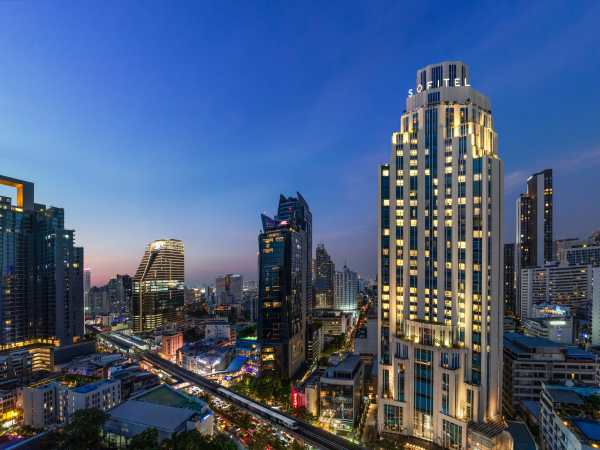
IDeaS, a SAS company and a provider of AI-powered hospitality revenue management software, today announced that Sofitel Bangkok Sukhumvit has achieved an 18% increase in revenue generation index (RGI) and a 10% increase in revenue per available room (RevPAR) following the implementation of IDeaS G3 Revenue Management System (RMS).
Located in one of Asia’s most dynamic hospitality markets, Sofitel Bangkok Sukhumvit operates in an environment where demand patterns shift quickly and competitive pressure is constant.
Prior to implementing IDeaS G3 RMS, the team relied on a system that functioned primarily as a reporting platform rather than a true optimisation engine. This limited their ability to fully capitalise on demand opportunities as they emerged.
“Staying responsive to the market is critical to protecting both rate integrity and optimising occupancy. Our previous systems were useful for reporting, but they didn’t provide the level of pricing optimisation we needed to react quickly to the market,” said Ivan Khrolenkov, Cluster Director of Revenue at Sofitel Bangkok Sukhumvit.
Under its previous approach to revenue management, the revenue team faced several structural constraints. Pricing rules limited flexibility across room types, and rates could only be updated once per day. As a result, the team often reacted to market changes after the fact rather than proactively shaping demand. These limitations led to missed revenue opportunities and required significant manual effort. Time spent on rate adjustments reduced the team’s capacity to focus on segmentation, demand analysis, and longer‑term strategy.
To move from reactive to proactive revenue management, Sofitel Bangkok Sukhumvit implemented IDeaS G3 RMS. The onboarding process was structured and collaborative, helping the team build confidence in the system and its tailor‑made recommendations.
With stronger forecasting, deeper segmentation insights and tools like Group Evaluation, both revenue and sales teams gained the ability to act faster with greater precision. Overbooking guidance enabled better control over occupancy, and granular forecasts strengthened pricing across segments and channels.
“The system allows us to react faster while protecting rate and optimizing occupancy,” observed Khrolenkov.
Comparing full year 2024 to full year 2025, Sofitel Bangkok Sukhumvit achieved more than an 18% increase in RGI and a 10% increase in RevPAR, reflecting stronger performance against its competitive set. These gains were driven by improved capture of high-value demand and greater confidence in pricing decisions.
“Sofitel Bangkok Sukhumvit’s improved commercial outcomes demonstrate what can be achieved when revenue teams have the right technology and insights to move beyond reactive decision-making,” said Jurgen Ortelee, Managing Director, APAC, IDeaS. “By combining pricing optimisation with more granular forecasting and demand analysis, the hotel has strengthened its competitive performance while enabling its commercial teams to focus more of their time on strategy and identifying new revenue opportunities.”
Beyond straight revenue performance improvements, Sofitel Bangkok Sukhumvit’s commercial approach has also evolved.
“We’ve shifted from manual, reactive work to a much more strategic and analytical approach. That change has made a real difference in how we manage revenue,” concluded Khrolenkov.











