

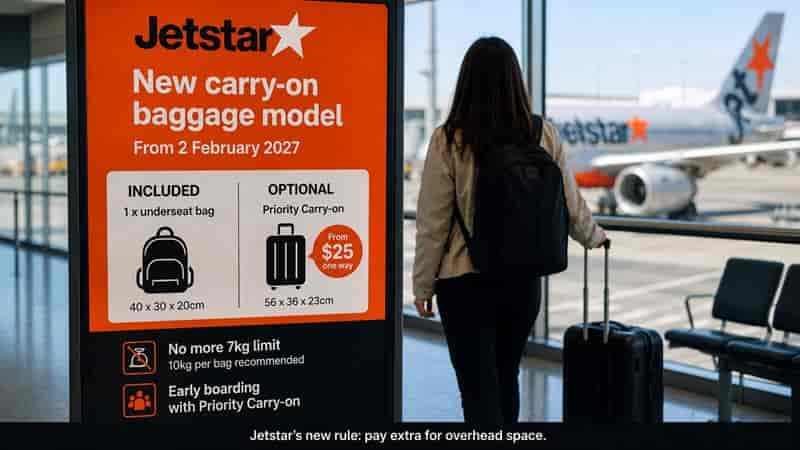
Jetstar has put the bathroom scales on notice. From 2 February 2027, the airline will abandon its familiar 7kg cabin-bag limit and move to a size-based carry-on system.
That sounds wonderfully simple until one notices the overhead locker has acquired a cover charge.
Under the new model, every Jetstar Airways economy booking will include one bag that fits beneath the seat. It may be a backpack, handbag or laptop bag, but it must measure no more than 40 × 30 × 20cm.
Passengers wanting a second, larger cabin bag will need to buy Priority Carry-on. The add-on permits an overhead bag measuring up to 56 × 36 × 23cm and includes early boarding.
Jetstar says it will no longer routinely weigh cabin bags at the gate. Customers will still be asked to keep each carry-on bag to 10kg so they can lift it safely without assistance.
The scales may be disappearing, but common sense has not been checked through to the carousel.
Overhead locker space gets a price tag
Priority Carry-on will be limited and priced according to the route. Jetstar’s published fares start at $25 one-way between Launceston and Sydney. The quoted prices are $33 between Sydney and Melbourne, $39 from Perth to Bali, and $52 from Cairns to Tokyo Narita.
Those figures apply to selected flights and travel dates. Jetstar says prices may vary, while some payment methods may attract a fee.
That is the detail likely to drive much of the public reaction. Jetstar is presenting the change as a simpler carry-on model, while news coverage has focused on passengers paying up to $52 to place a bag overhead.
Both descriptions are accurate.
The sharper question is not whether the system is simpler. This is what will be included in the advertised fare once the new rules take effect.
For passengers who travel light, the model may work rather well. A small backpack under the seat means no routine gate weigh-in and no last-minute hunt for overhead space.
For the traveller carrying a standard wheelie bag, however, the fare comparison becomes more complicated. The suitcase now requires a ticket of its own.
Jetstar says faster boarding is the aim
Jetstar chief executive Stephanie Tully said customer and crew research had identified gate weighing and crowded overhead lockers as two of the more stressful parts of the airport experience.
“We know that weighing carry-on bags at the gate can be frustrating for our customers and for our crew,” Tully said.
“To make packing easier we’ve decided to remove the 7kg weight limit, so from February, the main thing customers will need to think about is the size of their carry-on.”
Tully said the optional Priority Carry-on product should help Jetstar use locker space more efficiently.
“By giving customers an underseat bag with the option to add Priority Carry-on, we can make better use of overhead locker space, streamline boarding and help more flights depart on time,” she said.
“Our new carry-on baggage model provides more choice to customers while helping to keep our fares low. You only pay for what you need – travelling with less means paying less, and you can always add more if you need.”
There is practical sense behind that argument. Cabin bags can slow boarding as passengers stop in the aisle, search for space and rearrange other people’s possessions with the concentration of a suburban removalist.
Selling overhead capacity in advance gives Jetstar a clearer picture of how many larger bags are likely to enter the cabin. It may also reduce the gate-side ritual of weighing, repacking and wearing half the contents of a suitcase.
Swinburne expert explains the commercial logic
Swinburne aviation expert Salim Hijazeen says the decision should be viewed through the lens of a low-cost airline’s operating model, rather than simply as another charge imposed on travellers.
Hijazeen is listed as an aviation lecturer within Swinburne University of Technology’s Department of Aviation.
“Jetstar has generally been able to offer lower fares because passengers only pay for the services they actually need,” Hijazeen said.
“This is no different in principle to paying extra for seat selection or checked baggage. It’s another example of the low cost/value-based carrier model.”
His analysis goes to the heart of the Jetstar proposition. Low-cost and value-based carriers build their headline fares around a basic seat, then allow customers to add the services they value.
The approach can make the lowest fare genuinely cheaper for passengers carrying little more than a handbag or laptop. It can also make comparison shopping more difficult when a traveller needs a seat, a larger cabin bag, checked luggage, and a preferred seat on the aircraft.
Ancillary services such as baggage, seating and priority products have become an important part of the low-cost airline business model. They allow carriers to advertise a low entry fare while earning additional revenue from customers who need more than the basic product.
Hijazeen said the operational case also deserved attention.
“It’s true that some flights are delayed because cabin crew are trying to find space in the overhead lockers, and even small delays can have a knock on effect across the rest of the day’s schedule,” he said.
“Better compliance at the gate with carry-on baggage limits can also help, so it will be interesting to see whether this change actually reduces turnaround times and improves operational performance.”
That point is important. A short delay at the beginning of an aircraft’s operating day can flow through later sectors, particularly when schedules, gates, crews and airport slots are tightly organised.
A faster boarding process may therefore deliver more than a tidier cabin. It may help protect the timetable.
The real test will come after implementation. Jetstar will need to show that the new system does more than transfer stress from the gate scales to the payment screen.
Expert credit: Swinburne aviation expert Salim Hijazeen, Swinburne University of Technology.
Passengers will decide whether it works
Hijazeen expects some customers to object, especially on longer routes where the Priority Carry-on charge may be higher.
“Time will tell whether this was a smart commercial decision,” he said.
“If passengers continue booking Jetstar despite the additional fee, then the strategy will probably be considered a success.”
That is the commercial equation in its plainest form. Airlines may explain product design, operational efficiency and customer choice, but the booking engine supplies the final verdict.
If travellers continue to select Jetstar after adding the services they need, the model will have done its job. If they shift to competing carriers once the total trip price is calculated, the airline may need to reconsider the balance.
Consumer advocates have long argued that unbundled airline pricing can make the true cost of a journey harder to compare. The base fare may appear attractive, but the final amount can rise considerably after baggage, seating and other extras are selected.
Hijazeen does not expect the approach to spread quickly across Australia’s full-service airlines.
“I don’t see full service airlines introducing a similar model anytime soon. This type of product unbundling is much more consistent with the business model of low cost and value based carriers, where keeping the headline airfare as low as possible is a key part of attracting customers,” he said.
That distinction matters. Full-service carriers usually position a broader package of inclusions as part of the fare. Low-cost airlines compete more aggressively on the entry price and charge separately for optional services.
Who will be covered by the new rules?
The new carry-on policy applies to Jetstar Airways, or JQ, flights departing from 2 February 2027. It will not apply to Jetstar Japan-operated GK services or group bookings of 10 or more passengers.
Customers who already have bookings for travel after the start date will receive Priority Carry-on at no additional charge.
Customers travelling with an infant may carry an extra underseat bag containing baby items at no cost.
Jetstar’s checked-baggage rules are unchanged, with customers able to purchase up to 40kg per passenger.
For travel agents, the message must be delivered early and plainly. A client may reasonably assume that “carry-on included” means the small suitcase taken aboard on previous trips.
From February 2027, it may not.
Agents should check the dimensions of the traveller’s bag, explain that Priority Carry-on has limited availability and compare the add-on with the price of checked baggage before issuing the ticket.
Customers should also be told that the published Priority Carry-on prices are starting examples, not fixed charges across every flight. The amount may vary depending on the route, date, demand, and availability.
The low fare may require some arithmetic
The cost deserves particular attention on return itineraries. A $25 one-way charge becomes $50 return. A $52 add-on becomes $104.
Add seat selection, checked baggage, or payment costs, and the bargain displayed in large type may look rather more formal once all its accessories are in place.
Jetstar is not inventing the concept. Several overseas low-cost airlines already include a small personal item and charge separately for a larger bag placed in the overhead locker. EasyJet, for example, introduced a similar distinction between free underseat baggage and paid overhead storage several years ago.
The model is established and commercially proven. Whether Australians find it easy to love is another question.
The policy is likely to reward disciplined packers. It may irritate travellers who regard the overhead locker as part of the seat rather than an optional product.
It could also create new pressure at check-in and boarding if passengers arrive with bags that fit neither beneath the seat nor within their purchased allowance. Jetstar’s existing rules already impose much higher charges when excess baggage is dealt with at the airport rather than added in advance.
The airline will therefore need clear booking information, prominent size limits and consistent enforcement. Without those safeguards, a policy designed to reduce boarding stress could simply give that stress a new boarding pass.
Jetstar may have removed the 7kg limit, but it has not removed the need to read the fine print.
It has simply moved that fine print from the scales to the shopping cart.
By: Jill Walsh – © 2026.
Read Time: 6 minutes.
Author Bio:
 Jill Walsh has always kept a pen close and a suitcase closer. She started out on media releases, then learned the trade properly by escorting press trips around the world, discovering which stories travel well and which need a sharper edit.
Before long, she wasn’t just promoting destinations; she was representing them, translating civic ambition and local pride into words people actually wanted to read. These days, semi-retired and happily so, Jill has traded departure boards for deadlines, joining old friend and colleague Stephen at Global Travel Media on a casual basis.
Her patch is the business end of wanderlust: balance sheets, route maps, tender wins and the numbers that quietly decide where travellers go. She writes with dry humour, clean prose and an old-school respect for facts a steady voice when the market starts shouting.











