

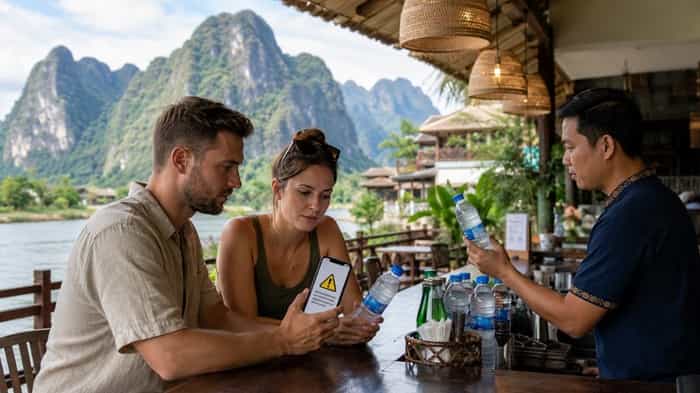
Australia has raised its travel warning for Laos. Smartraveller now tells Australian travellers to exercise a high degree of caution across the country.
The warning rests on three main risks: crime, methanol poisoning and a lack of transparency in the Lao justice system. Higher warnings apply in some areas. Australians should reconsider travel to Xaisomboun Province due to the risk of armed attacks and exercise particular caution in Bokeo Province, including around the Golden Triangle Special Economic Zone.
The full details are available in Smartraveller’s current Laos travel advice, which should be checked again immediately before departure.
Laos remains open. Its temples, river towns and limestone hills have not packed their bags. Yet the tourism trade now faces a hard fact: trust walks, while bad news tends to fly business class.
The deaths that changed the warning
The tougher advice follows a mass methanol-poisoning incident in Vang Vieng in November 2024 in which six foreign tourists died.
They included Australians Bianca Jones and Holly Morton-Bowles, both 19, two Danish women, a British woman and an American man.
The deaths were associated with drinks consumed in the well-known backpacker town, but the legal facts require care.
Lao police have said they do not have enough evidence to lay charges directly relating to the six deaths. A distillery owner has instead been charged with operating an illegal business and selling products considered harmful to health.
Those charges have not been explicitly linked to the deaths of Jones and Morton-Bowles.
There is also a gap between official accounts of the possible jail term. Denmark’s Ministry of Foreign Affairs said the charges may carry between three months and four years in prison, plus a fine. Australian officials have reportedly assessed the maximum term as one year.
That discrepancy remains unresolved.
Danish officials also said the case would formally remain open for 15 years, meaning more serious charges could still be brought if sufficient evidence emerged. The charges and legal uncertainty are detailed in ABC News reporting on the Lao investigation.
For the families, that offers scant comfort. For the travel trade, it shows why clear facts matter when lives, confidence and a nation’s good name are at stake.
Australia pushes for justice
Foreign Minister Penny Wong said the Australian Government was “deeply frustrated and bitterly disappointed” that Lao authorities were not pursuing the most serious charges.
The Australian Government appointed Pablo Kang as Special Envoy. He travelled to Laos to convey the government’s objections and reinforce its demand for a thorough investigation capable of delivering justice.
The Acting Secretary of the Department of Foreign Affairs and Trade also called in the Lao Ambassador in Canberra. The official Australian Government statement says Australia will continue advocating for the families at every level.
This matters because the warning is now about more than unsafe drinks. It also raises a difficult question: can a visitor expect a fair and transparent legal response when a journey ends in grave harm?
Smartraveller warns that the Lao legal system may not provide transparency or justice, particularly in criminal cases, and says laws may be applied inconsistently.
That is not a call for panic. It is a call to plan properly.
Avoid Tiger Vodka and Tiger Whisky
Lao authorities have issued an order prohibiting the sale and consumption of Tiger Vodka and Tiger Whisky because of serious health concerns. Australian travellers are advised to avoid both products.
A label is not a shield. A familiar logo is not a laboratory test. Even a licensed bar cannot prove that every bottle has a safe history.
Smartraveller says bottle labels may be inaccurate. It urges travellers to take special care with cocktails and other spirit-based drinks, to use reputable, licensed venues, and to avoid homemade alcohol.
Methanol is highly toxic. It can be added to unregulated alcohol to cut production costs or created accidentally during poor-quality distillation and production. As little as one shot can be fatal.
Methanol is colourless and odourless. There is no reliable way to identify it in an alcoholic drink by smell, taste or appearance. British travel advice on methanol risks in Laos also warns that cases have involved drinks purchased from licensed bars, shops and hotels in tourist areas.
A bold sniff at the bar may impress a mate. It will not impress a toxicologist.
Know the signs
Methanol poisoning can initially resemble a severe hangover. Symptoms can include fatigue, headache, dizziness, vertigo, nausea, abdominal pain, breathlessness and vision problems.
Symptoms may take 12 to 24 hours to appear, and a hangover that is unusually severe or continues to worsen should be treated as a warning sign.
Anyone who may have consumed methanol needs urgent medical attention. Do not wait to see whether the symptoms pass. Prompt treatment may save a life or prevent permanent disability.
Travellers and travel businesses can find printable factsheets, symptom posters and safer-drinking guidance through Smartraveller’s methanol-poisoning information hub.
Risk can be reduced, although it cannot be removed completely. Avoid free shots, unlabelled bottles, home-made spirits and drinks sold at prices that make little sense.
Choose branded, sealed drinks from reputable venues. Keep drinks in sight. Stay with people you trust. Seek help at once if a friend becomes far more ill than a normal night out would explain.
A night at the bar should end with a cab, not a blood test.
Health care can be basic
Medical facilities in Laos are generally basic. Hospitals outside Vientiane have very limited capacity, and Smartraveller advises travellers to seek care in Vientiane or Thailand where possible.
Many doctors and hospitals require cash before providing treatment, including emergency care. A seriously ill or injured traveller may need evacuation to Thailand or another country.
That can be difficult and very expensive.
Comprehensive travel insurance is therefore essential. It should cover overseas medical care and emergency evacuation. Travellers must also read the policy terms before leaving Australia.
The Product Disclosure Statement may not be poolside reading. It is still more useful than discovering an exclusion from a hospital bed.
Adventure activities require particular care. Smartraveller warns that transport, tour, adventure, and water sports operators may not meet Australian safety or maintenance standards.
River tubing, zip-lining, hot-air ballooning, rock climbing, and fast-boat travel may pose additional risks. Some policies will not cover every activity, and cover may be limited where alcohol was involved.
Check first. Drink later. Do not mix alcohol with river or adventure activities.
What the travel trade must do
The revised warning gives Australian agents, tour operators, wholesalers and hotel partners a clear professional and commercial responsibility.
Clients should receive the latest Smartraveller advice when they enquire, when they book and once more before they leave. A link sent six months ago may be old news by the time of check-in.
Tour operators should ask local partners where they buy alcohol and how they store it. Welcome drinks, meal plans, bar crawls, party tours and free-shot offers all need a fresh review.
The checks are straightforward. Does the venue buy from legal, trusted suppliers? Are bottle seals inspected? Are drinks opened in front of guests? Do staff recognise the signs of methanol poisoning? Is there a written emergency plan? How long would it take to reach suitable medical care?
These are not extravagant demands from a jumpy head office. They are ordinary safety checks, much like those used for vehicles, boats, food, fire exits and life jackets.
Responsible Lao travel businesses also stand to gain from firmer standards. They should not pay for the actions of unsafe producers or poorly managed venues.
Clear supply chains, sound records and trained staff can help rebuild confidence.
Laos still has much to offer
Laos still offers the sights and hospitality that have drawn Australians for years. Luang Prabang has its temples. The Mekong still sets a calm pace. Vang Vieng still has vast cliffs and green fields.
The right response is not to condemn an entire country. Nor is it wise to act as though nothing has changed.
Travellers need plain advice. Agents need sound procedures. Local businesses need firm standards. Governments need to pursue the truth and communicate with care.
Tourism runs on trust. Once lost, it is not restored by a bright advertisement and a glass raised for the camera.
Laos remains open, but the advice for Australians is clear. Check the latest warning. Buy drinks from trusted sources. Avoid Tiger Vodka and Tiger Whisky. Carry suitable insurance. Seek urgent medical care if poisoning may have occurred.
And when a spirit seems far too cheap, keep the oldest rule in travel in mind: the true cost of a bargain may not be shown on the menu.
By: Michelle Warner – © 2026.
Read Time: 6 minutes.
Author Bio:
 Michelle Warner has always carried stories the way others carry passports lightly, faithfully, and with purpose. She learned her craft in newsrooms, shaping sentences with care, before swapping deadlines for departures as a flight attendant with some of the world’s great airlines. Years aloft sharpened her eye for character and deepened her fondness for the small, dignified rituals of travel, the quiet kindness of strangers, the poetry of arrival, the patience learned between time zones.
Now grounded by choice, Michelle has come home to writing with the same calm authority she once brought to turbulent cabins. Her prose blends an editor’s discipline with a traveller’s wonder, tinged with humour and reverence for the golden age of travel. Each piece feels like a handwritten boarding pass, gracious, observant, and unmistakably alive.











