


Hilton has checked in with a strong second-quarter result. The numbers should please hotel owners, travel sellers and investors alike. Better still, the growth was not built on room rates alone.
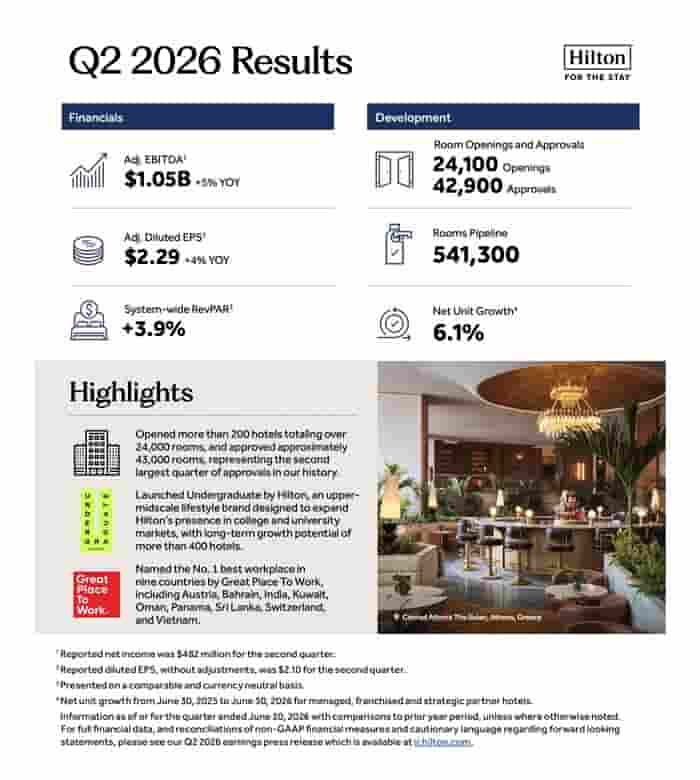
The global hotel group made net income of US$482 million for the three months to 30 June 2026. That was up from US$442 million a year earlier. Adjusted EBITDA rose to US$1.054 billion from US$1.008 billion. Diluted earnings per share climbed to US$2.10 from US$1.84. On an adjusted basis, earnings reached US$2.29 a share.
Hilton’s system-wide RevPAR rose 3.9 per cent on a currency-neutral basis. RevPAR means revenue per available room. It is a key test of hotel trade. Both occupancy and average daily rates improved.
In plain English, more rooms were sold, and guests paid more for them. That is a far sounder result than a rise driven solely by price. It is also the hotel trade’s ideal double act. The beds are busy, and the rates are holding.
Strong profit, mixed world
Chief executive Christopher J. Nassetta said: “We delivered strong top and bottom-line results for the second quarter, driven by the continuation of strengthening demand trends and broad-based momentum across our system.”
Management and franchise fee income rose 6.4 per cent in the quarter. It rose 8.3 per cent in the first half. This is vital to Hilton’s model. The group earns fees from a vast hotel network without owning any of the properties.
Total revenue reached US$3.341 billion, up from US$3.137 billion. Operating income rose to US$858 million from US$778 million. Yet interest expense also climbed. It reached US$183 million, against US$151 million a year ago.
Debt, it seems, remains one hotel extra that is never free.
The world result was strong, but it was not even. US RevPAR rose 5.4 per cent. Europe gained 4.3 per cent. The Americas outside the US grew 4.6 per cent. Asia Pacific rose by a softer 1.2 per cent.
The Middle East and Africa were the weak spot. RevPAR fell 29.5 per cent in the region. Occupancy dropped 16.1 percentage points. Average room rates also fell 8.1 per cent.
That sharp fall does not erase the group result. It does show why a world average needs care. A full lobby in New York cannot fill an empty room elsewhere.
Room pipeline steals the show
Hilton opened 207 hotels in the quarter. They added 24,100 rooms to the system. After exits and other changes, net room growth was 21,600. Openings rose 50 per cent from the first quarter.
That pace helped lift net unit growth to 6.1 per cent over the year. Hilton still expects growth of between 6.0 per cent and 7.0 per cent in 2026.
The bigger figure sits in the pipeline. Hilton ended June with a record 541,300 rooms planned across 3,853 hotels. Those projects span 132 countries and territories.
Almost half of the rooms were already being built. More than half were outside the United States. The pipeline also reached 26 markets where Hilton had no open hotel.
This is more than a stack of plans on a developer’s desk. It points to future fees, broader brand reach, and more Hilton Honors members. It should also give agents more stock to sell.
Some openings carried real weight. Conrad Athens The Ilisian marked the Conrad brand’s debut in Greece. The hotel rose from a major remake of the former Hilton Athens and opened on 23 April 2026.
In India, Slohh by Roach Bengaluru joined Curio Collection by Hilton. It became the brand’s first hotel in India. It was also Hilton’s first lifestyle hotel in the country.
Hilton also opened its first three Apartment Collection hotels. They are in Salt Lake City, Austin and Atlanta. New deals included Waldorf Astoria Miami Beach. Another was Umfolozi River Hotel, Tapestry Collection by Hilton, in South Africa.
Undergraduate joins the class
Hilton also launched Undergraduate by Hilton in June. The upper-midscale brand targets college and university towns. It will sit beside Graduate by Hilton but serve a wider set of markets.
The brand can be used for new hotels or conversions. That gives owners more choice. It can also cut the time and cost needed to open.
Its guest list is wider than the name may suggest. Hilton is aiming at students, parents, former students, sports fans and business travellers. Events and conferences should add more demand.
The idea makes sense. College towns have clear peaks through the year. Graduation, sports, and campus events can fill rooms fast. Parents often learn this only after every decent bed has gone.
Undergraduate gives Hilton a lower-priced way into more of these towns. It also adds one more rung to a brand ladder that now has 28 names.
That range can help Hilton meet many needs. It can also test how well guests know each flag. Even the best hotel portfolio may need a map at reception.
Cash returns, debt remains
Hilton bought back 2.9 million shares in the quarter. It spent US$932 million at an average US$326.99 a share. With dividends, it returned US$966 million to investors in the quarter.
Capital returned through July reached US$2.034 billion. Hilton expects about US$3.5 billion for the full year. It paid a US$0.15 quarterly dividend in June. The board has approved the same sum for September.
The cash return is large. So is the debt pile.
Hilton had US$13.4 billion of debt at the end of June. Its weighted average interest rate was 5.03 per cent. Cash and cash equivalents stood at US$1.064 billion.
In May, Hilton issued US$1 billion in senior notes. They carry a 5.5 per cent rate and fall due in 2031. The group used some of the funds to repay US$450 million on its credit line.
No sum was drawn on that line at quarter-end. Hilton had close to US$1.9 billion left to borrow after letters of credit.
A brighter outlook, with fine print
Hilton now expects full-year RevPAR growth of between 3.0 per cent and 3.5 per cent. Its first-quarter range was 2.0 per cent to 3.0 per cent. The lift shows more faith in demand.
Adjusted EBITDA is now expected to be US$4.04 billion to US$4.08 billion. Net income is forecast at US$1.883 billion to US$1.911 billion. Net unit growth remains at between 6.0 per cent and 7.0 per cent.
The new guide needs a close look. The RevPAR range is higher. The middle of the EBITDA range has also risen. Yet the net income range is lower than it was after the first quarter.
Demand is doing more work, but not every cost is moving the right way.
For the third quarter, Hilton expects RevPAR to rise about 4.0 per cent. Net income should reach US$502 million to US$516 million. Adjusted EBITDA is expected to be US$1.035 billion to US$1.055 billion.
The FIFA World Cup should help the quarter. Better dates in the calendar should help too. Hilton sees less kind timing in the fourth quarter. It also expects the US midterm elections to weigh on trade.
Hotels remain tied to the calendar. People travel when they meet, vote, play and celebrate. At times, they also stay home.
What it means for travel
The quarter sends three clear signals to the travel trade.
First, hotel demand is stronger. Both room use and rates rose. That points to a broad gain, not a price trick.
Second, Hilton is opening hotels at a faster clip. Its record pipeline should add more rooms outside the US. It should also open new markets to the brand.
Third, Hilton keeps cutting the market into smaller parts. It has luxury hotels, lifestyle stays, long-stay rooms and now a fresh college-town offer. That gives agents more choice. It gives owners more ways to join the system.
There are risks. Debt costs are higher. Some regions are weak. Geopolitical conflict, slow economic growth and new travel barriers can change demand fast. Hilton’s own guide is a forecast, not a promise. Its filings also warn of inflation, interest rates, labour issues, supply chain strain, and shifts in travel policy.
Still, the core result is sound. Profit rose. Fees grew. More hotels opened. The pipeline set a record.
Hilton has not claimed the hotel cycle is won. It has simply placed another 541,300 rooms in the queue. For now, the “vacancy” sign is staying in the cupboard.
By: Bridget Gomez – © 2026.
Read Time: 6 minutes.
Author Bio:
 Bridget has never been built for stillness. Of Portuguese heritage, she began as a nurse, tending veterans at the Repatriation Hospital, listening to stories as colourful as the life she was yet to live. It was worthy, steady work, but wanderlust, as always, proved louder than routine.
So, she traded starch for a backpack and disappeared for a year, chasing trains, sunsets and the occasional regrettable glass of wine. She wrote everything down: the dust, the laughter, the missteps, the magic. Those notebooks became a travel blog, then a habit, then a calling.
Eventually she found Global Travel Media, or perhaps it found her.
Today Bridget writes with heart, humour and a dash of mischief, still travelling, just now with words.











