

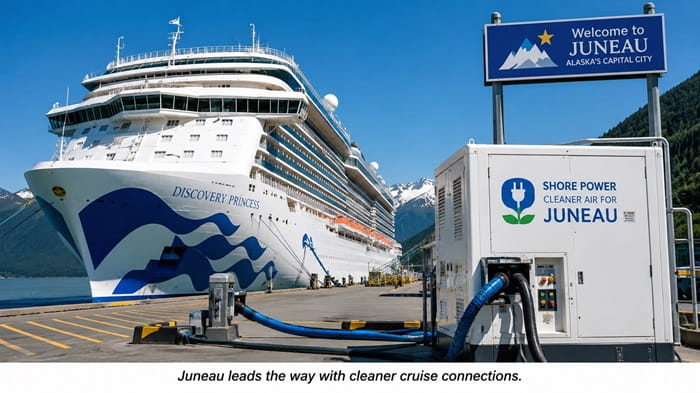
Princess Cruises has marked 25 years since it first plugged a passenger ship into Juneau’s hydroelectric grid. It may have looked like a cable and a switch. In truth, it helped change the way cruise ports think about cleaner calls.
The system began at Juneau’s Franklin Dock in 2001. It let ships turn off their diesel engines while in port and use local electricity instead. The project was the first shore-to-ship power system of its kind for passenger vessels. It was also no small feat. Juneau runs a small, isolated power grid, not a vast network with spare capacity at every turn.
Cruising enjoys a grand occasion, preferably with champagne and a ribbon large enough to be seen from the bridge. Yet this quiet anniversary deserves a proper salute. Shore power is not the whole answer to cruise emissions. It does, however, cut engine use, smoke, noise and vibration while a ship is tied up.
Cleaner calls add up over 25 years
Princess says the Juneau partnership has made 1,725 shore power connections. It has used 123,668,490 kilowatt-hours, or about 123.7 million kWh, of hydroelectricity. The cruise line also reports that the program has avoided 84,533.60 metric tonnes of emissions.
The local benefit is just as striking. Princess says US$11,242,400 has flowed into Community Partnership, or COPA, credits for Juneau. Alaska Electric Light & Power says the money paid for electricity goes through a local cost-of-power account. It can help offset diesel costs and return surplus value to Juneau homes and businesses.
Princess Cruises president Gus Antorcha said the partnership had “demonstrated what’s possible” when business, government and communities work towards the same goal. That is the heart of the story. The plug is clever. The lasting partnership is smarter.
Juneau’s bold move became a global model
Princess worked with the City and Borough of Juneau and Alaska Electric Light & Power to build the original system. Local records confirm that Juneau led the world with this type of shore power in 2001. Other ports later followed, including Seattle, Vancouver, Los Angeles, San Diego, San Francisco, New York and Halifax.
Princess now says 41 cruise ports around the world have shore power. That sounds like solid progress, and it is. Still, the global gap remains wide. Cruise Lines International Association says fewer than 3 per cent of the world’s cruise ports offer onshore power at a cruise berth.
A modern ship cannot plug into a socket that does not exist. Ports need strong grids, costly equipment, safe links and close planning with cruise lines. This is not a job for an extension lead and an optimistic harbourmaster.
The source of the electricity also matters. Shore power offers its best result when the grid is clean. CLIA says it can cut covered emissions by up to 98 per cent, based on the local energy mix. Juneau’s hydroelectric supply gives the project a clear edge.
Benefits reach beyond the dock
Juneau Mayor Beth Weldon said the city remained proud to be “the port that pioneered shore power”. AEL&P president and chief executive Alec Mesdag praised the “innovation, trust and close collaboration” behind the project.
For Juneau, the gains are easy to see and hear. Less engine use can mean less smoke, noise and vibration near the waterfront. Power sales keep more money in the local economy. City documents have also linked shore power with a better downtown visitor experience and a stronger cruise port.
This is why the program still matters after 25 years. Green plans often arrive with bright banners, bold promises and a rather shy budget. Juneau’s system stayed at work. It kept ships connected and produced results that can be counted.
Why the milestone matters to travel advisors
Princess has sailed in Alaska for almost 60 years. The state remains a core part of the brand and a major draw for cruise clients. For travel advisors, the Juneau story offers a sound example of destination care that goes beyond a glossy brochure.
Advisors should keep the claim in proportion. Shore power cuts emissions while a ship is in port. It does not remove emissions from the full voyage. Even so, it shows what can happen when ports, utilities and cruise lines invest in a practical idea and stay with it.
Carnival Corporation, the parent of Princess, says about 75 per cent of its fleet of more than 90 ships can use shore power. The next task is to build more ports able to supply it.
Juneau’s lesson is refreshingly old-fashioned. Build sound infrastructure. Keep faith with good partners. Measure the result. The cable may never look as grand as an Alaska glacier, but after 25 years it has earned a firm place in cruise history.
By: Anne Keam – © 2026.
Read Time: 4 minutes.
Author Bio:
 Anne Keam’s story begins in Queensland, on a grain farm in the state’s wide western reaches, where the days were long and the lessons simple: work hard, look after your own, and don’t make a fuss. Those early years left their mark.
She later studied Arts at the University of Queensland, before doing what felt natural at the time, heading back home to the family property. But the world was calling. Anne packed a backpack and went looking, spending years on the road and finding herself most alive in South America. She wrote everything down along the way. Those notebooks, full of dust, colour, and curiosity, eventually became her blog, a quiet, personal record of seeing the world and learning from it.











