

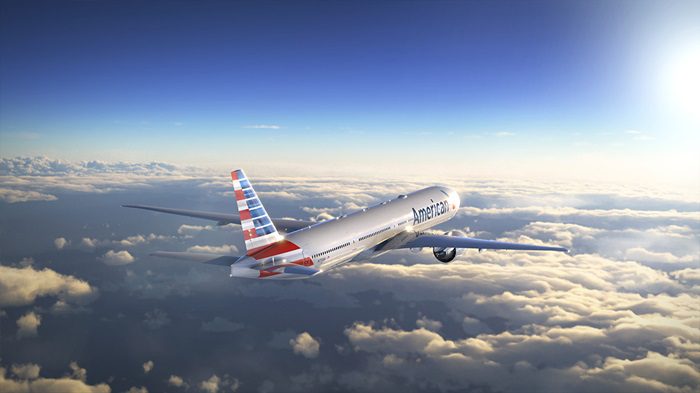
American Airlines has delivered record quarterly revenue of US$16.7 billion, but an 83 per cent rise in fuel expense left the carrier with little room for a financial victory lap.
American Airlines has posted the highest quarterly revenue in its history. That is the headline. The footnote is less festive.
The carrier brought in US$16.7 billion during the three months to 30 June 2026. Revenue rose 16.3 per cent from the same quarter last year. Yet fuel costs also surged. As a result, the airline finished with a profit that looked rather small beside that vast sales figure.
American reported GAAP net income of US$71 million, or US$0.11 per diluted share. Adjusted net income was US$99 million, or US$0.15 per diluted share. Its operating profit was US$446 million.
By calculation, that gives American an operating margin of about 2.7 per cent. Its GAAP net margin was close to 0.4 per cent. In plain English, the airline sold a great many seats, upgrades and loyalty products. It still kept less than one cent in net profit from each dollar of revenue.
That does not make the quarter a failure. Far from it. It does show how hard it is to run a major airline when fuel prices turn hostile.
Four pillars push American Airlines revenue higher
American says its growth came from four main parts of its plan. They are a better customer experience, a wider global network, more premium revenue and stronger loyalty.
Chief executive Robert Isom said, “This performance reflects the strength of our commercial strategy.”
The results back his point. Premium passenger unit revenue rose 13.4 per cent from a year earlier. Main Cabin passenger unit revenue rose 8.8 per cent. Domestic passenger unit revenue was up 10.6 per cent.
Demand was also strong offshore. Atlantic passenger unit revenue rose 8.9 per cent. Pacific revenue climbed 15.1 per cent, while Latin America gained 6.6 per cent.
Corporate travel was another bright spot. Managed corporate revenue rose 26 per cent from the second quarter of 2025. It was the fifth quarter in a row with double-digit growth.
That is good news for travel advisers and travel managers. It shows that firms are still willing to spend on well-run travel programs. They want useful schedules, clear fare rules and help when plans go wrong. A cheap seat has its place. A capable person at the end of the phone still has one too.
Premium demand keeps doing the heavy lifting
Premium travel remains a major source of growth. American is adding more high-value seats through new Boeing 787-9 and Airbus A321XLR aircraft. It is also upgrading its Boeing 777-300ERs, 777-200ERs, Airbus A319s and A320s.
The logic is simple. Premium seats bring in more revenue from the same flight. That matters even more when fuel costs rise.
American says it will offer more premium seats than any other airline during the northern summer. That claim will interest both rivals and agents. More premium supply can create more choice, but it can also lead to sharper price moves when demand shifts.
American also changed parts of its checked-bag fee structure and Basic Economy offer. Those moves helped lift the share of travellers who upgraded from Basic Economy to Main Cabin by five percentage points.
There is a lesson here for the trade. The lowest fare is not always the best fare. Clear advice on bags, changes, seat choice and loyalty value can save a client money and grief. It can also protect an adviser from the old airport complaint: “Nobody told me.”
Fuel costs spoil the party
Fuel was the quarter’s main problem. American said its fuel expense rose by more than US$2.2 billion, or 83 per cent, from a year earlier.
The airline’s financial fact sheet shows fuel and related taxes of US$4.9 billion. That was its largest operating expense. Salaries, wages and benefits came next at US$4.6 billion. Total operating costs reached US$16.3 billion.
Higher fares and stronger sales helped offset almost half of the fuel hit. That is a solid result. It also shows why customers may see firm pricing even when aircraft are full.
Fuel is not a small line in an airline budget. It can change a quarter at speed. It can also undo careful work in sales, schedules and service.
American expects the pressure to stay. Based on the forward fuel curve at 21 July, it expects third-quarter fuel expense to be US$1.7 billion higher than last year. It also expects to pay about US$3.75 per gallon on average.
The airline now forecasts full-year adjusted earnings or loss of between negative US$0.65 and positive US$0.65 per diluted share. That is a wide range. It is also an honest sign that fuel prices can make forecasts age rather quickly.
For the third quarter, American expects revenue growth of 16 to 19 per cent. It expects capacity to rise 3 to 5 per cent. Adjusted earnings are forecast at a loss of US$0.70 to US$0.10 per diluted share.
So, yes, sales remain strong. Profit is another matter.
New routes add reach and higher-value demand
American kept growing its global network during the quarter. It launched nonstop flights from Philadelphia to Budapest and Prague. It also began nonstop service from Dallas–Fort Worth to Athens.
The carrier also returned to the Miami–Caracas route. American said it was the first United States airline to resume service to Venezuela.
These routes are not only dots on a map. They target markets that may support higher fares and premium demand. They also give agents more ways to build trips through American’s large hubs.
Miami remains vital for Latin America. Philadelphia plays a strong role across the Atlantic. Dallas–Fort Worth gives American a huge base for domestic and long-haul links.
The airline also changed the timing of flight banks at Dallas–Fort Worth. It said system misconnections fell by almost 25 per cent from a year earlier. Unit revenue at the hub rose four percentage points above the airline-wide average.
Across the network, capacity rose 5.4 per cent. On-time arrival performance improved by 2.8 percentage points.
Those gains matter. A missed connection can wreck a holiday, a meeting or a family visit. Better hub timing is not glamorous. It is, however, the kind of work that passengers remember when it goes wrong.
Lounges and Wi-Fi support the premium pitch
American reported a five-point rise in its Net Promoter Score from a year earlier. The score is used to track whether customers would recommend the airline.
The carrier is also improving its Admirals Club and premium lounge network. Work is under way or planned at New York JFK, Dallas–Fort Worth, Charlotte and Miami.
From 2027, American plans to begin installing Starlink high-speed Wi-Fi on its fleet. Reliable internet is now close to a basic need for many business travellers. It is also useful for leisure guests who prefer streaming to studying the safety card for a third time.
Better lounges and Wi-Fi can support higher fares. Yet they must work well. A fine lounge cannot rescue a poor trip, and “high-speed” Wi-Fi has a habit of being judged by its speed.
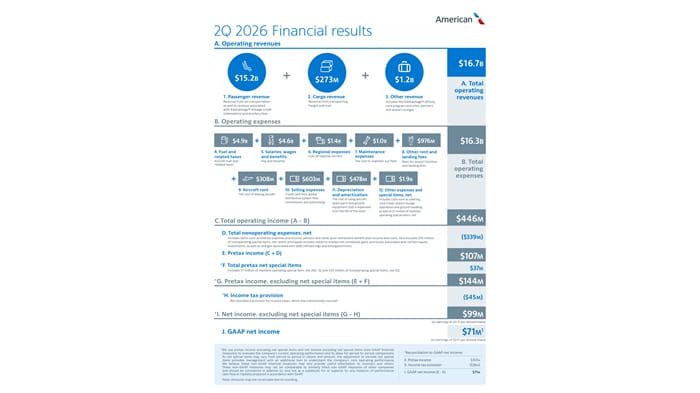
American Airlines 2Q26 – Financial Results Fact Sheet
AAdvantage loyalty keeps growing
The AAdvantage program remains a key part of American’s business. New enrolments rose more than 30 per cent from a year earlier. Spending on Citi co-branded cards rose 8 per cent.
This matters because loyalty programs do more than fill seats. They can drive card income, repeat bookings and upgrades. They also give an airline a closer link to the customer.
For travel advisers, loyalty knowledge can add real value. A well-planned booking may help a client earn status, use points or gain lounge access. A poor booking can leave those benefits on the table.
The strongest agents have long understood this. They do not merely sell a flight. They fit the flight into the traveller’s wider needs.
Costs, cash and debt remain in focus
American ended the quarter with US$11.3 billion in available liquidity. It also completed financing deals that helped address its main debt maturity in 2027.
The airline says it still plans to cut debt, lower interest costs and improve leverage. Those goals matter because aircraft, lounges, technology and service all need cash.
Chief financial officer Devon May said recent work was “enabling more efficient capacity production”. Cost per available seat mile, excluding fuel, special items and profit sharing, rose by about 3 per cent.
That figure suggests American is keeping non-fuel cost growth under some control. Still, the balance sheet remains important. Strong sales are useful. Strong cash flow and lower debt make an airline safer when the next shock arrives.
American Airlines’ record revenue comes with a warning
American’s second-quarter result has much to praise. Revenue reached a record. Premium and Main Cabin sales grew. Corporate demand was strong. International markets improved. Loyalty enrolments rose. Hub changes cut missed connections.
But the profit result was thin. US$16.7 billion in revenue produced US$71 million in GAAP net income. Fuel was the main reason.
For the travel industry, the signal is clear. Demand remains healthy, especially in premium and managed corporate travel. American’s product and network plan is gaining ground. Yet higher fuel costs may keep fares firm and margins under strain.
The airline has proved that it can fill its network and grow sales. Its next job is harder. It must turn that demand into steady profit while fuel prices refuse to sit still.
That is aviation in one neat quarter: record revenue at the front of the aircraft, and a fuel bill in the back row asking who ordered the expensive option.
By: Sandra Jones – © 2026.
Read Time: 8 minutes.
Author Bio:
 Sandra has spent a working lifetime quietly rescuing journeys, one itinerary, one anxious caller, one impossible connection at a time. Years in Australia’s finest travel agencies taught her the art of calm, how to find a flight in a fog of cancellations, how to soothe a traveller when luggage wanders, how to turn nine frantic days in Europe into something resembling sense. Qualified, seasoned, endlessly patient, she learned that good travel advice is part logistics, part listening.
But the storyteller in her was always waiting its turn. Writing offered a new map, a way to turn experience into reflection, detail into delight. At Global Travel Media, Sandra now writes the truths only insiders know: the mishaps, the laughter, the grace found between gates and goodbyes. She reminds us that travel, for all its fuss, is still one of life’s better ideas.











