

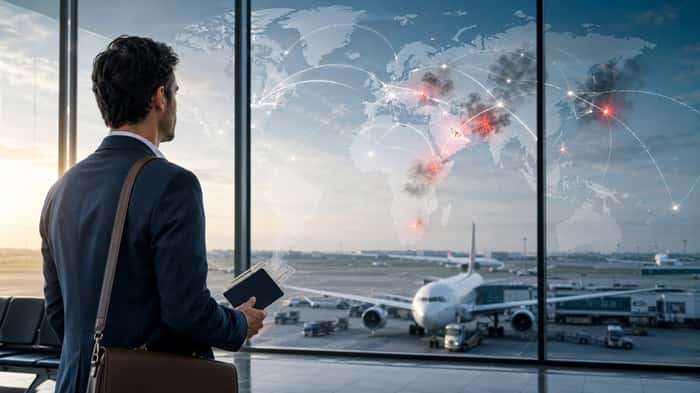
A passport is a modest little booklet with an immodest job. It proves who you are, asks foreign governments to let you in and, on a good day, keeps the airport queue moving. Yet the latest Henley Passport Index shows that it is also a measure of national influence.
The index has now reached its 20th anniversary. Its central finding is striking. The average passport gives access to 108 destinations without a prior visa. In 2006, the figure was only 58.
Global mobility has almost doubled. Global peace, sadly, has travelled in the other direction.
The 2026 Global Peace Index records a 12th straight year of decline. It counts 61 active state-based conflicts, the highest number since the end of the Second World War. Travellers have more doors open to them, while an increasing number of rooms are on fire.
Singapore Keeps the Passport Crown
Singapore remains the world’s most powerful passport. Its citizens can visit 192 destinations without obtaining a visa before departure. Japan, South Korea and the United Arab Emirates share second place with access to 188 destinations. Sweden is third on 187.
Australia remains firmly in the leading group. The Australian passport is tied seventh with Canada, Czechia, Latvia, Malaysia, New Zealand, Slovakia and Slovenia. It offers access to 183 destinations.
That is good news for Australians heading overseas. It is not, however, a licence to arrive at immigration armed with nothing more than confidence and a boarding pass.
The index uses exclusive Timatic data from the International Air Transport Association. Airlines use Timatic to check passport, visa and health rules. The index compares 199 passports across 227 destinations.
Its method is simple. A passport gains one point when its holder does not need a visa before travel. Visa on arrival and some electronic travel authorities may count. A government-approved electronic visa obtained before departure does not.
That distinction matters. Entry rules can change with little notice. Diplomatic disputes, war, health events and new border systems can all alter the position. A strong passport cuts red tape. It does not remove the need to check the rules.
The UAE’s Extraordinary Rise
No country has improved more than the UAE. Over 20 years, its passport has gained access to 153 extra destinations. It has climbed from the middle of the table to joint second place. Since January 2026 alone, it has risen three positions.
This is not an administrative accident. It reflects years of diplomacy, trade, air links and bilateral deals. The UAE has treated mobility as national infrastructure. Roads, airports and visa waivers have all been built with purpose.
Dr Christian H. Kaelin, chairman of Henley & Partners and creator of the index, said passport strength now showed the depth of a country’s geopolitical capital.
“Twenty years of data show that passport power is one of the clearest expressions of a country’s geopolitical capital. It reflects far more than peace or prosperity alone. The world’s strongest passports belong to nations that other countries want as partners — for trade, investment, security, or cooperation. Mobility is ultimately a measure of the value other countries place on their relationship with you.”
His point explains why the passport list does not simply copy the peace list. Peace matters. So do trade, trust, strong institutions, regional agreements and diplomatic reach.
More Freedom, but a Wider Divide
In 2006, the passports of the United States, Denmark and Finland led the index. They offered access to 130 destinations. Afghanistan sat last, with access to 12 destinations. The gap was 118 destinations.
Today, Singapore offers 192. Afghanistan remains last, with access to 23 in the current ranking table. The gap has widened to 169 destinations.
That divide is about much more than holidays. A passport affects access to work, study, investment, family and safety. Two people with equal skill and ambition can face very different futures because of the document in their pocket.
Henley’s anniversary study says Bolivia is the only passport to record a net loss over the full 20 years. It has lost six destinations. Every other passport has gained access.
The broad trend is positive. Yet the rewards are not shared equally.
The Atlantic Powers Lose Ground
The old leaders have also lost relative power. The United States ranked first in 2006. It now shares 10th place with Iceland, offering access to 180 destinations.
The United Kingdom has climbed one place since January. It now ranks sixth with access to 184 destinations after gaining visa-free entry to China and Malawi.
Neither passport is weak. Far from it. The change is about the speed of improvement elsewhere. Asian and Middle Eastern nations have moved up. Europe still fills much of the top tier through Schengen links and wide reciprocal deals.
There are now 38 passports inside the top 10 ranking positions. In 2006, there were 26. The club is larger, but the contest is tighter.
Peace Helps, but Power Still Talks
Henley & Partners compared its passport data with the Global Peace Index. It found a strong positive link between peace and passport power, recording a Spearman rank correlation of 0.65.
Singapore ranks first for passport strength and eighth for peace. Japan, Switzerland, Ireland, Austria, Portugal, Finland, Denmark, New Zealand, Canada, Czechia and Malaysia also perform well on both lists.
The reverse is also clear. Afghanistan, Syria and Yemen have weak passports and very low peace rankings. Conflict damages trust. It weakens institutions and makes other governments more cautious.
Still, there are major exceptions. Israel ranks 159th for peace but 18th for passport power. The United States ranks 134th for peace and 10th for mobility. France is 99th for peace but shares fourth place for passports. Ukraine ranks 160th for peace, yet its passport holds 31st place.
These cases show that mobility rights are built over many years. Visa deals do not always vanish when war begins. A trusted passport can keep much of its value while a country faces conflict.
The wider peace data remains grim. Of the 163 countries measured, 119 are less peaceful than when the index began. The number involved in external conflict has almost doubled, from 59 in 2008 to 103 in 2026.
Violence also carries a vast price. Its global economic impact reached US$21.81 trillion in 2025. That was equal to 10.5 per cent of world GDP.
For tourism, these figures are not distant policy talk. Conflict can close airspace and extend flight times. It can disrupt insurance and trigger new border rules. It can also strand travellers far from the trip they booked.
Passport power may help a traveller cross a border. It cannot ensure that the border will work as planned.
What Australians Need to Know
Australia’s seventh-place passport is a major asset. Australians should still avoid complacency.
Visa-free access does not mean rule-free access. A passport may need six months of validity. Travellers may need an onward ticket, proof of funds or an online authorisation. Transit countries can impose separate rules.
Before travel, Australians should check the destination’s official immigration website. They should also use the IATA Travel Centre and read the Australian Government’s Smartraveller visa advice. Those visiting or crossing conflict zones must also check airline routes and insurance exclusions.
A professional travel adviser can be invaluable here. Advisers can track entry changes, explain fare rules and find safer routes. They can also help when plans fall apart.
The internet can sell a ticket in seconds. It is less skilled at answering the telephone when the airspace closes.
Mobility Becomes a Family Strategy
Henley & Partners says global tension is also changing how wealthy families plan. In the first half of 2026, the firm received applications from 86 nationalities across 47 residence and citizenship programs. More than 28 per cent of applicants already lived outside their country of nationality.
Americans remained the firm’s largest source market. Enquiries from UAE-based residents rose by 41 per cent after the Gulf conflict escalated in February.
The issue will be discussed at the Safe Haven Forum in Zurich on 8 September 2026. Governments, investors and advisers will examine access rights, security and cross-border resilience.
Dr Kaelin said wealth was no longer only about money.
“For twenty years, we have measured how nations build freedom of movement for their citizens. Today, we are witnessing the same shift in how families think about their future. They recognize that true wealth is no longer defined solely by financial capital, but by the freedom to choose where they and future generations can live, work, study, invest, and belong. In an increasingly uncertain world, the greatest privilege is no longer simply the freedom to travel — it is the freedom to choose, to have access rights.”
That is the index’s strongest message. Passports have become more powerful. The world has become less certain. Freedom of movement is growing, but safety, preparation and sound advice matter more than ever.
A passport can open the door. Wisdom still decides whether it is sensible to walk through it.
By: Jill Walsh – © 2026.
Read time: 8 minutes.
Author Bio:
 Jill Walsh has always kept a pen close and a suitcase closer. She started out on media releases, then learned the trade properly by escorting press trips around the world, discovering which stories travel well and which need a sharper edit.
Before long, she wasn’t just promoting destinations; she was representing them, translating civic ambition and local pride into words people actually wanted to read. These days, semi-retired and happily so, Jill has traded departure boards for deadlines, joining old friend and colleague Stephen at Global Travel Media on a casual basis.
Her patch is the business end of wanderlust: balance sheets, route maps, tender wins and the numbers that quietly decide where travellers go. She writes with dry humour, clean prose and an old-school respect for facts a steady voice when the market starts shouting.











