

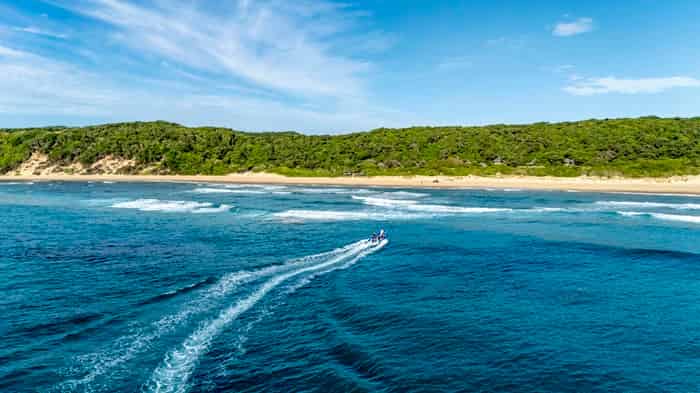
Some whale-watching ports feel like peak-hour traffic with better scenery. Engines rumble. Radios chatter. Boats crowd the water for the best view.
Mabibi is different.
This remote beach on South Africa’s Maputaland coast lies far from the busy marine hubs farther south. Here, Thonga Beach Lodge sits beside one of the Indian Ocean’s quiet whale routes. The lack of noise is not an empty detail. It is the main event. The lodge is set within the secluded Mabibi area of iSimangaliso Wetland Park, with direct access to the coast and its rich marine life.
Each year, humpback whales leave their feeding grounds near Antarctica and head north. They travel towards the warm breeding waters of Mozambique and Madagascar. Their journey is among the longest made by any mammal. From June to September, many pass the coast beside Thonga Beach Lodge.
Whales rely on sound to speak, find their way and keep close. Ship noise, sonar and other human sounds can hide those calls. Research also shows that soft calls between humpback mothers and calves may be at risk. A quiet sea is therefore more than pleasant. It is vital habitat.
Set inside iSimangaliso Wetland Park, Thonga has direct access to Mabibi’s shore. Its Open Ocean Experience launches through the surf in front of the lodge. The area has none of the packed boat traffic found at larger whale-watching centres. Guests can also watch from land, often without binoculars. There is no need to elbow past a coach group. The local crabs would object.
The whales do not arrive alone. Bottlenose and spinner dolphins use these waters. So do manta rays, whale sharks and giant turtles. Coral reefs and rock pools sit close to the lodge. The result is a marine show with a strong supporting cast and no ticket booth in sight.
Yet Thonga’s greatest asset may be its people.
The lodge’s Marine Centre guides come from the Mabibi community. They knew these beaches before they wore uniforms or carried dive gear. Their skill comes from both formal training and a life spent beside the sea.
Bonani Mbonambi began work as a general helper. His interest in the underwater world led him to become a qualified dive master. Sipho Qwabe started in maintenance. He now leads guests through the coral-filled rock pools he explored as a child.
Their stories give the lodge a clear edge. Many nature trips promise local insight. At Thonga, local knowledge leads the experience rather than decorating it.
“The ocean has always been part of our lives here in Mabibi,” says marine educator Saneliso Mathenjwa, known to guests as Sunny, who was born and raised in the village. “As children, we swam and fished here. Now we help protect the same beaches and teach our youth how important the ocean is to all of us.”
The guides help watch marine life and share what they see. They also turn science into stories that guests can grasp. No classroom can fully teach the rhythm of a reef or the mood of a changing sea. Time on the coast can.
The wider setting adds real weight. iSimangaliso became South Africa’s first World Heritage Site in December 1999. The park authority says it spans 1,328,901 hectares of land and sea. It also contains South Africa’s largest marine protected area.
In 2025, UNESCO approved a link with Mozambique’s Maputo National Park. The new cross-border World Heritage property covers 397,403 hectares. It protects marine, coastal, wetland, freshwater and land habitats.
The landscape includes coral reefs, beaches, dunes, forests, lakes, mangroves and seagrass beds. It is also tied to the West Indian Ocean coelacanth. Scientists had known of the fish only from fossils until a living specimen was found off the coast of South Africa in 1938. Not every old-timer makes such a grand return.
For the travel trade, Thonga meets a fast-growing demand. Guests want rare access, local expertise and a clear conservation purpose. They also want space. A quiet whale route, guided by people born beside it, offers all four.
This is not whale watching turned into a floating scrum. It is a chance to see a great migration in a place still shaped by restraint. The whales provide the drama. Mabibi provides the silence. Sensibly, the lodge lets both speak for themselves.
For further information, visit Thonga Beach Lodge. Park and conservation details are available from iSimangaliso Wetland Park and the UNESCO World Heritage Centre.
By: Karuna Johnson – © 2026.
Read Time: 4 minutes.
Author Bio:
 Karuna Johnson’s career only makes sense if you know she truly loves travel. Thai by birth, with dual citizenship, she moves easily between worlds, equally at home sharing street food in Bangkok or sitting quietly through a Sydney boardroom meeting.
Educated in both Thailand and Australia, she speaks several languages and has applied them across destination management companies and hotels, spanning sales and administration. She’s the sort who keeps things running smoothly while others are still waking up.
Her journeys have taken her across Asia, Europe, and the United States, but it’s the smaller details that stay with her: people, customs, and the stories beneath every trip.
Worldly without being showy, Karuna brings a steady, thoughtful voice to Global Travel Media, exactly the kind of travel needs.











