

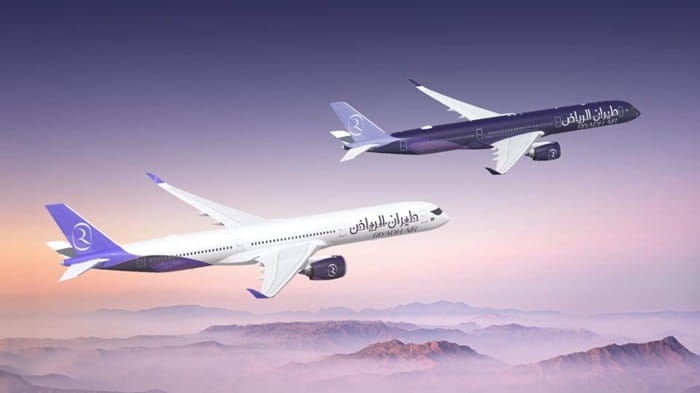
Riyadh Air has placed one of the loudest markers yet on the global aviation map, locking in six more Airbus A350-1000s while moving to exercise options for 28 additional Boeing 787 Dreamliners.
The twin announcements give the Saudi carrier another 34 widebody aircraft for a network designed to reach more than 100 destinations by 2030. Both agreements were unveiled at the Farnborough International Airshow on 20 July 2026.
That is not fleet planning with a timid pencil. It is expansion written in indigo ink, backed by Saudi Arabia’s Public Investment Fund and tied directly to the Kingdom’s wider Vision 2030 ambitions. Riyadh Air expects its future network to play a central role in strengthening tourism, international connectivity and Saudi Arabia’s non-oil economy.
A350 order gives Riyadh Air longer legs
The Airbus agreement raises Riyadh Air’s firm A350-1000 commitment from 25 to 31 aircraft. It forms part of the original 2025 agreement that allowed the airline to acquire up to 50 of the long-range jets.
Riyadh Air is also set to become the first Saudi airline to operate the A350-1000, giving the young carrier an aircraft built for major intercontinental markets where range, capacity and premium demand must all share the same cabin.
For Airbus, the order adds further weight to an already successful widebody program. At the end of June 2026, the A350 family had secured 1,595 firm orders from 68 customers worldwide.
Airbus says the aircraft is designed to fly as far as 18,000 kilometres non-stop. Its latest-generation Rolls-Royce engines and lightweight construction provide a claimed 25 per cent advantage in fuel consumption, operating costs and carbon dioxide emissions compared with previous-generation competitor aircraft.
Adam Boukadida, Riyadh Air’s chief financial officer, said the additional aircraft reflected confidence in both the carrier and Saudi Arabia’s aviation outlook.
“Increasing our A350-1000 commitment to 31 aircraft strengthens the foundation of our future network,” Boukadida said.
The language is measured, but the message is not. Riyadh Air is building for scale, range and premium demand, and it clearly does not intend to spend the remainder of the decade politely circling the holding pattern.
Boeing order brings the 787-10 into view
On the Boeing side, Riyadh Air is exercising options for 28 more 787 Dreamliners from its 2023 order. Twenty of those aircraft will be converted to the larger 787-10 variant, adding a higher-capacity option alongside the airline’s existing 787-9 fleet.
The announcement includes 11 aircraft that had not previously been linked to an identified customer. Boeing said that once the remaining 17 aircraft are finalised, Riyadh Air’s firm Dreamliner order book will rise to 67 jets.
Riyadh Air has already taken delivery of six 787-9 aircraft and is serving six cities. Its network has therefore moved from glossy promise to commercial reality, a useful distinction in an industry where launch plans can occasionally enjoy longer lives than launch dates.
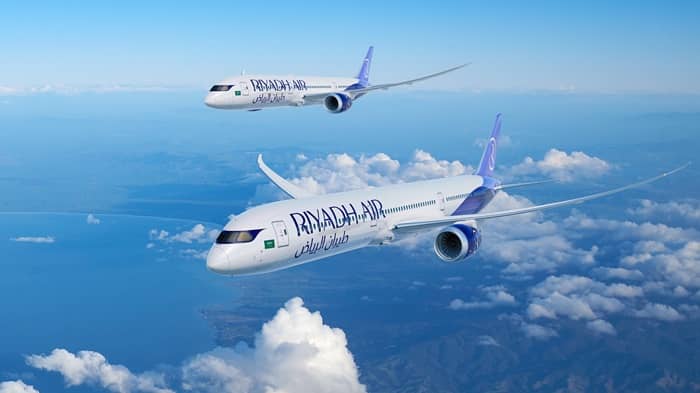
Riyadh Air Commits to Purchase 28 Boeing 787 Dreamliners, Adds 787-10 to Future Fleet
Chief executive Tony Douglas said the larger Dreamliner would give the carrier more capacity to respond to growing passenger and freight demand.
“The addition of the 787-10 strengthens our ability to accommodate growing passenger and cargo demand,” Douglas said.
The 787-10 is the largest member of Boeing’s Dreamliner family. Boeing says it will provide Riyadh Air with approximately 50 more seats than the 787-9 while retaining common flight-deck systems, maintenance procedures and pilot-training requirements.
That commonality matters. Airlines do not operate on brochure language alone; they run on trained crews, spare parts, dependable schedules and the expensive arithmetic of keeping aircraft in the air rather than admiring them from the hangar.
A dual-family strategy for a global network
Riyadh Air’s expanding commitments to both the A350-1000 and the 787 family point to a deliberate two-track widebody strategy.
The A350-1000 brings substantial capacity and very-long-range performance. The 787-9 and 787-10 offer flexibility across international markets with different passenger volumes, freight requirements and seasonal demand patterns. This is less a case of choosing sides and more a case of choosing the right tool for each route.
It is a sizeable fleet architecture for an airline that commenced full commercial operations only recently. Yet the carrier’s ambitions are equally sizeable.
Riyadh Air aims to connect the Saudi capital with more than 100 global destinations by 2030. The airline also forecasts that its expansion will support more than 200,000 direct and indirect jobs and contribute more than US$20 billion, or SAR75 billion, to Saudi Arabia’s non-oil gross domestic product.
Those are company projections, not funds already safely deposited in the national accounts. Even so, they demonstrate why these aircraft announcements matter beyond the Airbus and Boeing assembly lines.
Riyadh Air is intended to function as an economic instrument as well as an airline. Its network is expected to draw tourists, business travellers, investment, conferences and trade through Riyadh while strengthening the capital’s position as an international hub.
The challenge will be execution. Aircraft must arrive on time. Airports, engineering systems, crew recruitment, training and distribution must grow alongside the fleet. New routes must mature beyond launch-day fanfare.
Premium cabins must also deliver consistently. Travellers can be generous with compliments, but they remain wonderfully ruthless when making their next booking.
Still, the fleet decisions give Riyadh Air credible tools for the job. The carrier is not betting everything on one aircraft type or one network model. It is buying flexibility in the broadest sense of the word.
Philippine Airlines joins the widebody buying wave
Riyadh Air was not the only carrier making substantial widebody news at Farnborough.
Philippine Airlines committed to order as many as 20 Boeing 787 Dreamliners, comprising 15 787-10 aircraft with options for another five. Once finalised, the agreement will become the airline’s largest-ever widebody order.
The 787-10s will complement Philippine Airlines’ fleet of 10 Boeing 777s and support expansion across medium- and long-haul markets.
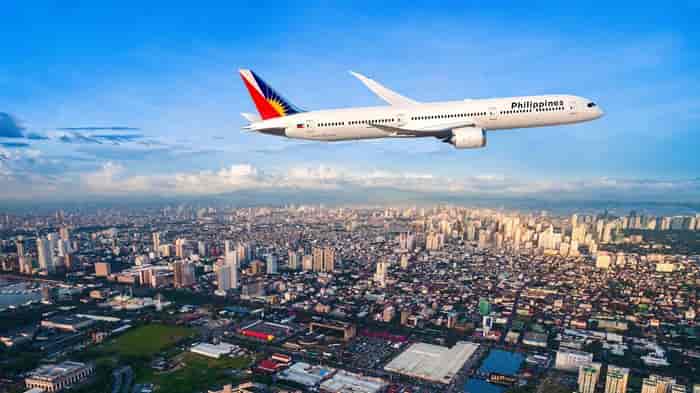
Boeing and Philippine Airlines Announce Commitment for up to 20 787 Dreamliner Jets
Boeing lists the aircraft’s capacity at between 300 and 375 passengers and its range at up to 13,890 kilometres. The manufacturer claims the composite design uses 25 per cent less fuel than the aircraft types the Dreamliner commonly replaces.
Lucio C. Tan III, president and chief operating officer of PAL Holdings, described the decision as a vote of confidence in the carrier’s future.
“This investment manifests our confidence in the future of Philippine Airlines and the continued growth of air travel,” Tan said.
The commitment also arrives in a landmark year. Philippine Airlines has celebrated its 85th anniversary, while its relationship with Boeing has reached 80 years.
There is something reassuringly traditional in that continuity: an old partnership renewing itself through a thoroughly modern aircraft.
For passengers, both manufacturers are selling more than range and fuel efficiency. Airbus highlights the A350’s Airspace cabin, while Boeing points to the Dreamliner’s large dimmable windows, increased cabin humidity, lower cabin altitude and turbulence-sensing technology.
The specifications differ, but the commercial contest remains straightforward: make long flights feel considerably less long.
What the orders mean for travel sellers
For travel advisers and corporate travel buyers, the immediate effect will not be another 34 Riyadh Air aircraft appearing overnight. Deliveries, airport slots, regulatory approvals and the carrier’s operational ramp-up will take time.
The more important signal is strategic.
Riyadh is being developed as a major connecting hub, with Riyadh Air positioned to compete for long-haul traffic moving between Asia, Europe, Africa, the Middle East and, eventually, the Americas.
Additional aircraft create the capacity for more destinations, higher frequencies and stronger connecting schedules. They could also provide room for competitive fares, corporate agreements and Saudi stopover products as the network expands towards its 2030 target.
Philippine Airlines’ move carries a similar message for Asia-Pacific markets. A larger and more efficient widebody fleet can support network growth while improving seat economics on routes where demand is strong enough to fill the 787-10.
The aviation industry has spent several years talking about recovery. These orders belong to a different chapter. They concern expansion, market share and the next generation of international connectivity.
Riyadh Air’s latest commitments do not guarantee that every proposed route will succeed or every aircraft delivery will arrive precisely on cue. Aviation has never been quite that obliging.
However, another 34 widebody aircraft, on top of an already substantial order book, amount to a remarkably clear statement.
Saudi Arabia’s new airline is no longer merely promising to join the global aviation establishment. It is buying the hardware to challenge it.
By: Octavia Koo – © 2026.
Read Time: 6 minutes.
Author Bio:
 Octavia Koo arrived in Australia in the early eighties with little fuss and a good eye. Sydney suited her. At UNSW, she studied Arts, then found her footing in graphic design before drifting, quite naturally, into the digital side of things, building websites and shaping words that made people want to stay.
Singapore followed, and with it, the fast pace of tourism platforms and ITB Asia. Long before SEO became a buzzword, Octavia understood how stories travelled online. That’s where she met Stephen, and the seed for something more was planted.
A few years later, she joined Global Travel Media.
Today, Octavia works with quiet assurance, blending art, instinct and experience to produce stories that don’t shout; they simply work and linger.











