

The world’s busiest airports are once again filling their terminals, stretching their runways and testing the patience of anyone who has joined a security queue just as three long-haul flights arrived together.
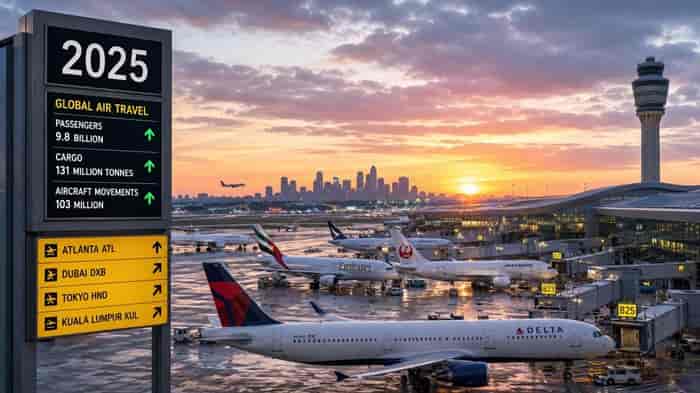
Final 2025 figures from Airports Council International World show global passenger traffic reached 9.8 billion. That was 3.7 per cent higher than in 2024 and 6.5 per cent above 2019. In other words, aviation is no longer merely recovering. It is advancing towards the 10-billion-passenger mark with its seatbelt sign firmly on.
The 2026 ACI World Airport Traffic Dataset covers 2,817 airports in more than 180 countries and territories. The top 20 airports handled 1.59 billion passengers, equal to 16 per cent of global traffic. Yet the most revealing story is not simply how many people flew. It is where the strongest growth occurred.
Asia-Pacific airports produced the sharpest ranking changes, helped by new capacity, stronger airline networks, improved connectivity and renewed tourism demand. North America still supplies the world’s busiest passenger airport. However, the balance of aviation power is becoming more widely spread.
Atlanta keeps the crown, but rivals are closing in
Hartsfield-Jackson Atlanta International Airport retained first place with 106.3 million passengers. That was despite a 1.6 per cent fall from 2024 and traffic remaining 3.8 per cent below 2019.
Atlanta’s advantage rests heavily on the enormous United States domestic market and its role as a connecting hub. It is an airport designed to move people through a vast network on an industrial scale. Glamorous it may not always be, but neither is a well-run railway junction, and both are rather useful when the timetable becomes ambitious.
Dubai International Airport remained second with 95.2 million passengers, up 3.1 per cent. Tokyo Haneda climbed to third with 91.7 million after a growth of 6.7 per cent. The gap behind Atlanta is therefore shrinking.
Dallas/Fort Worth slipped to fourth after handling 85.7 million passengers, while Shanghai Pudong surged from 10th to fifth with almost 85 million. Chicago O’Hare, London Heathrow, Istanbul, Guangzhou and Denver completed the top 10.
Five of the top 20 passenger airports are in the United States. Most rely chiefly on domestic travel. Los Angeles is the exception, with a larger international share than its American peers. That mix shows why the US remains formidable, even while hubs in Asia and the Middle East gain altitude.
Asia-Pacific changes the departure board
Kuala Lumpur International Airport delivered the biggest leap in the top 20. It rose six places, from 26th to 20th, after handling 63.4 million passengers. Traffic grew 11 per cent, supported by a 17 per cent rise in domestic passengers and an 8.7 per cent increase in international traffic.
The result gives Malaysia useful momentum ahead of Visit Malaysia 2026. It also underlines the value of airport capacity and route development. Tourism campaigns can make the invitation, but an airport still has to provide the front door.
Shanghai Pudong recorded the second-largest rise. It jumped five positions to fifth place as passenger numbers increased 10.7 per cent. Easier visa settings, restored international services and broader connectivity helped drive the rebound.
Guangzhou Baiyun offered an even more dramatic case study. It ranked first globally in 2020, dropped to 57th in 2022, then returned to ninth in 2025. Few airport rankings have contained quite so much turbulence without a single aircraft leaving the ground.
Elsewhere, Shenzhen rose to 19th with 66.5 million passengers, an increase of 8.2 per cent. Incheon, Singapore and Tokyo Haneda also strengthened Asia-Pacific’s presence near the top of the table.
The pattern matters to airlines, tourism boards, travel sellers and investors. Rising hubs create new transfer options, improve access to secondary markets, and enable new routes. They also intensify competition for airline capacity, premium passengers and connecting traffic.
Capacity becomes aviation’s next great test
ACI World Director General Justin Erbacci warned that “record demand is also exposing growing pressures on capacity”.
That message sits at the centre of the rankings. Airports can celebrate fuller terminals, but growth without investment quickly becomes congestion. More passengers require gates, baggage systems, border processing, ground transport, airspace and trained staff.
A shiny terminal extension is useful, but only when the road, railway, runway and roster all keep pace.
ACI World has forecast that global passenger traffic will reach 10.2 billion in 2026. It also expects demand to reach 18.8 billion by 2045. Those projections make present-day planning decisions far more than an engineering exercise. They are choices about national competitiveness, tourism growth and the reliability of future journeys.
For the travel trade, the lesson is straightforward. Demand remains strong, but smooth growth cannot be assumed. Capacity shortages can affect schedules, fares, connection times and customer satisfaction.
The industry’s next challenge is not persuading people to travel. It ensures the system can carry them without turning every peak period into an endurance event.
Air cargo keeps the global economy moving
Passenger terminals attracted the headlines, but freight produced another strong year. Global air cargo exceeded 131 million metric tonnes in 2025, up 3.3 per cent from 2024 and 7.4 per cent above 2019.
The top 20 cargo airports handled 53.1 million tonnes, or nearly 41 per cent of the global total. Cargo is therefore much more concentrated than passenger traffic.
Hong Kong International Airport remained the world’s busiest cargo hub with 5.1 million tonnes. Shanghai Pudong ranked second with 4.1 million tonnes, followed by Ted Stevens Anchorage International Airport with 3.9 million.
Louisville and Miami recorded growth above 13 per cent. E-commerce, time-sensitive deliveries, and supply chain changes continued to support demand for air freight. The parcel on the doorstep may look modest, but its journey can involve an impressive chain of aircraft, warehouses and overnight decisions.
Memphis moved in the opposite direction. Cargo volume fell 20.9 per cent after the airport lost a United States Postal Service contract in late 2024. It dropped from third to sixth, providing a blunt reminder that major contracts can shift rankings as quickly as consumer demand can lift them.
Chicago wins the movement race
Aircraft movements offer a different measure of airport activity. ACI World’s final release says global take-offs and landings exceeded 103 million in 2025, up 2 per cent year on year and close to the pre-2019 level.
Chicago O’Hare claimed first place with 857,392 movements, an increase of 10.5 per cent. It displaced Atlanta, which recorded 807,625 movements. Dallas/Fort Worth remained third with 743,394.
The result shows that the busiest airport by passengers is not necessarily the busiest by aircraft activity. Aircraft size, route length, airline schedules and hub structure all shape the numbers. One airport may move more people with larger aircraft, while another operates a denser timetable.
A new global airport order takes shape
Atlanta remains the champion, and American domestic aviation remains a force of nature. Yet the 2025 rankings point clearly towards a more competitive global map.
Dubai is closing the passenger gap. Tokyo Haneda is climbing. Shanghai, Guangzhou, Shenzhen and Kuala Lumpur are moving rapidly. Hong Kong continues to dominate cargo, while Chicago has taken command of aircraft movements.
The winners will be airports and destinations that combine capacity with connectivity, reliable operations and a passenger experience that does not feel like an obstacle course with retail lighting.
Nearly 10 billion passengers travelled through the world’s aviation system in 2025. The industry should welcome that confidence. It should also recognise the warning on the arrivals board: the next era of growth will be won not merely by attracting demand, but by building the infrastructure, resilience and service needed to handle it.
By: Octavia Koo – © 2026.
Read Time: 6 minutes.
Author Bio:
 Octavia Koo arrived in Australia in the early eighties with little fuss and a good eye. Sydney suited her. At UNSW, she studied Arts, then found her footing in graphic design before drifting, quite naturally, into the digital side of things, building websites and shaping words that made people want to stay.
Singapore followed, and with it, the fast pace of tourism platforms and ITB Asia. Long before SEO became a buzzword, Octavia understood how stories travelled online. That’s where she met Stephen, and the seed for something more was planted.
A few years later, she joined Global Travel Media.
Today, Octavia works with quiet assurance, blending art, instinct and experience to produce stories that don’t shout; they simply work and linger.











