

Europe’s summer has stopped merely turning up the temperature and begun rewriting the record book.
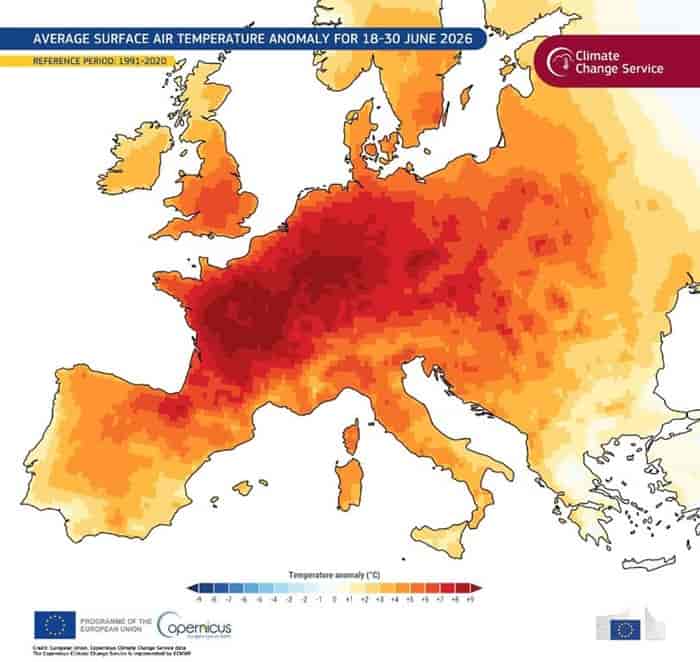
June 2026 was the hottest June ever recorded across Western Europe and the second-warmest June globally, according to the Copernicus Climate Change Service.
Western Europe recorded an average temperature of 20.74°C, 3.06°C above the 1991–2020 average, surpassing the record set only last year. Globally, the month averaged 16.54°C, ranking behind June 2024 but remaining 1.39°C warmer than the estimated pre-industrial average.
For travellers and the tourism industry, these are no longer figures to be filed away under “weather”. Extreme heat is becoming an operational issue, affecting itineraries, transport networks, insurance exposure, outdoor attractions, workforce safety and the simple business of keeping guests comfortable.
Europe’s seas join the heatwave
The sea was running hot as well.
Average sea-surface temperatures across the extra-polar oceans reached 20.86°C, the highest June reading on record and 0.01°C above the previous peak in 2024. Copernicus said the result partly reflected the development of strong El Niño conditions in the equatorial Pacific.
John Kennedy, head of climate information at the World Meteorological Organisation, put the shift plainly.
“Heatwaves like this are what we expect to see in a changing climate,” Kennedy said.
Europe has warmed by about 2°C since the historic heatwave of 1976, according to WMO, making it the world’s fastest-warming continent and increasing the severity of temperature extremes.
That warming translated into a remarkable collection of national and local records.
Denmark reached an all-time high of 37.0°C at two locations, breaking a mark set in 1975. The Netherlands established a new national June record of 39.4°C, while Basel in Switzerland reached a June record of 39°C.
France recorded its hottest day on record on 24 June, with an average national temperature of 30.0°C. Pulluau in western France climbed to 43.8°C, while overnight temperatures set a national record of 22°C.
Spain endured its hottest June days on record on 23 and 24 June, with Bilbao reaching 42.7°C, the city’s highest June temperature.
Germany’s Coschen reached 41.7°C on 28 June, while 252 German weather stations registered all-time temperature records. Hungary recorded 40.7°C near Budapest, Austria set a June record of 40.0°C in Vienna, and the United Kingdom broke its June temperature record on three consecutive days, with a provisional high of 37.3°C in southern England on 25 June.
Even the old European summer ritual of seeking shade, ordering something cold and pretending the paving stones are not radiating like a pizza oven has its limits.
Tropical nights raise the danger
The greater danger is what happens after sunset.
A “tropical night” occurs when temperatures remain above 20°C. Such nights are becoming more frequent during heatwaves, particularly in cities, where concrete, asphalt and limited greenery trap heat long after the sun has disappeared.
“When assessing the health impact of a heatwave, minimum temperatures can be more telling than the peak afternoon high,” said Armel Castellan, extreme heat services technical adviser at the WHO-WMO Climate and Health Joint Office.
“A day that reaches 38°C but drops to 18°C overnight is very different from a day that reaches 36°C and stays above 25°C through the night. The second scenario carries a much higher health risk.”
The World Health Organisation describes heat stress as a leading cause of weather-related deaths.
Studies estimate that approximately 489,000 heat-related deaths occurred annually worldwide between 2000 and 2019, with Europe accounting for 36 per cent. During the European summer of 2022 alone, an estimated 61,672 heat-related excess deaths occurred.
Older adults, infants, pregnant women, outdoor workers, people without secure housing and those living with chronic illness face the greatest risk.
However, sufficiently intense and prolonged heat can affect anyone, including visitors unfamiliar with local conditions, those walking long distances, those drinking too little water, or those packing an itinerary as though midday sightseeing were a competitive sport.
Heat becomes a tourism business risk
The economic consequences travel well beyond hospital admissions.
Prolonged heat can reduce labour productivity, disrupt rail and road infrastructure, strain electricity and water systems, increase fire danger and force tourism operators to alter schedules at short notice.
Dry conditions across much of Western, Central and Eastern Europe also pushed river flows below average and increased drought and wildfire risk, particularly across the Iberian Peninsula and southern France.
The heat continued into July, with France and Spain facing dangerous fire conditions and Barcelona’s Fabra Observatory recording 40.5°C on 8 July, its highest temperature in more than a century of observations.
The implications for travel businesses are direct.
Tour operators may need to move walking tours into the cooler morning and evening hours. Hotels must consider cooling capacity, water demand and staff exposure. Airlines, rail companies and coach operators face infrastructure and occupational risks, while destinations dependent on outdoor attractions may need flexible ticketing and cancellation policies.
Heat is also becoming a duty-of-care issue.
Operators cannot control the weather, but they can control the quality of their warnings, the suitability of their schedules and the speed with which they respond when conditions deteriorate.
Early warnings offer a practical response
The practical response is neither panic nor business as usual. It is planned.
WMO and WHO are supporting heat-health early warning systems and action plans designed to give governments, businesses and communities time to respond.
The agencies say these systems can improve public awareness, support protective action, and help reduce damage to health, infrastructure, ecosystems, and labour productivity.
For travel companies, sensible measures include flexible tour hours, shaded rest stops, reliable access to drinking water, clear guest guidance, staff heat protocols, and contingency plans for fire, transport, or power disruptions.
Travel advisers also have a part to play. Clients who are older, pregnant, travelling with small children, or managing chronic medical conditions may need more detailed advice on accommodation, insurance, transfers, and the physical demands of an itinerary.
Europe remains one of the world’s great travel drawcards. That has not changed.
What has changed is the duty of care required when selling and operating summer travel there.
The thermometer has delivered the message. The industry would be wise to read it before the next record arrives.
By: Bridget Gomez – © 2026.
Read Time: 4 minutes.
Author Bio:
 Bridget has never been built for stillness. Of Portuguese heritage, she began as a nurse, tending veterans at the Repatriation Hospital, listening to stories as colourful as the life she was yet to live. It was worthy, steady work, but wanderlust, as always, proved louder than routine.
So, she traded starch for a backpack and disappeared for a year, chasing trains, sunsets and the occasional regrettable glass of wine. She wrote everything down: the dust, the laughter, the missteps, the magic. Those notebooks became a travel blog, then a habit, then a calling.
Eventually, she found Global Travel Media, or perhaps it found her.
Today, Bridget writes with heart, humour and a dash of mischief, still travelling, just now with words.










