

Australian War Memorial unveils new Afghanistan Gallery
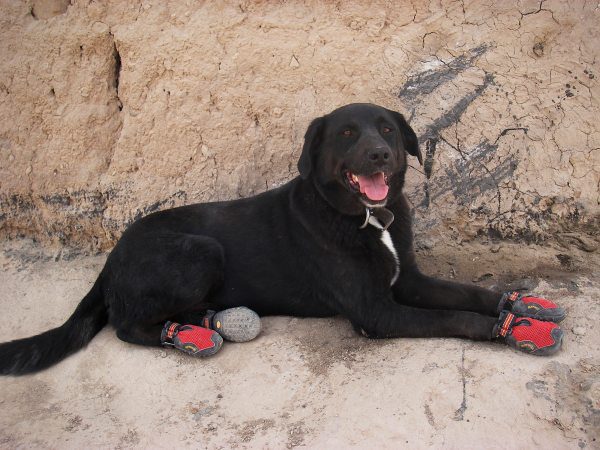
Sarbi, a black Labrador-cross who was preserved forever, is a finishing touch to the Australian War Memorial’s new Afghanistan Gallery.
The explosive detection dog, that vanished during a Taliban ambush in Afghanistan and was miraculously reunited with her handler, completes the new Anzac Hall.
Director of the AWM, Matt Anderson, said: “This is the most comprehensive exhibition ever created on Australia’s involvement in Afghanistan – Australia’s longest war.
“It is so contemporary the galleries were formed in real time. The Fall of Kabul was happening as our curators were collecting the unfolding stories.”
The emotional moment was witnessed by veterans who served in Afghanistan, including former Chinook pilot Naomi Hansen and bomb disposal specialist Warrant Officer Class One Damien Wolf.
For AWM’s Kassandra Hobbs PSM, the installation marked the end of one of the largest collection moves in the Memorial’s history.
Over several years, Ms Hobbs has overseen the relocation of more than 3,700 objects as part of the Memorial’s redevelopment.
“From aircraft weighing tonnes to some of our most fragile artefacts, every object has a story,” Ms Hobbs said.
“But Sarbi is special. After moving more than 3,700 collection items, it’s fitting that a dog who never gave up would be among the last.”
Australian War Memorial Director Matt Anderson, who served as Australia’s Ambassador in Afghanistan, said the new gallery was a “first draft of history”.
“This is Australia’s longest war told through the people who lived it,” Mr Anderson said.
Sarbi became one of the most recognisable figures of the Afghanistan conflict after disappearing during a fierce Taliban ambush in Uruzgan Province in 2008.
Separated from her handler, Corporal David Simpson, during the battle, she survived alone for 13 months before being discovered by an American soldier and eventually reunited with Australian troops.
Today, she takes her place among more than 1,000 objects, photographs, artworks and personal stories that explore Australia’s involvement in Afghanistan from 2001 to 2021.
Among the veterans previewing the gallery was former Australian Army pilot Naomi Shephard, who became the first Australian woman to fly CH-47 Chinook helicopters operationally and deployed to Afghanistan at just 25 years of age.
“I knew it was going to be the hardest thing I was ever going to do,” Mrs Shephard said.
“I knew my life was on hold while I was there, but it was such a positive, life-changing experience.
” Afghanistan challenged me in ways I could never have imagined, but it also gave me a military family. We relied on each other.”
For Warrant Officer Class One Damien Woolfe, who served in East Timor, Iraq, and deployed twice to Afghanistan as an explosive ordnance disposal technician, the gallery captures more than combat.
“We often focus on the fighting, and that’s important because of the sacrifices that were made,” Mr Woolfe said.
“But what I remember are the things we rebuilt – bridges, schools and communities.
“We were there to help create security and opportunity. Those are the things that have stayed with me.”
The gallery also includes material relating to the Inspector-General of the Australian Defence Force Afghanistan Inquiry, commonly known as the Brereton Report, placing it within the broader context of two decades of Australian service.
“The Afghanistan Gallery tells a complex Australian story,” Mr Anderson said.
“Most importantly, it tells these stories through the people who were there and the objects they carried, used, protected and brought home.
“It tells our uniting story of service and sacrifice, through the experiences and the voices of the men and women who put themselves in harm’s way, in our uniform and in our name, We must be terribly proud of them, I know I am.”











