If there is one complaint travellers share about artificial intelligence, it is this: AI has the memory of a goldfish.
Ask a travel platform to find a hotel, suggest a flight, or build an itinerary, and chances are you’ll spend half your time repeating information you’ve already provided elsewhere. Preferred airlines, dietary requirements, favourite hotel brands, seat preferences, loyalty memberships, travel history, it’s often Groundhog Day with boarding passes.
Now, TravelAI believes it has found a solution.
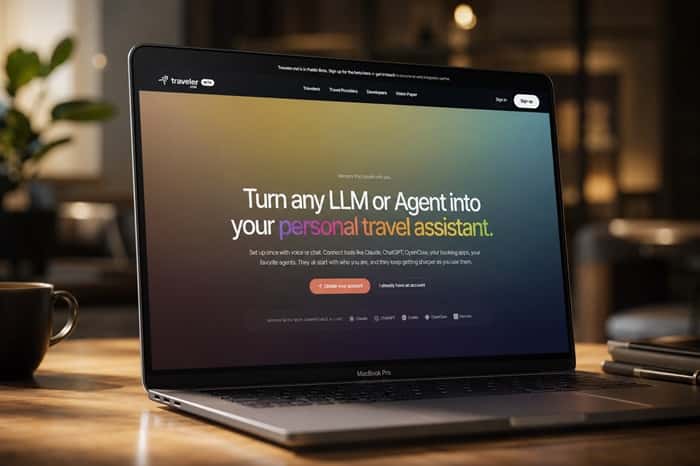
The company, which describes itself as The Travel Memory Company, has unveiled Traveler.md at Phocuswright Europe in Barcelona, introducing what it calls the world’s first portable, user-owned travel memory file.
The concept is both simple and potentially transformative.
Rather than forcing travellers to repeatedly educate every new AI-powered travel platform they encounter, Traveler.md creates a governed, portable memory file that stores relevant travel information, preferences, past experiences and future intentions. Most importantly, travellers own it, control it and decide when it can be accessed.
In an era where data privacy concerns are rising almost as quickly as airline baggage fees, that ownership model may prove to be one of the product’s strongest selling points.
TravelAI CEO John Lyotier believes the industry has reached a turning point.
“Effective AI should remember what matters, respect permissions, and make travel easier,” said Lyotier.
“Traveler.md gives travelers a memory file they own. It stops the traveler from having to repeat themselves every time they make a travel booking and helps travel companies deliver more trustworthy and more useful experiences.”
It’s a compelling proposition.
The travel industry has spent years chasing the holy grail of personalisation. Airlines, hotels, cruise lines and online travel agencies have invested billions in collecting customer data, yet travellers still find themselves re-entering the same information across countless platforms.
Traveler.md aims to bridge that gap.
The file automatically compiles information gathered through AI-assisted travel interactions into a clean, machine-readable format. Through the Model Context Protocol (MCP) distribution, AI systems can access information only when the traveller explicitly grants permission.
That means every interaction begins with context rather than guesswork.
Or, as many travellers would put it, the AI finally remembers who you are.
Brianna MacNeil, Director of AI Products & Personalisation at TravelAI, says the product was designed specifically to tackle what she describes as the industry’s growing “digital amnesia” problem.
“Traveler.md is the first memory file that lets travelers carry the nuance of how they like to travel into any tool they choose,” said MacNeil.
“We built Traveler.md to solve the problem of digital amnesia that currently plagues the travel industry. We built it to be created automatically, to travel with the user across systems, and to stay fully under the traveler’s permission.”
“That unlocks something the industry has never had before: Portable Traveler Context. Every AI travel system needs this to deliver on its promises.”
That phrase, Portable Traveler Context, may well become one of the most important buzzwords in travel technology over the next few years.
AI has become remarkably capable of generating recommendations, but it remains heavily dependent on context. Without memory, even the smartest AI starts every conversation as a stranger.
TravelAI’s broader vision extends well beyond a single file.
Traveler.md represents the first stage of the company’s three-part strategy focused on portable memory for travellers, governed memory for enterprises and ultimately creating better travel experiences through better information management.
Alongside the launch, TravelAI released a vision paper outlining its philosophy.
Among its key declarations:
“We believe a traveler’s memory should travel with them.”
And perhaps more tellingly:
“We believe travel is for presence, not paperwork.”
It’s difficult to argue with that.
After all, nobody books a holiday because they enjoy filling in forms.
Before rolling the technology out to enterprise customers, TravelAI plans to deploy Traveler.md across its proprietary network of more than 531 consumer-facing brands. This will allow the company to demonstrate measurable improvements in both traveller satisfaction and business performance before broader commercial adoption.
For individual travellers, the barrier to entry is refreshingly low.
Traveler.md is available free of charge, allowing users to create and manage their own travel memory profile.
For travel suppliers, technology companies, and booking platforms exploring integration opportunities, TravelAI invites participation through its MCP ecosystem.
Whether Traveler.md becomes the industry standard remains to be seen. The travel sector has never been short of ambitious technology promises.
However, TravelAI appears to address a genuine problem that many travellers face daily.
And if it succeeds, AI may finally stop asking the same questions over and over again.
That alone could make it one of the smartest travel innovations we’ve seen in years.
For more information, visit TravelAI, explore the Traveler.md initiative via Traveler.md, and learn more about the industry event at Phocuswright Europe.