

Most countries celebrate national milestones with fireworks, concerts or military parades.
Bhutan, true to form, has chosen something rather different.
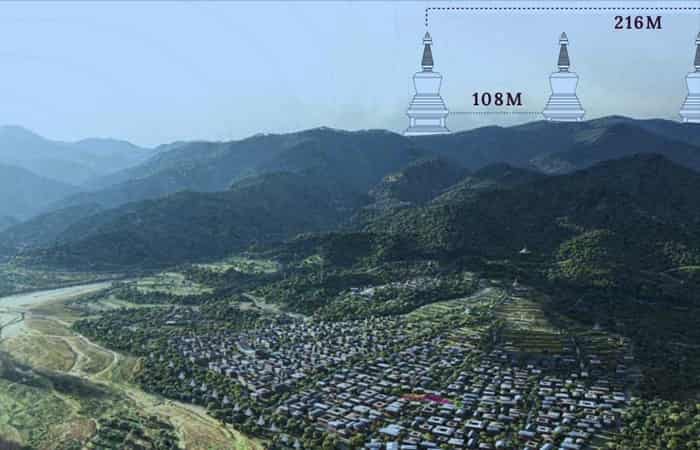
On 1 November this year, the Himalayan kingdom plans to raise 108 sacred Buddhist chortens in a single day in what is being described as one of the largest collective spiritual offerings ever undertaken.
The ambitious undertaking, known as Project 108, will take place in the rapidly developing Gelephu Mindfulness City, a project already attracting international attention for its unique blend of economic development, sustainability and Buddhist values.
While much of the world appears locked in a permanent cycle of conflict, political division and economic uncertainty, Bhutan is quietly investing in something that has become a surprisingly rare hope.
Announced by His Majesty King Jigme Khesar Namgyel Wangchuck during celebrations marking his 46th birthday, Project 108 aims to create a continuous line of sacred monuments stretching more than 12 kilometres alongside the Mao River in southern Bhutan.
Each chorten will stand 15 metres high and be positioned exactly 108 metres from the next.
That’s a lot of measuring tape.
But organisers insist the project is about far more than construction.
“In the Buddhist tradition, building a chorten is considered one of the most meritorious acts a person can undertake,” said Dasho Tashi Dorji, lead of the GMC Authority’s Spiritual Workstream.
“Project 108 is envisioned as a collective offering to the world.”
For many outside Bhutan, a chorten may simply appear to be an elegant monument.
In Buddhist tradition, however, they carry profound significance.
Known formally as Jangchub Chortens, or Stupas of Enlightenment, they commemorate the Buddha’s attainment of enlightenment and are regarded among the most important structures in Buddhist culture.

A 15-metre Jangchub Chorten towers above buildings, symbolising Bhutan’s spiritual vision
Each will contain sacred scriptures, prayers and blessings known as zungs, which believers say radiate spiritual benefit to all who pass by.
The figure 108 itself is deeply woven into Buddhist teaching.
It represents the purification of the 108 human afflictions believed to cloud wisdom, compassion and clear thinking.
Given the current state of global affairs, many might suggest the world could do with a few extras.
Making the project even more remarkable is the scale of community participation required.
Organisers estimate around 40,000 volunteers will be needed to complete the simultaneous raising of all 108 structures.
Preparatory work is already well underway.
Across Bhutan, monks, students, farmers, business owners, civil servants and Bhutanese communities living overseas have joined the effort through the country’s long-standing tradition of zhabto, voluntary communal labour offered as an act of service.
Long before cranes and construction teams arrive for the final stage, thousands of people have already spent months preparing sites, foundations and access routes.
It’s the sort of community effort many nations talk about but rarely achieve.
The project is also shining an international spotlight on Gelephu Mindfulness City, one of Bhutan’s most closely watched developments.
The city forms part of the King’s long-term vision to create an economic gateway connecting Bhutan with South Asia while preserving the values and cultural identity that make the country unique.
In an era when many destinations compete for attention with bigger hotels, bigger airports, and higher tourism numbers, Bhutan continues to chart its own course.
Visitors do not travel to Bhutan looking for the world’s largest shopping mall.
They come searching for something increasingly difficult to find elsewhere: authenticity.
Project 108 fits neatly into that story.
Participation is open globally, with individuals, organisations, Buddhist groups and communities invited to contribute.
Sponsorship opportunities begin at approximately US$200,000 per chorten, while smaller contributions can be made through the official crowdfunding platform operated by the Royal Securities Exchange of Bhutan Limited.
Whether viewed through a religious lens, a cultural lens or simply as an extraordinary display of community spirit, Project 108 is undeniably ambitious.
Yet perhaps its greatest achievement is not the number 108.
Nor the 40,000 volunteers.
Nor even the 12 kilometres of sacred monuments.
Perhaps it is the reminder that while much of the world seems determined to build walls, Bhutan is still focused on building something intended to bring people together.
That alone makes Project 108 worth watching.
For further information on sponsorship, participation and volunteering, visit www.gmc.bt.
By: Prae Lee – © 2026.
Read Time: 4 Minutes.
About the Author.
 You can tell a great deal about a person by how they meet a Bangkok morning. Prae Lee doesn’t charge into it; she glides, unhurried, as if time itself has agreed to behave. There is a calm assurance about her, the sort earned by knowing both your roots and your destination.
A graduate of Chulalongkorn University, she earned her business degree with quiet pride, then further honed it in Singapore and Australia. Travel didn’t change her. It refined what was already there: curiosity, discipline, grace.
Back in Bangkok, she slipped modern life into the family business, mastering social media with an instinct for listening and selling with Thai gentleness.
Prae never seeks attention, yet everything she touches grows brighter.
Now with Global Travel Media, she writes with authenticity, drawing on culture, travel and a rare, steady confidence.











