


The U.K. travel industry has just delivered a statistic big enough to make airline executives smile, hotel investors nod approvingly, and tourism ministers reach for the nearest media release.
Travel bookings hit a record £56.6 billion in 2025.
Not bad for a country that spent much of the past few years battling inflation, economic uncertainty and enough political turbulence to make a long-haul flight through a thunderstorm feel calm by comparison.
Yet buried beneath the headline number is a truth that many travel executives may find both reassuring and frustrating.
For all the noise about disruption, digital transformation and changing traveller behaviour, the way Britons actually buy travel has barely changed.
And that’s what makes the latest research from Phocuswright so fascinating.
For years, the travel industry has been selling a familiar promise.
The next technology would change everything.
The next platform would redefine customer behaviour.
The next booking revolution would redraw the competitive landscape.
Instead, the latest numbers suggest the market has quietly settled into a comfortable groove.
The players are bigger.
The market is bigger.
The technology is certainly better.
But the scoreboard looks remarkably familiar.
Online travel agencies generated a record £10.3 billion in bookings during 2025. On paper, that sounds like another victory lap for the OTA giants.
Look a little closer, and the picture changes.
While OTA bookings continue to rise in absolute terms, their share of the overall market has slipped from 22 per cent in 2023 to 20 per cent in 2025.
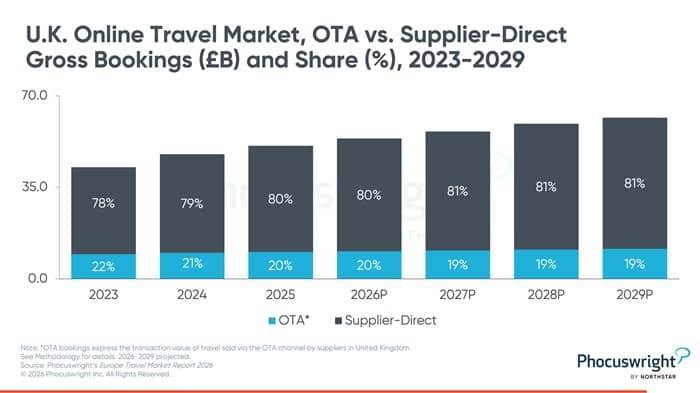
By 2029, that figure is expected to edge down to 19 per cent.
Hardly a collapse.
But hardly domination either.
Meanwhile, suppliers have spent years pouring millions into websites, apps, loyalty schemes, customer data platforms, and direct-booking campaigns.
The reward?
Their share is expected to rise from 78 per cent to 81 per cent over the next four years.
Three percentage points.
After all that investment.
That’s not exactly the sort of result that gets executives dancing on boardroom tables.
What it does tell us is that travellers have become remarkably comfortable with the channels they already use.
Changing consumer habits, it turns out, is a lot harder than changing technology.
The OTA market itself remains dominated by familiar names.
Booking Holdings continues to tower above the competition with 44 per cent of OTA bookings.
Trainline holds 23 per cent.
Expedia Group sits on 16 per cent.
The hierarchy is so established that it almost feels like the Premier League table after Christmas. Everyone knows who’s near the top. The debate is mostly about the margins.
Perhaps the most revealing statistic in the entire report is the growth rate.
OTA expansion surged by 27 per cent in 2023.
By 2025, that figure had slowed to just three per cent.
That doesn’t signal weakness.
It signals maturity.
The gold rush is over.
The market is entering a phase where growth comes from execution rather than expansion.
Hotels remain one of the few genuinely competitive battlegrounds left.
Unlike air travel, where direct channels have become dominant, accommodation continues to be fought over room by room and booking by booking.
Supplier-direct channels hold around 35 per cent of hotel bookings.
OTAs command approximately 32 per cent.
That’s close enough to keep both sides awake at night.
And close enough to ensure neither side can afford complacency.
Then there is the wildcard.
Great British Railways.
Scheduled to launch in 2027, the new integrated rail authority could become the most significant structural shift in British travel distribution for years.
The organisation’s ability to centralise ticketing and fare management could alter the foundations of the rail booking ecosystem.
That matters because Trainline’s position has been built on precisely that ecosystem.
Whether Great British Railways becomes a minor adjustment or a genuine game-changer remains one of the industry’s most intriguing questions.
The broader outlook is equally fascinating.
According to Phocuswright Managing Director Pete Comeau, strong travel demand and economic weakness are currently existing side by side.
“Strong demand and weakening macro conditions are not mutually exclusive, and right now the U.K. market has both,” said Comeau.
“U.K. residents took 44.7 million outbound trips in the first half of 2025 alone, against a GDP forecast that has since been cut to 0.7% for 2026.”
“The question for travel companies is not whether growth continues. It is whether their planning assumptions reflect a market that looks meaningfully different heading into the second half of 2026 than it did a year ago.”
That observation may be the most important takeaway from the entire report.
Travel remains one of the world’s most resilient industries.
People postpone purchases.
They delay renovations.
They hold off replacing cars.
Yet somehow they still find a way to book the holiday.
The challenge for travel companies is no longer convincing people to travel.
The challenge is convincing them to book differently.
And that’s proving far harder than many expected.
As senior industry leaders gather in Barcelona for Phocuswright Europe this month, they will undoubtedly discuss artificial intelligence, retailing technology, customer experience and the next generation of travel innovation.
All important topics.
But the latest U.K. data offers a timely reminder.
Sometimes the biggest story in travel isn’t disruption.
Sometimes it’s stability.
And in an industry addicted to predicting the next revolution, that may be the most surprising headline of all.
For further information and registration details, visit Phocuswright Europe 2026.
By: Bridget Gomez – © 2026.
Read Time: 5 Minutes.
About the Author.
 Bridget has never been built for stillness. Of Portuguese heritage, she began as a nurse, tending veterans at the Repatriation Hospital, listening to stories as colourful as the life she was yet to live. It was worthy, steady work, but wanderlust, as always, proved louder than routine.
So, she traded starch for a backpack and disappeared for a year, chasing trains, sunsets and the occasional regrettable glass of wine. She wrote everything down: the dust, the laughter, the missteps, the magic. Those notebooks became a travel blog, then a habit, then a calling.
Eventually, she found Global Travel Media, or perhaps it found her.
Today, Bridget writes with heart, humour and a dash of mischief, still travelling, just now with words.











