

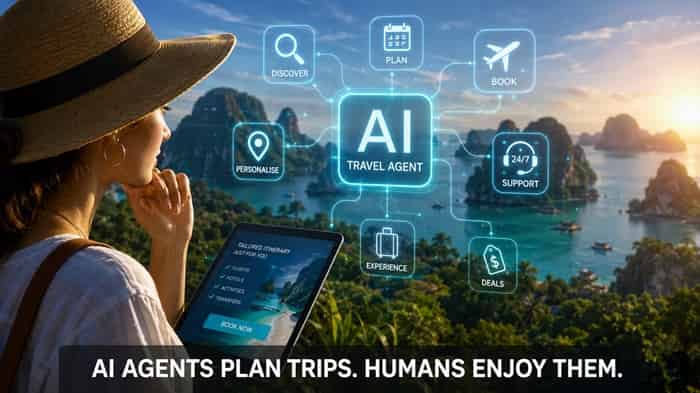
For more than two decades, the travel industry operated with a level of predictability that executives, marketers and travel advisors could almost set their watches by.
A traveller dreamed about a holiday, searched online, compared prices, clicked through countless websites, booked a trip and eventually packed a suitcase. The process wasn’t always elegant, but it was familiar. Search engines sit at the top of the funnel. Online travel agencies competed fiercely for clicks. Metasearch engines battled for attention. Travel brands spent billions chasing visibility.
Now, according to some of the industry’s leading technology thinkers, that funnel is beginning to collapse.
Not slowly. Not eventually.
Right now.
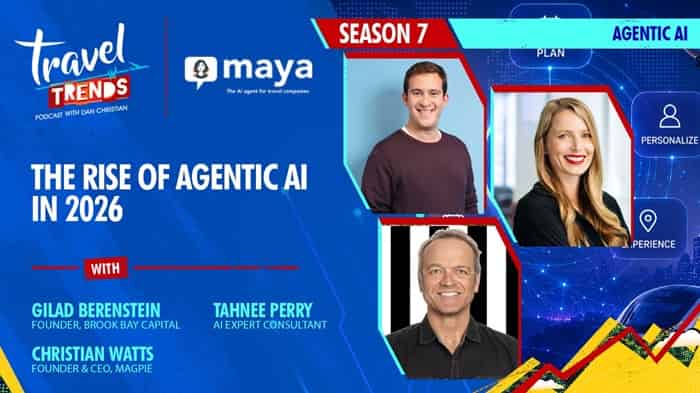
Insights emerging from Dan Christian’s Agentic AI Series, The Rise of Agentic AI in 2026, suggest the travel sector is entering one of the most significant structural shifts since the arrival of online booking.
The series gathered some of the industry’s most influential voices, including Gilad Berenstein of Brook Bay Capital, AI strategist Tahnee Perry, Christian Watts of Maya, Michelle Denogean of Mindtrip, Jeff Kischuk of Tripian, Jesse Fischer of GuestOS, Marius Nigond of iWander and other leading innovators shaping the future of travel technology.
Collectively, they paint a picture of an industry moving away from traditional digital journeys and toward something far more powerful: intelligent AI agents capable of thinking, interpreting, deciding and acting on behalf of travellers.
The implications are enormous.
The Search Box Is Losing Its Crown
For years, travellers behaved like amateur detectives.
Open a browser.
Search.
Compare.
Read reviews.
Open another tab.
Then another.
And another.
Anyone who has ever planned a family holiday knows that by the end of the process, the browser can resemble a digital game of Whac-A-Mole.
That behaviour is rapidly changing.
Instead of hunting for answers, travellers are increasingly delegating decisions to AI-powered assistants capable of simultaneously understanding preferences, budgets, timing, loyalty programs, and personal tastes.
Michelle Denogean captured the shift perfectly.
“It’s almost unfathomable to go back to the way we used to search and peck and hunt.”
That statement may turn out to be one of the defining observations of travel technology in 2026.
Travellers are beginning to ask conversational questions rather than perform keyword searches. They are requesting complete itineraries instead of piecing together individual components.
In effect, discovery, planning and booking are merging into a single interaction.
And that changes everything.
Why Traditional SEO May No Longer Be Enough
For travel marketers, the implications are confronting.
For years, the battle for visibility centred around search rankings, paid advertising and content marketing.
Now another audience has entered the room.
The machine.
Tahnee Perry delivered a warning that many travel brands cannot afford to ignore.
“You need to have a plan for that because if you don’t, you won’t show up.”
In an AI-driven world, visibility is increasingly determined not simply by search rankings but by whether AI systems can understand, interpret and trust a brand’s information.
Structured data, machine-readable content, contextual relevance and authoritative information are becoming the new battleground.
In simple terms, travel companies may soon need to optimise not just for Google, but for the AI agents making recommendations on behalf of millions of travellers.
From Novelty to Utility
The transformation is not limited to customer-facing experiences.
Behind the scenes, AI is rapidly dismantling inefficiencies that have existed for decades.
Tasks that once consumed hours of staff time are increasingly being automated.
Ben Manzi explained the impact succinctly.
“Low judgment work like general question proposal requests… was very time consuming for companies and today that’s eliminated completely.”
Across hospitality, aviation, tour operations and travel management, repetitive processes are becoming prime candidates for automation.
The result is not merely greater efficiency.
It is an organisational redesign.
Jeff Kischuk believes the real story lies beneath the surface.
“What you’re seeing is AI moving from novelty to utility.”
The competitive advantage is increasingly shifting toward businesses capable of connecting fragmented data sources and creating meaningful context.
As Kischuk noted:
“Do they have the right context? Do they have the right relevance?”
Those questions may soon determine which companies thrive and which struggle to remain visible.
The Human Advantage Is Becoming More Valuable
The rise of AI inevitably raises concerns about jobs.
Yet, one of the strongest themes emerging from the Agentic AI discussions is that human expertise is not disappearing.
If anything, it is becoming more important.
Tahnee Perry offered reassurance for travel advisors.
“A travel advisor, what makes them special is them and their experience and their personality. The profession of a travel advisor is safe.”
That observation reflects a broader reality.
AI can process information at extraordinary speed.
It cannot replicate decades of industry wisdom, emotional intelligence, empathy or trusted relationships.
Those remain distinctly human strengths.
Jesse Fischer highlighted this opportunity.
“AI is excellent at doing those repetitive mundane tasks that allow staff to focus on experiences.”
For travel advisors, hotel teams, and customer service professionals, the future may involve less administration and more relationship-building.
Frankly, most people would rather spend time helping travellers create memorable experiences than chasing paperwork anyway.
Context Becomes Travel’s Most Valuable Currency
One of the most fascinating developments is the growing importance of context.
Historically, travel personalisation relied heavily on past behaviour.
The next generation of AI is moving beyond that model.
Marius Nigond believes context may be even more valuable than customer data itself.
“Context actually matters almost more than data points on the customer.”
This new era focuses on real-time understanding.
Where is the traveller now?
What are they doing?
What is happening around them?
How are conditions changing?
Instead of static recommendations, AI systems continuously adapt itineraries, activities and suggestions as circumstances evolve.
Brianna McNeil believes the outcome will be transformative.
“This next era of personalization… will lead to better trips for travelers and more value for travel sellers.”
That represents a significant leap forward from traditional recommendation engines.
A Golden Opportunity for Smaller Players
Perhaps the most surprising takeaway is that the AI revolution may favour smaller businesses.
Historically, scale provided a significant advantage.
Large companies enjoyed bigger budgets, larger teams and greater technological resources.
Agentic AI is beginning to level that playing field.
Tahnee Perry sees enormous opportunity.
“This is the golden era of small and medium businesses.”
Powerful AI tools are becoming more accessible and affordable, enabling smaller travel brands to compete with organisations many times their size.
However, Christian Watts issued an important reminder.
“Just because you can build something amazing doesn’t mean you’re going to be able to get distribution with it.”
Technology may be democratising creation.
Distribution remains fiercely competitive.
The Future Belongs to Those Machines That Understand
The most significant conclusion emerging from the Agentic AI Series is that travel’s traditional funnel is evolving into something entirely different.
Discovery.
Planning.
Booking.
Personalisation.
These are no longer separate stages.
They are becoming part of a single intelligent decision layer powered by AI agents that continuously interpret traveller intent and act accordingly.
For years, travel companies focused on owning the customer journey.
That objective may now be changing.
The new challenge is simpler, yet potentially far more difficult.
Can the machine understand you?
In the emerging agentic era, the companies that thrive may not be those with the largest marketing budgets, the biggest teams, or the highest advertising spend.
They may simply be the businesses that AI trusts most when making decisions on travellers’ behalf.
And that, perhaps, is the biggest travel disruption since the internet itself arrived at the departure gate.












