

For years, corporate travel followed a familiar script.
Fly in.
Sit through meetings.
Shake hands.
Collect loyalty points.
Fly home.
Simple.
Not anymore.
Across Asia-Pacific, business travellers are quietly rewriting the rules and, in the process, reshaping one of the region’s most important hotel markets.
The latest Global Hotel Strategies Report 2026 from FCM Consulting reveals that a growing number of travellers are stretching business trips beyond the boardroom, turning a three-day work assignment into a five-day stay, a client visit into a long weekend, or a conference into an opportunity to finally see the city beyond the airport motorway.
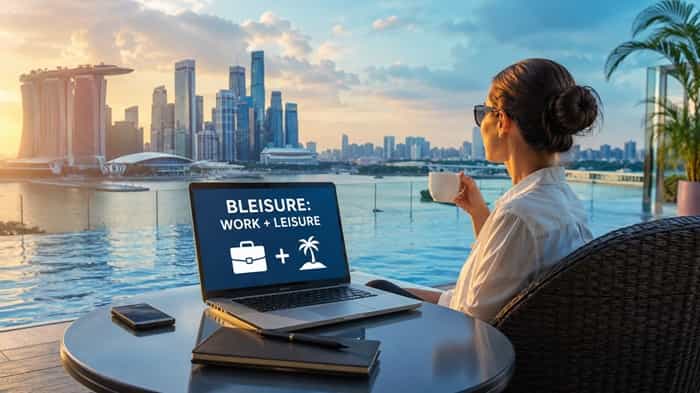
The industry has a name for it: bleisure.
It may sound like another piece of travel jargon dreamt up in a marketing meeting, but the numbers suggest it is becoming a serious force.
Singapore recorded a striking 25 per cent increase in long-stay corporate demand during 2025, while similar patterns are emerging across China, India and Japan. Travellers are increasingly combining work commitments with personal experiences, remote working and a little exploration.
And frankly, who can blame them?
If you’ve flown halfway around the world for a two-hour meeting, spending an extra day enjoying the destination suddenly seems less like an indulgence and more like common sense.
For hotels, it is proving highly lucrative.
Occupancy rates across key business centres are running at levels many operators would have happily signed up for a few years ago. Tokyo is leading the charge at 82.9 per cent occupancy, Sydney sits at 81.5 per cent, while Singapore has reached 79.2 per cent.
Those figures tell a bigger story than simple recovery.
They signal a market that has moved beyond post-pandemic rebuilding and into a new phase of growth.
The traditional road warrior is evolving.
Today’s traveller wants a comfortable workspace, but they also want a rooftop bar.
They need reliable internet, but they are also looking for wellness facilities, local experiences, and somewhere to enjoy a decent meal that doesn’t involve room service eaten over a laptop.
FCM Consulting’s Head of Consulting Asia Pacific, Felicity Burke, says the shift is already influencing hotel procurement strategies throughout the region.
“Corporate travellers are extending stays, particularly in Singapore, China, India, and Japan,” Burke says.
“These actions impact average length of stay and complicate hotel procurement models.”
Complicated is probably putting it politely.
For travel managers, bleisure creates an increasing number of headaches.
When does a business trip become a holiday?
Who pays for the extra nights?
Does company travel insurance cover personal extensions?
What happens when travellers choose a resort over a preferred hotel because they intend to stay through the weekend?
These are no longer hypothetical questions.
They are becoming real policy challenges.
FCM identifies bleisure-related policy gaps as one of the biggest pressure points facing corporate travel buyers heading into 2026.
Many travel programmes were designed for a world where business travel and leisure travel lived in separate boxes.
Today’s traveller is happily ignoring those boxes.
At the same time, hotels are moving quickly to capture the opportunity.
Luxury accommodation development is accelerating across the region. Kuala Lumpur has almost 2,000 luxury rooms in the pipeline. Auckland’s five-star inventory has nearly doubled over six years, while Thailand continues to attract fresh investment across Bangkok and major resort destinations.
The timing could hardly be better.
Demand remains strong, and room rates are climbing.
Tokyo’s average room rate now sits at US$327. Hong Kong has reached US$293. Premium hotels across leading markets are expected to increase rates by between three and eight per cent during the year ahead.
That may delight hotel owners.
Corporate travel budgets, however, may have a different view.
Another challenge emerging from the report is programme leakage, industry shorthand for travellers booking outside approved corporate channels.
The temptation is obvious.
A discounted rate appears online.
A traveller books it.
Everyone thinks they have saved money.
Yet organisations lose visibility, negotiated rates are weakened, and traveller tracking becomes more difficult.
In an era where duty of care remains a major responsibility, it creates risks that many organisations would rather avoid.
Despite the challenges, the broader outlook for Asia-Pacific remains exceptionally positive.
Australia is on track to reach 11 million annual visitors by 2027, while Malaysia is targeting 43 million international arrivals under its Visit Malaysia 2026 campaign. Expanded visa-free access for Chinese and Indian travellers is expected to add further momentum.
For travel managers preparing for hotel negotiations, Burke offers practical advice.
“Before launching your next hotel RFP in APAC, audit your existing program rates for correctness, check if hotels are actively used, and aligned with current booking behaviour,” she says.
“With luxury supply expanding in several key cities, structured upper-tier options in high-demand markets may support compliance and traveller satisfaction.”
The message is difficult to miss.
Bleisure is no longer a fashionable buzzword, making occasional appearances at industry conferences.
It has become part of the corporate travel landscape.
The traveller has changed.
The hotel market is changing with them.
Now corporate travel programmes have to catch up.
Because the line between business and leisure isn’t merely blurring.
Across the Asia-Pacific, it has almost disappeared.
By: Prae Lee – © 2026.
Read Time: 4 Minutes.
About the Author.
 You can tell a great deal about a person by how they meet a Bangkok morning. Prae Lee doesn’t charge into it; she glides, unhurried, as if time itself has agreed to behave. There is a calm assurance about her, the sort earned by knowing both your roots and your destination.
A graduate of Chulalongkorn University, she earned her business degree with quiet pride, then further honed it in Singapore and Australia. Travel didn’t change her. It refined what was already there: curiosity, discipline, grace.
Back in Bangkok, she slipped modern life into the family business, mastering social media with an instinct for listening and selling with Thai gentleness.
Prae never seeks attention, yet everything she touches grows brighter.
Now with Global Travel Media, she writes with authenticity, drawing on culture, travel and a rare, steady confidence.











