

A flight attendant who has travelled to 65 countries and flies up to 12 times a month has shared her expert seat hacks with mattress experts at Sleepy’s to reveal the common mistake that leaves travellers exhausted on arrival and the simple switches that could make all the difference.
For many passengers, getting this wrong means landing and feeling stiff and sleep-deprived, struggling to enjoy the first day of their trip.
Sherry Peters, a 27-year international flight attendant and founder of Atlas + Wild, says travellers often unknowingly sabotage their sleep by choosing seats near the galley or lavatory.
“Seats near the galley or toilets are the absolute worst if you’re trying to sleep,” Peters says. “There’s constant foot traffic, people queuing, lavatory doors slamming, and constant crew activity, it’s almost impossible to get uninterrupted rest.”
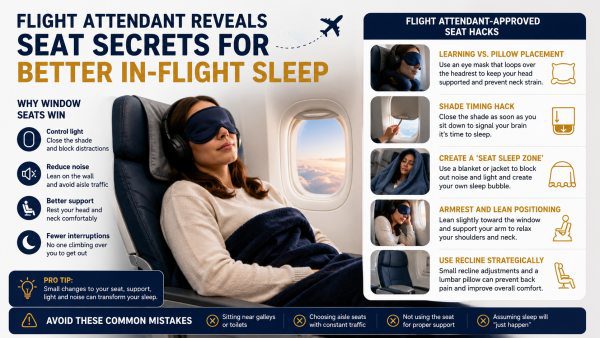
Instead, she recommends a window seat, which allows travellers to control light, reduce noise, lean against the wall, and avoid repeated interruptions.
“Being next to the window gives you much more control over your environment, which is key to falling asleep,” she explains.
“You can close the shade, lean against the wall for support, and avoid being elbowed by people passing in the aisle. It’s one of the closest things to a controlled sleep environment on a plane, even if you only have one or two hours, it makes a huge difference.”
Why Your Choice of Seat Matters More Than You Think
Peters says the biggest factor impacting sleep on a plane isn’t comfort, it’s control.
“Most people blame jet lag or the flight itself, but often it comes down to how to control your environment and if you are staying hydrated,” she says.
“I may not be able to control the time of day, but I can control noise and light by closing the window shades and using noise-cancelling headsets. I may not be able to control that I’m surrounded by 300 people who are wide awake, but I can control how much I get jostled. That’s how I trick my body into thinking it’s time to sleep, even mid-flight.”
From short-haul flights to long-haul journeys, even small adjustments can have a major impact.
“Even if I only have one, two, or three hours, every minute matters,” Peters adds. “I use various strategies to maximise rest wherever I am, planes, trains and hotels.”
Flight Attendant-Approved Seat Hacks for Better Sleep
-
Leaning vs. pillow placement
Most travellers simply lean against the window, but Peters recommends adding support to keep the neck aligned.
“I use an adjustable eye mask that loops over the headrest, so my head doesn’t bob, and it also keeps my head from twisting and prevents stiff necks mid-flight,” she says. “Just keep in mind, not every airline allows this setup, so it’s worth checking their guidelines before you fly.” -
Shade timing hack
Use your seat to control the light from the moment you sit down.
“Closing the shade as soon as I sit down signals my brain that it’s time to sleep,” Peters explains. Create a ‘seat sleep zone’
Use what’s around you to minimise distractions and create a more enclosed space.
“I create a small sleep bubble by putting a blanket over my head, or using my jacket Even if the plane is loud, I trick my brain into thinking that it’s quiet and dark,” she says. -
Armrest and lean positioning
How you sit matters as much as where you sit. Small shifts in how you sit can change everything. “I lean slightly toward the window and support my arm so my shoulders and neck can actually relax.” -
Use recline strategically
Minor adjustments can improve comfort significantly.
“Even subtle changes in seat recline prevent your lower back from aching, but I also recommend travelling with a lumbar pillow. Tiny tweaks make a huge difference,” she says.
The Biggest Mistakes Travellers Make When It Comes to Sleep
Despite this, Peters says many travellers still make the same sleep mistakes:
-
Sitting near high-traffic areas like galleys or toilets
-
Choosing aisle seats where they’re constantly disturbed
-
Not using the seat itself for proper support
-
Assuming sleep will “just happen” without preparation
“Your seat choice alone can make or break your sleep on a plane,” Peters says.











