

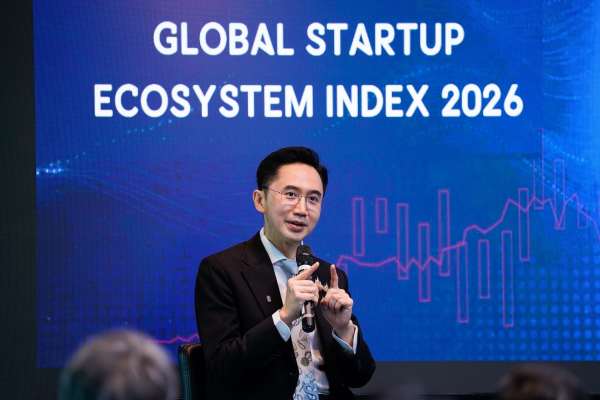
The Ministry of Higher Education, Science, Research and Innovation (MHESI), through the National Innovation Agency (NIA), today announced the results of the Global Startup Ecosystem Index 2026, published by StartupBlink, a global research and analytics platform tracking startup ecosystem activity across 120 countries and more than 1,500 cities. This year, Thailand advanced to 49th place globally, entering the Top 50 for the first time in six years, and ranking 4th in Southeast Asia. The country also recorded a startup ecosystem growth rate of 62.6 percent, and was ranked the best startup ecosystem for MedTech in ASEAN. Bangkok climbed to 76th globally and 4th in ASEAN, while claiming the No. 1 ranking for Robotics in the region (17th globally). Chiang Mai and Phuket posted strong growth of 91.6 percent and 85.9 percent respectively, while four emerging cities, namely Pattaya, Samut Prakan, Pathum Thani, and Nakhon Pathom, entered the rankings for the first time, making Thailand the 3rd most represented country by number of ranked cities in Southeast Asia.
Prof. Dr. Yodchanan Wongsawat, Deputy Prime Minister and Minister of Higher Education, Science, Research and Innovation (MHESI), said this is another proud moment for Thailand’s innovation journey. The results of the Global Startup Ecosystem Index 2026 by StartupBlink, which placed Thailand at 49th globally, entering the Top 50 for the first time in six years and ranking 4th in Southeast Asia behind Singapore, Indonesia, and Malaysia, reflect the country’s progress in building an innovation ecosystem driven by sustained policy efforts across government, academia, and the private sector. “The government has consistently prioritized innovation-led economic development and the nurturing of technology entrepreneurs, because startups are not merely new businesses; they are a critical mechanism for building new growth engines for the country, in terms of the digital economy, the growth of target industries, high-skilled job creation, and global competitiveness. Thailand’s rise into the global Top 50 and its No. 1 ranking in MedTech in Southeast Asia (8th globally), as well as Bangkok’s No. 1 ranking in Robotics in the region, signal that Thailand is earning increasing confidence from investors, entrepreneurs, and international innovation networks,”
MHESI and NIA are currently accelerating efforts to build Thailand’s national innovation ecosystem through key initiatives, including Area-Based Innovation Ecosystems, Matching Fund and University Holding Company programs, community Makerspaces, the Startup Thailand League, and systematic intellectual property management. These aim to develop DeepTech startups and advanced technology industries in strategic sectors such as MedTech, AI, Robotics, Climate Tech, and FoodTech. This goes alongside high-skilled workforce development, commercialization-driven research, and stronger linkages between academia, industry, and investment, to build new knowledge- and innovation-driven economic engines and advance Thailand toward becoming a fully-fledged “Innovation Nation.”
Prof. Dr. Yodchanan added that a particularly notable highlight of the ranking is Thailand’s emergence as a MedTech startup leader, which demonstrates the country’s readiness to align with the global trend toward a Wellness Economy, representing a new economic engine for Thailand’s future. Thai entrepreneurs have strong knowledge and innovation capabilities to develop new technologies addressing healthcare and medical market needs. However, challenges remain, including access to funding, opportunities to test innovations prior to full product development, and the need for stronger growth support networks. “The government stands ready to support collaboration across all sectors, including public, private, universities, and investors, to jointly create opportunities toward our goal of becoming a high-income country driven by research and innovation,”

Dr. Krithpaka Boonfueng, Executive Director of the National Innovation Agency (NIA), said the results reflect growth across multiple dimensions of Thailand’s startup ecosystem. Thailand has not only entered the global Top 50 for the first time in six years, but has also achieved the 4th fastest growth rate among the global Top 50 at 62.6 percent (2nd in Southeast Asia), reflecting the strength of Thai entrepreneurs, the expansion of technology investment, and the robustness of startup networks across the country. Thailand also ranked 2nd in Asia-Pacific for Startup Community Activity, reflecting the ongoing vibrancy of innovation activity and entrepreneurial communities. This year marks a period in which Thailand’s structural development of its innovation ecosystem has become clearly visible, particularly in the strengthening of linkages between entrepreneurs, investors, universities, and support agencies, and in the expansion of innovation activity into the regions, all of which have been key drivers of Thailand’s improved ranking.
“Bangkok has risen five places to 76th globally and 4th in Southeast Asia, and is now the No. 1 city for Robotics in the region and 17th globally. Secondary cities such as Phuket and Chiang Mai have seen explosive growth, reflecting the expansion of the innovation ecosystem across the country and demonstrating the potential of secondary cities to attract entrepreneurs, investors, and digital nomads from around the world to build businesses and innovations in Thailand. The key criteria StartupBlink uses to assess rankings are: 1) Quantity Score: the volume of ecosystem activity, including the number of startups, investors, accelerators, co-working spaces, and ecosystem actors; 2) Quality Score: the quality and impact of the ecosystem, including unicorn startup growth, investment flows, the strength of tech companies, and global ecosystem influence; and 3) Startup Business Environment Score: assessing the readiness of the business environment across infrastructure, regulation, internet quality, business operating conditions, talent readiness, and other support services,” Dr. Krithpaka said.
“Thailand today is not merely a tourism destination; it is also a key location for tech entrepreneurs, investors, and digital nomads from around the world who come to live, work, and build businesses, particularly in Bangkok, Chiang Mai, and Phuket, which have strong infrastructure, quality of life, and a continuously growing creative entrepreneur community. NIA will develop the Ari Innovation District into a flagship startup community hub to strengthen Thailand’s startup ecosystem on the global stage, connecting knowledge, capital, technology, and international innovation networks to create new economic opportunities for the country in the future. Thailand’s growth this time is therefore not merely a matter of rankings, but a clear signal that the Thai innovation ecosystem is advancing toward becoming a Global Startup Hub. NIA will continue to work with all stakeholders to create new opportunities for Thai entrepreneurs, connect the country to global innovation networks, and drive Thailand sustainably toward its vision as a Startup Nation,” Dr. Krithpaka concluded.











