

The travel industry has always had a short memory.
Thank goodness.
Five years ago, aviation executives were discussing survival. Hotel operators were calculating how long their cash reserves would last. Tourism boards were desperately producing campaigns encouraging locals to holiday in their own backyards because international visitors had vanished faster than complimentary champagne in an airport lounge.
Today?
The conversation has changed dramatically.
Now the debate is not about recovery.
It’s about capacity.

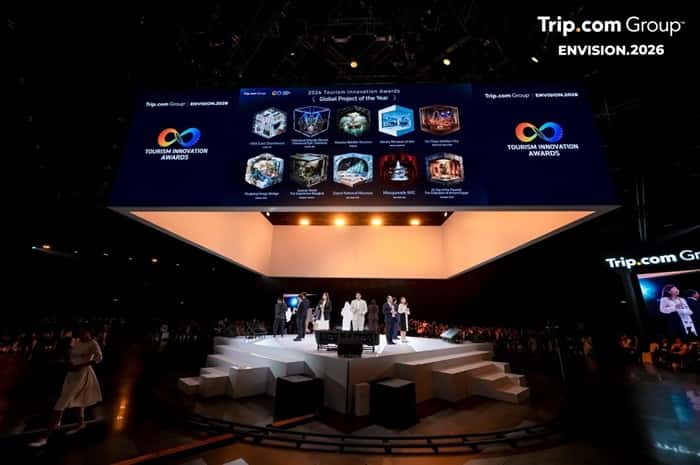
Jane Sun outlines a bold vision as travel’s remarkable resurgence accelerates
How many aircraft can airlines find?
How many hotel rooms can destinations build?
How many travellers can airports process?
And perhaps most importantly, how much bigger can tourism become?
That question hovered over Shanghai this week as 3,500 tourism leaders from 78 countries gathered for Trip.com Group’s Envision 2026 conference.
Officially, the event was about innovation, partnerships and technology.
Unofficially, it felt like a declaration that the travel industry’s next growth cycle has already begun.
And China intends to be at the centre of it.
There was a time when every major tourism conference featured endless discussions about uncertainty. Delegates would nod thoughtfully while economists explained why consumers might stop travelling.
Travellers clearly weren’t listening.
Instead, they have returned to the skies in extraordinary numbers.
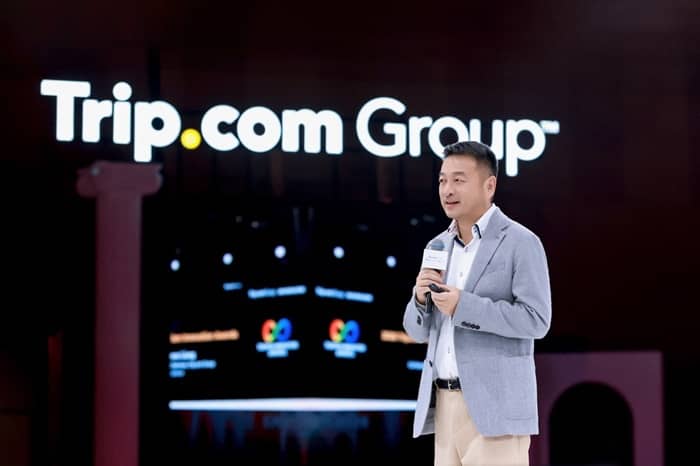
James Liang champions innovation as travel enters a bold new era
According to figures presented at the conference, tourism generated a record US$11.6 trillion globally in 2025 and now accounts for around 10 per cent of global GDP.
Not only is travel back, but it is also growing at more than twice the pace of the global economy.
Those are numbers capable of making even the most hardened airline chief smile.
Trip.com Chief Executive Officer Jane Sun certainly had reason to be optimistic.
The company’s international platform recorded a 60 per cent increase in bookings last year, while outbound flight and hotel bookings climbed to more than 140 per cent of pre-pandemic levels.
That is not recovery.
That is expansion.
The distinction matters.
Recovery suggests returning to where you once were.
Expansion means heading somewhere entirely new.
And increasingly, travellers are doing exactly that.
Forget Paris, London and New York for a moment.
One of the more fascinating revelations from the conference was the emergence of destinations many Western travellers would have struggled to find on a map a decade ago.
Uzbekistan.
Colombia.
Argentina.
These are among the destinations experiencing some of the fastest growth on Trip.com’s platforms.
Travellers, it seems, have developed an appetite for discovery.
Or perhaps they’ve simply become tired of standing in queues behind 500 people trying to photograph the same landmark.
Either way, tourism is changing.
Modern travellers want stories, not souvenirs.
Experiences, not itineraries.
Depth, not speed.
That trend is creating opportunities for destinations clever enough to recognise it.
Australia should be paying attention.
Tasmania certainly is.
One of the most significant announcements from Shanghai involved a new partnership between Trip.com Group and Tourism Tasmania.
At first glance, it looks like another routine memorandum of understanding.
In reality, it represents something far more valuable.
Access.
Trip.com possesses enormous influence across Asia’s outbound travel markets. For Tasmania, gaining greater visibility across those markets could deliver significant long-term benefits.
Particularly among travellers increasingly seeking nature, authenticity, and experiences that don’t involve fighting crowds.
Meanwhile, another buzzword continued its relentless march through every conference corridor.
Artificial intelligence.
Thankfully, Envision 2026 featured less science fiction and more practical reality.
The travel industry has spent the last two years talking about AI.
Now it is quietly putting it to work.
Trip.com showcased systems helping airlines predict demand, hotels personalise offers and corporations automate travel approvals.
One platform now approves low-risk business travel requests with a reported success rate exceeding 98 per cent.
More remarkably, Trip.com says it will absorb the cost if the technology gets it wrong.
That may be the most confidence anyone has shown in artificial intelligence all year.
Yet perhaps the most important story emerging from Shanghai was not technology.
It was China.
While much of the world remains fixated on outbound Chinese tourism, another trend is gathering momentum.
The world is returning to China.
Trip.com served 20 million inbound visitors in 2025.
Its Free City Tours program has already welcomed more than 30,000 visitors from 127 countries.
Shanghai, Beijing, Hong Kong and Shenzhen are all benefiting.
For many travellers, China remains one of the last great unexplored destinations.
The cuisine, history, landscapes and culture have never disappeared.
What changed was accessibility.
Now, with simplified travel processes and stronger international connectivity, visitors are returning in growing numbers.
Even Jackie Chan joined the proceedings via video message, encouraging international travellers to discover a side of China many have never experienced.
It was a clever reminder.
Technology may sell travel.
People still inspire it.
As delegates departed Shanghai, one conclusion seemed unavoidable.
The industry’s biggest challenge is no longer convincing people to travel.
That battle has already been won.
The challenge now is keeping pace with demand.
For airlines, hotels, destinations and travel companies, that is a far better problem to have.
And if the mood inside Envision 2026 proves accurate, the next tourism boom may make the last one look like a warm-up act.
by Soo James – (c) 2026.
Read Time: 6 Minutes
About the Author.
 There’s nothing rehearsed about Soo James, and that’s precisely the point. Malaysian by heritage, Sydney-schooled, she arrived at UNSW to study Arts, then took a left turn into IT, not out of ambition but out of curiosity. Somewhere among systems and schedules, she worked out what really held her attention: people, language, and the quiet spaces between them.
Writing followed naturally. Travel and lifestyle gave her room to observe, to listen, to notice the details others rush past. Soo writes the way good travellers move, watching the room before admiring the view, catching the gesture before chasing the headline.
At Global Travel Media, her stories don’t shout or sell. They linger. They slow you down, open a door, and gently suggest there’s more to see if you’re willing to look.











