

The global airline industry has weathered volcanic ash clouds, pandemics, financial crises and the occasional politician with a fondness for trade wars. Yet April 2026 delivered a reminder that geopolitical conflict remains one of aviation’s most disruptive forces.
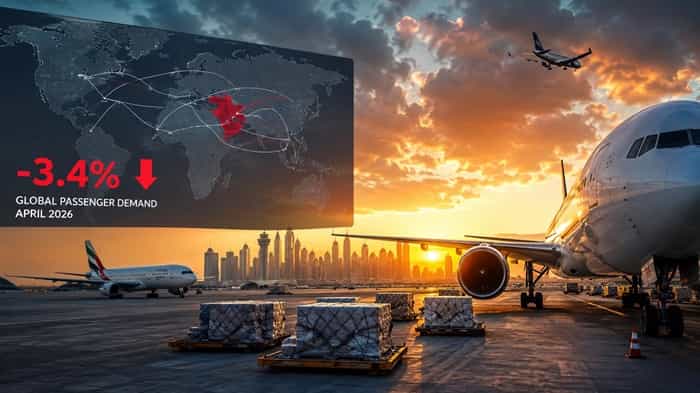
According to the latest figures from the International Air Transport Association (IATA), the war in the Middle East has sent shockwaves through the global aviation network, dragging worldwide passenger demand down by 3.4 per cent compared with April last year.
At first glance, the figures appear alarming. But as with many aviation statistics, the devil is hiding somewhere between the departure gate and the baggage carousel.
Remove the Middle East from the equation, and global passenger demand actually grew by 1.2 per cent.
That single statistic tells a remarkable story. The global aviation industry is not experiencing a widespread collapse. Instead, it is confronting the consequences of one of the world’s most strategically important aviation regions being thrown into turmoil.
IATA Director General Willie Walsh did not attempt to sugar-coat the situation.
“The 46.6% fall in demand for carriers in the Middle East due to war in the region was so acute that it dragged overall demand down -3.4%. The situation for air transport remains highly volatile. The cost of jet fuel more than doubled in April, which is pushing airfares up. Forward schedule data is showing a reduced offering in the coming months, indicating that airlines are balancing high fuel costs and weaker demand.”
For airlines, this is the kind of turbulence no pilot can simply fly above.
Gulf Crisis Reshapes Global Aviation
The Middle East has long functioned as aviation’s crossroads.
Mega-carriers connecting Europe, Asia, Africa and North America have spent decades building global networks through Gulf hubs. Those hubs now find themselves operating under extraordinary pressure.
Middle Eastern airlines recorded a staggering 48.1 per cent decline in international passenger demand during April. Capacity fell by 38.4 per cent while load factors plunged more than 13 percentage points to just 70.1 per cent.
The ongoing conflict involving Iran has disrupted traditional traffic flows across some of the world’s busiest long-haul corridors.
Even as an uneasy ceasefire reduced the pace of decline compared with March, the damage remains substantial.
For airlines built around connecting traffic, losing nearly half of passenger demand is the aviation equivalent of discovering half the runways have suddenly disappeared.
Asia-Pacific Shows Remarkable Resilience
While the Middle East struggled, the Asia-Pacific region once again demonstrated why it remains aviation’s growth engine.
Airlines across the region posted a 3.0 per cent increase in international passenger demand, accompanied by a record April load factor of 87.5 per cent.
Aircraft are flying fuller than ever, a statistic airline chief executives generally regard as considerably more attractive than empty seats.
The performance is particularly impressive given ongoing political tensions affecting traffic between Japan and China.
Despite those headwinds, regional demand continued to expand, underlining the strength of intra-Asian travel and the region’s growing middle class.
Europe Benefits From Route Diversions
European carriers may not be celebrating, but they certainly have reasons to smile.
Passenger demand increased by 0.9 per cent while load factors improved to 84.9 per cent.
More importantly, direct Europe-Asia traffic surged by 15.3 per cent.
The reason is straightforward.
Travellers and airlines are increasingly choosing routes that avoid Middle Eastern transit hubs. Traffic that once flowed through Gulf gateways is now being redirected onto direct services.
In aviation, as in nature, traffic tends to find the path of least resistance.
Australia Faces Domestic Pressure
Australia’s domestic market delivered less encouraging news.
Domestic passenger demand slipped by 0.4 per cent while capacity increased by 3.8 per cent.
The result was a significant decline in load factors, which dropped 3.4 percentage points to 79.8 per cent.
This suggests airlines are operating more seats into a market where demand growth has softened.
Australian carriers are hardly alone.
The United States and India also recorded declines in domestic demand, reflecting growing consumer caution amid higher travel costs and economic uncertainty.
With fuel prices soaring and fares inevitably following, some travellers are clearly deciding that a weekend away can wait.
Air Cargo Keeps Global Trade Moving
If passenger aviation endured a difficult April, air cargo provided a brighter story.
Global cargo demand increased by 4.0 per cent year-on-year, despite widespread disruption across Middle Eastern trade routes.
Cargo has often been aviation’s quiet achiever. It rarely attracts the glamour associated with passenger travel, but when global supply chains face disruption, freight operators become indispensable.
Willie Walsh highlighted the sector’s growing importance.
“Air cargo demand grew 4% year-on-year in April, driven by strong Asia-linked trade flows. But this positive news masks a more complex operating environment. Severe disruption at major Gulf hubs due to the war in the Middle East continued to reshape trade routes and constrain capacity on key corridors. With dedicated freighters carrying much of the growth, air cargo is once again keeping supply chains moving amid trade disruptions. The coming months will test how well the sector can absorb continued geopolitical uncertainty and elevated operating costs.”
The strongest cargo growth came from Asia-Pacific carriers, which recorded an impressive 10.5 per cent increase in demand.
European operators followed with six per cent growth, while North American airlines achieved five per cent growth.
Meanwhile, Middle Eastern cargo demand fell 18.2 per cent, reflecting the broader regional disruption.
Trade Routes Are Being Rewritten
The cargo figures reveal a fascinating shift in global commerce.
Europe-Asia freight traffic rose by 16.2 per cent, marking 38 consecutive months of growth.
Africa-Asia traffic climbed 12.8 per cent, marking ten consecutive months of expansion.
Within Asia, demand increased by 13 per cent.
Conversely, routes involving the Middle East suffered significant declines.
Europe-Middle East cargo traffic fell 25.9 per cent, while Middle East-Asia traffic declined 22.4 per cent.
These numbers highlight an emerging reality: global trade does not stop during crises. Instead, it adapts.
Goods still move. Supply chains still function. Routes simply evolve around obstacles.
Fuel Costs Add More Pressure
One challenge looming over both passenger and cargo markets is fuel.
Jet fuel prices surged an extraordinary 121.1 per cent year-on-year during April.
Crude oil prices jumped 77.7 per cent.
For airlines already dealing with weakened demand and geopolitical uncertainty, fuel costs represent an unwelcome additional burden.
Historically, fuel accounts for one of the largest airline operating expenses.
When costs rise this sharply, passengers eventually notice through higher fares.
That places carriers in an uncomfortable position: raise prices and risk further reducing demand, or absorb costs and damage profitability.
Neither option is particularly appealing.
Aviation’s Next Test
The broader aviation industry enters the second half of 2026 facing a delicate balancing act.
Passenger demand outside the Middle East remains broadly positive.
Cargo markets continue to demonstrate resilience.
Manufacturing indicators remain supportive, with global Purchasing Managers’ Index figures above the expansion threshold.
Yet geopolitical instability, soaring fuel costs and shifting travel patterns ensure uncertainty remains firmly on the departure board.
For now, aviation is proving remarkably adaptable.
The industry has always been at its best when responding to unexpected challenges. April’s figures suggest airlines, airports and cargo operators are once again adjusting course.
The skies may be turbulent, but global aviation remains very much in flight.
Travel professionals, airline executives and tourism leaders should closely monitor evolving aviation trends through IATA’s latest market intelligence and economic updates. Understanding how geopolitical events are reshaping passenger and cargo flows will be critical for planning capacity, pricing strategies and future investment decisions.
by Jason Smith – (c) 2026.
Read Time: 5 Minutes.
About the Author.
 Jason Smith didn’t learn travel from textbooks. He learned it in airports, taxis and hotel lobbies, watching the business unfold long before he played his own part. Half American, half Asian, he grew up around the quiet workings of tourism, where people come and go, and stories rarely stand still.
Bangkok came first, then formal study, then a career that carried him through Singapore, Malaysia and Vietnam. Each place left something behind. In the end, Thailand felt like home, and I took on a senior role in hotel sales.
Then everything stopped. Borders shut, planes grounded, and Jason found himself back in America with time to reflect.
Now at Global Travel Media, he writes travel as it really is, not polished, not perfect, but human, and all the better for it.











