

There’s a certain ritual to returning home from Asia. The suitcase is unpacked, the laundry pile grows heroic, and the photos, thousands of them, sit patiently awaiting a quiet Sunday afternoon. But what many travellers don’t realise is that something else comes home with them too: a small army of apps, quietly working in the background, gathering data long after the holiday glow has faded.
According to a new analysis from the cybersecurity firm Surfshark, the vast majority of travel apps widely downloaded across Asia may continue collecting user data even after their usefulness has expired. It’s not quite the souvenir anyone asked for, but it’s increasingly part of the modern travel experience.
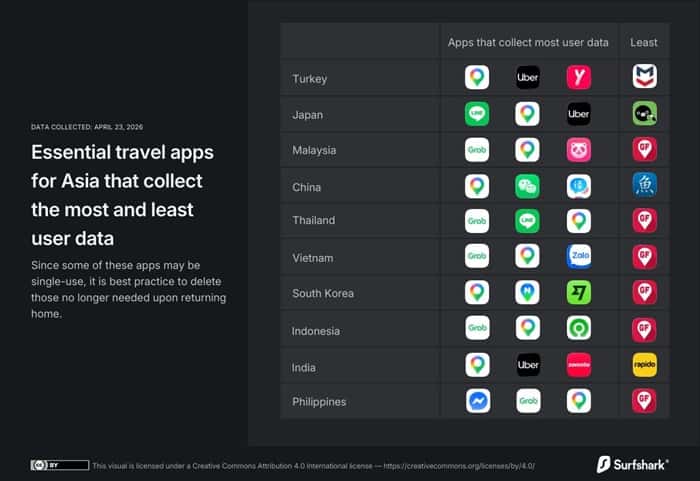
The numbers are sobering. Of 65 widely used apps spanning food delivery, ride-hailing, maps, messaging, finance and translation, a striking 97 per cent were found to collect some form of user data. More telling still, 72 per cent may engage in what Apple defines as “tracking”, linking personal or device data with third-party information, often for advertising or analytics.
It’s a reminder that convenience, while seductive, rarely comes free.
Miguel Fornes, Information Security Manager at Surfshark, offers a metaphor that lands with uncomfortable clarity. Travellers, he says, treat their phones like digital pantries stocking up on apps for every conceivable need, then forgetting them once the journey ends.
“When people travel, they download various local apps for transport, food delivery, or communication, and later stop using them,” Fornes explains. “However, these apps often remain installed on the device and continue collecting data, including location information and usage patterns, and in some cases, this data may be shared with third parties for advertising or research purposes.”
It’s a neat comparison, and an apt one. Just as forgotten tins at the back of a cupboard can spoil and attract unwelcome attention, neglected apps can quietly erode privacy.
A Tale of Two Apps
Not all apps, it turns out, behave equally. Surfshark’s analysis reveals a wide gulf between the most data-hungry platforms and their more restrained counterparts.
In the ride-hailing category, for instance, Grab collects 27 out of a possible 35 data types, nearly seven times more than Rapido, which gathers just four. That’s not a marginal difference; it’s a philosophical one.
The same pattern plays out elsewhere. Translation app Baidu Translate collects 18 data types, compared with just four for Pleco Chinese Dictionary. In messaging, Facebook Messenger gathers 32 data points, while KakaoTalk collects 14.
Even financial apps, where trust ought to be non-negotiable, show disparity. Wise collects 18 data types, compared with 10 for Revolut.
The takeaway is simple enough: not all digital conveniences carry the same privacy cost. Yet most travellers, pressed for time and keen to navigate unfamiliar cities, rarely pause to compare.
The Hidden Cost of Convenience
On average, travellers heading to Asia download around 21 apps to cover everything from taxis to translation. It’s understandable. In many destinations, local platforms are not just helpful, they’re essential.
But the problem isn’t downloading these apps. It’s forgetting to let them go.
Idle accounts and dormant applications have already proven fertile ground for data breaches. A widely cited incident in the United States affected 21 million users when unused accounts on a parking app were compromised. In another case, a Canadian coffee chain faced backlash after its app continued tracking users’ GPS locations even when not actively in use.
The lesson here is less about paranoia and more about housekeeping.
“After returning from a trip, much like clearing out expired food from a pantry, users should review installed apps, remove those that are no longer needed, and check app permissions in their phone settings,” Fornes advises. “Especially access to location services.”
It’s sensible guidance, though often ignored in the rush back to routine.
A Smarter Way to Travel
There’s a broader point worth considering. The modern traveller, armed with a smartphone, has never been more empowered or more exposed. Every new app expands what cybersecurity experts call the “attack surface”, the potential points at which personal data can be accessed or exploited.
In practical terms, that means the more apps you install, the more doors you leave ajar.
A more measured approach, Fornes suggests, begins before departure. Rather than downloading every recommended platform, travellers should ask whether existing apps or even built-in phone tools can do the job just as well. Often, they can.
It’s not glamorous advice, admittedly. There’s no app for restraint. But it’s effective.
The Bottom Line
Travel has always involved a degree of risk, such as lost luggage, delayed flights, and the occasional questionable street meal. In today’s digital age, those risks have quietly expanded into the invisible realm of data.
The good news is that the remedy is straightforward. A few minutes spent reviewing apps, deleting those no longer needed, and tightening permissions can dramatically reduce exposure.
It’s hardly the stuff of travel brochures, but perhaps it should be.
After all, the best journeys are the ones that leave memories, not metadata.
by Sandra Jones – (c) 2026.
Read Time: 4 minutes.
About the Author.
 Sandra has spent a working lifetime quietly rescuing journeys, one itinerary, one anxious caller, one impossible connection at a time. Years in Australia’s finest travel agencies taught her the art of calm, how to find a flight in a fog of cancellations, how to soothe a traveller when luggage wanders, how to turn nine frantic days in Europe into something resembling sense. Qualified, seasoned, endlessly patient, she learned that good travel advice is part logistics, part listening.
But the storyteller in her was always waiting its turn. Writing offered a new map, a way to turn experience into reflection, detail into delight. At Global Travel Media, Sandra now writes the truths only insiders know: the mishaps, the laughter, the grace found between gates and goodbyes. She reminds us that travel, for all its fuss, is still one of life’s better ideas.











